
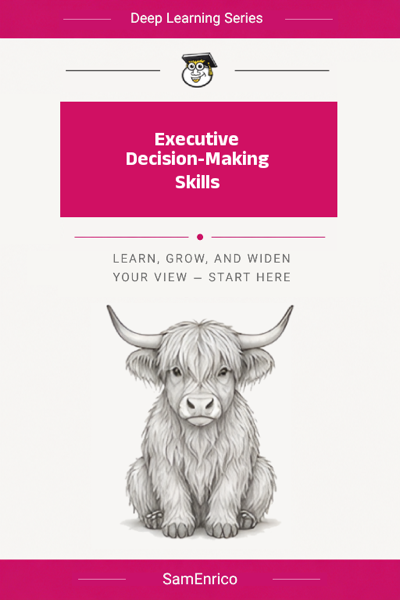
Non-FictionInformativeEducational
Executive Decision-Making Skills eBook
A Coursebook on Executive Decision-Making Skills
A Coursebook on Executive Decision-Making Skills
Formats
Free sample
Chapter 1: The Autopilot Trap--The $125 million spacecraft was twenty seconds from entering the Martian atmosphere when it disappeared.Not exploded. Not diverted. Simply gone. Telemetry data flatlined. Engineers at NASA’s Jet Propulsion Laboratory sat in stunned silence, watching empty screens.
The Mars Climate Orbiter—a masterpiece of late-1990s engineering, designed to study climate patterns on the red planet—had just crashed into the surface at nearly 15,000 miles per hour.The investigation that followed revealed something far more disturbing than a technical glitch. The problem was not a broken thruster. It was not a faulty sensor. It was not even a miscalculation by a single engineer.The problem was that no one decided to check.Two teams had worked on the spacecraft. One used metric units—newtons, kilograms, meters.
The other used imperial units—pounds, feet, inches. The software that guided the orbiter’s trajectory assumed metric inputs. The ground control team sent thruster data in imperial units. For nine months, the spacecraft drifted off course by a few miles every day. For nine months, no one asked the obvious question: “Are we all using the same units?”The crash was not a failure of engineering.
It was a failure of decision architecture. The brilliant men and women at NASA had put their brains on autopilot. They assumed that because the process had worked before, it would work again. They assumed that because everyone was smart and well-intentioned, someone would catch the error. They assumed that a catastrophe would not happen to them.They were wrong.
And the cost was $125 million and years of scientific progress.Here is the uncomfortable truth this book asks you to confront: You are making the same mistake every single day.Not the unit conversion error. But the deeper error. You are running your executive brain on autopilot when it should be in manual control. You are making billion-dollar decisions with the same mental machinery you use to order coffee. And you do not even know you are doing it.The Two Brains Living Inside Your Head Nobel Prize-winning psychologist Daniel Kahneman spent decades mapping the architecture of human judgment.
His discovery, now validated by hundreds of replication studies, is both simple and devastating: you do not have one brain. You have two. And they are locked in a constant, invisible war for control of your decisions.System 1 is the autopilot. It is fast, intuitive, emotional, and energy-efficient. System 1 recognizes your child’s face in a crowded airport.
It catches a falling glass before you consciously register the drop. It tells you that the person across the table looks untrustworthy, even though you cannot articulate why. System 1 runs on pattern recognition and gut feeling. It processes information in milliseconds. It consumes almost no metabolic energy.
It is the reason you can drive home from work without remembering any part of the journey.System 1 is also spectacularly wrong in predictable, systematic, and expensive ways.System 2 is the pilot. It is slow, deliberate, logical, and exhausting. System 2 calculates a 17 percent tip on a restaurant bill while accounting for the fact that service was mediocre. It evaluates competing job candidates by comparing their resumes against a weighted scorecard that you designed before you saw any of the candidates. It forces itself to read the terms of service before clicking “agree,” even though it knows the terms are unreadable.
System 2 processes information in seconds or minutes. It burns through glucose like a furnace. It requires effort, attention, and conscious intention.System 2 is also lazy. Extremely lazy. Pathologically lazy.
It would rather watch Netflix. It would rather agree with the first plausible answer. It would rather conserve its precious energy for an emergency that might never come.Here is the punchline that most leadership books get wrong, the one that separates this book from the dozens of other decision-making manuals on your shelf: The problem is not that executives are unintelligent.You are almost certainly brilliant. You have decades of experience. You have a track record of success.
Your intuition has served you well enough to get you to the executive suite.That is precisely the problem.Because your brain has learned that System 1 works most of the time. In routine operations, in familiar markets, with predictable competitors, your autopilot is efficient and mostly accurate. So your brain has stopped asking the question that separates great executives from catastrophic failures: Is this situation routine enough for autopilot, or is it novel enough to demand the pilot?Most executives never ask that question at all. They default to System 1 because it feels easier, because they are busy, because they have always trusted their gut, because asking for slow thinking would require admitting that they do not already know the answer. They have been rewarded for decisiveness their entire careers.
No one ever rewarded them for pausing, for doubting, for checking their assumptions.And then a $125 million spacecraft crashes into Mars.The Seduction of Cognitive Ease There is a phenomenon that Kahneman calls “cognitive ease.” It is the pleasant, effortless feeling you get when something is familiar, consistent, and easy to process. Cognitive ease is why you trust a familiar brand over an unknown one, even when the unknown brand has better reviews. It is why you believe a statement that rhymes—“woes unite foes”—feels truer than the same statement rendered without rhyme. It is why you are more likely to invest in a company with a pronounceable name than one with a string of consonants.Cognitive ease is also why boardrooms are so dangerous. Let me show you what I mean.Imagine a Tuesday morning.
You walk into the executive conference room after a restless night. The agenda is distributed. The first presenter—let us call her Sarah—stands up. She has prepared beautiful slides. The fonts match.
The colors are on-brand. She speaks confidently, without notes. Her proposal is clear, straightforward, and aligned with what the team already believes about the market. She finishes to nods and murmured agreement. The CEO looks around the room.
“Any questions?” Silence. “Great. Let’s move on.”Now imagine that Sarah had presented the exact same data in a messy, disorganized way. Ugly slides. Awkward phrasing.
Tentative language. She would have been challenged immediately. People would have asked hard questions. Someone would have said, “Wait, can we walk through that assumption again?” System 2 would have engaged because the presentation felt like work.But because the presentation was smooth, because it felt right, the boardroom nodded and moved on. Cognitive ease had seduced them.
They agreed with the first well-presented idea without ever asking whether it was the right idea. They confused fluency with truth.This is not a failure of character. It is a feature of how human brains evolved. In the ancestral environment—savannas, small tribes, immediate threats—cognitive ease was a survival advantage. If a rustling bush looked like a lion and sounded like a lion, assuming it was a lion (rather than stopping to verify) kept you alive.
The cost of a false positive was a few moments of unnecessary fear. The cost of a false negative was death.But the corporate environment is not the savanna. Strategic decisions are not…
This is the end of the free sample. Get the eBook to keep going. Buy now
About this book
Details
- Author
- Dailey Dortha
- Publisher
- SamEnrico
- Language
- English
- Genre
- Non-Fiction, Informative, Educational
- Released
- 2026-05-25
- Pages (approx.)
- 153
- Available as
- eBook, Audiobook

Read better in the ZLOADR app
Your eBooks on your phone or tablet. Sign in with your SamEnrico account and start reading.
More by Dailey Dortha
 The Childhood Apology Never GivenDailey Dortha$11.99
 Short Breath AwarenessDailey Dortha$11.99
 Comparison Culture for ArtistsDailey Dortha$11.99
 Misty Morning LakeDailey Dortha$11.99
 John Marshall ChiefDailey Dortha$11.99
 Telling Friends About LossDailey Dortha$11.99
 The Self Talk for New Moms GuideDailey Dortha$11.99
 The HIV Vaccine ResearchDailey Dortha$11.99
 Rockefeller University StoryDailey Dortha$11.99
 The Billion-Dollar Bubble: How a Tech Guru Fooled the WorldDailey Dortha$11.99
 The Last Trial of Hypatia: Logic vs. Faith in AlexandriaDailey Dortha$11.99
 Chisel and Charm: The Sculptors Who Defined Western BeautyDailey Dortha$11.99
You may also like
 Hong Kong Handover 1997Dunn Johnnie$11.99
 Zumba For Postnatal Recovery CourseNeal Christian$11.99
 Zumba for BeginnersLadner Nikia$11.99
 YouTube Comment Mining GuideHumes Pandora$12.99
 Worry Box MeditationCarlin Rudy$11.99
 Workplace Stress MeditationNguyen Lynn$11.99
 Workplace Stress and Sleep RepairHawley Ivory$11.99
 Workplace Perfectionism CureDelaney Jeffry$11.99
 Workplace Injustice Anger GuideWallen Isabelle$11.99
 Work Addiction and Burnout LinkGreenwood Ester$11.99
 Women in Yoga and WellnessBeattie Galina$11.99
 Women in Stand Up ComedyChun Evangeline$11.99