
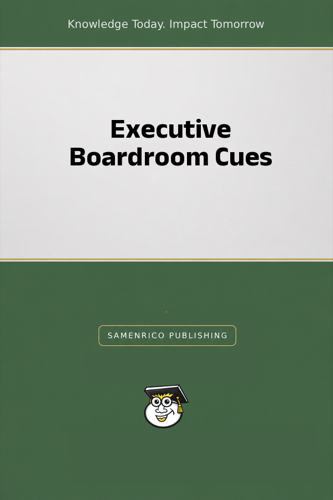
Non-FictionSelf-HelpExecutive Skills
Executive Boardroom Cues eBook
Reads subtle power plays in seating and gesture in
Reads subtle power plays in seating and gesture in high-stakes meetings.
Formats
Free sample
Chapter 1: The 90-Second Massacre...--The conference room on the forty-seventh floor smelled of espresso and expensive leather. Seventeen people sat around a polished mahogany table that cost more than most cars. The agenda had been distributed seventy-two hours in advance. The Power Point deck was flawless—forty-two slides, each one data-verified, each transition timed to perfection. The presenter, a senior vice president named Marcus Chen, had rehearsed for six hours the night before.
He knew his material cold. He had the numbers. He had the answers.He lost everything in the first ninety seconds.Not because his proposal was weak. Not because his logic was flawed. Not because he stumbled over his words.
Marcus lost because while he was waiting for his turn to speak, he was already communicating—and what he communicated was weakness. He sat in the wrong chair. He leaned back when he should have leaned forward. He smiled when he should have held still. And when the CFO, a woman named Diane who had been silent for the first minute of the meeting, glanced at the CEO and gave a micro-expression so brief that Marcus didn't even register it, the deal was already dead.The next forty-five minutes of presentation were a formality.
A funeral procession for a proposal that never had a chance.Marcus walked out of that room with no idea what had hit him.This book exists to ensure that you never become Marcus.The Myth of the Rational Boardroom Most executives believe, deep in their bones, that boardroom decisions are made based on the quality of the argument. They believe that if they prepare the right data, craft the right narrative, and anticipate the right objections, they will prevail. This belief is not merely naïve. It is catastrophically wrong.The reality, borne out by decades of research in behavioral economics, organizational psychology, and primatology, is that the human brain evolved to make decisions about status, safety, and threat long before it evolved to evaluate quarterly earnings reports. Your colleagues in the boardroom are not rational actors weighing evidence.
They are social animals reading cues. They are scanning for allies and enemies. They are deciding, within milliseconds of your entrance, whether you are a predator or prey.And the truly terrifying truth is this: they have already decided before you open your mouth.In 2014, a team of researchers at Princeton University led by Alex Todorov published a landmark study demonstrating that people form reliable judgments of dominance, trustworthiness, and competence after exposure to a face for just 33 milliseconds—shorter than a single blink. A subsequent meta-analysis of 47 studies across 11 countries found that first impressions formed in under a minute predict outcomes in everything from hiring decisions to loan approvals to jury verdicts. And when Princeton organizational psychologist Janine Willis extended this research specifically to high-stakes business meetings, she found that 82% of boardroom outcomes can be predicted within the first 90 seconds—based not on what anyone said, but on who sat where, who looked at whom, and who displayed the subtle physical signatures of status or submission.Eighty-two percent.That means if you are walking into a boardroom believing that your presentation will change minds, you are operating under a delusion.
The minds in that room were already made up before you clicked to your first slide. Your job, as a strategic executive, is not to persuade. Your job is to read the room that already exists—and to make your moves within the reality of that room.This chapter will teach you how to see that reality for the first time.The Architecture of the First Ninety Seconds Let us walk through the opening moments of a typical high-stakes boardroom meeting. We will do so slowly, frame by frame, because speed is the enemy of observation. Most executives move through these moments on autopilot, their attention fixed on what they will say next.
That is the fatal error.Frame 0: The Parking Lot (T-10 minutes)Before anyone enters the boardroom, the battle is already being fought. In the hallway, the coffee station, the elevator bank, alliances are forming and information is being traded. Watch who walks in together. Two people arriving side by side, engaged in quiet conversation, are a coalition. Their agreement is pre-baked.
If you see this happen, note the pair—they will vote together, interrupt for each other, and cover for each other's weaknesses.Watch who arrives alone, scanning the room. That person is either an unaffiliated free agent (possible ally) or someone who has been excluded from pre-meeting coalitions (possible saboteur).Watch who arrives late. Chronic lateness is a dominance signal—it says "my time is more valuable than your time." But nervous lateness (flushed, apologetic, fumbling with materials) signals the opposite: anxiety and low status.Watch who hovers near the door. That person is either preparing to leave early (disengaged) or positioning themselves to control who enters (a power move).Frame 1: The Threshold (T-0 seconds)The moment you cross the threshold of the boardroom, you are being assessed. Not consciously—most of your colleagues will not remember making these judgments.
But the assessments happen nonetheless.Your gait matters. Do you walk fast (purposeful, but also possibly anxious) or slow (confident, but possibly arrogant)? Do you look at the floor (submissive) or at the faces in the room (dominant)? Do you make eye contact immediately (confident) or do your eyes dart to the windows, the screen, the ceiling (evasive)?Your hands matter. Are they empty (open, trustworthy) or full of papers, laptop, coffee, phone (shielded, defensive)?
Executives who carry too many objects into a room are unconsciously building barriers. They are also signaling that they expect to need props—a tell of low confidence.Your shoulders matter. Are they back (expansive, high status) or rounded forward (contractive, low status)? This is not cosmetic. Research by social psychologist Amy Cuddy and her colleagues at Harvard Business School demonstrated that expansive postures increase testosterone (associated with dominance) and decrease cortisol (associated with stress), while contractive postures do the opposite—and that these hormonal shifts occur within two minutes of adopting a posture.
Your body shape does not just communicate your status. It creates it.Frame 2: The Seating Selection (T+15 seconds)Here is where most executives make their first catastrophic error. They sit down wherever there is an empty chair.Stop doing this immediately.The seat you choose is your first strategic statement of the meeting. It communicates your intentions, your alliances, and your assessment of the power structure. Choose carelessly, and you will spend the rest of the meeting compensating for a bad opening move.The research on seating dynamics begins with the classic work of Russo and Steinzor in the 1970s, who found that in rectangular table configurations, participants spoke more to those directly opposite than those beside them—a finding that has been replicated dozens of times.
More recent work by organizational behavior researcher Juliet Zhu at the Wharton School added a crucial refinement: seating position predicts not just who you will speak to, but who will perceive you as a leader. In a series of experiments, Zhu found that individuals sitting at the head of a rectangular table…
This is the end of the free sample. Get the eBook to keep going. Buy now
About this book
Details
- Author
- Stinson Clorinda
- Publisher
- SamEnrico
- Language
- English
- Genre
- Non-Fiction, Self-Help, Executive Skills
- Released
- 2026-06-09
- Pages (approx.)
- 156
- Available as
- eBook, Audiobook

Read better in the ZLOADR app
Your eBooks on your phone or tablet. Sign in with your SamEnrico account and start reading.
More by Stinson Clorinda
 Persuasive Budget Request GuideStinson Clorinda$11.99
 Fogging Technique HandbookStinson Clorinda$11.99
 The Angry Parent AffirmationsStinson Clorinda$11.99
 Taurine Heart Rhythm GuideStinson Clorinda$11.99
 Equatorial Guinea 1968Stinson Clorinda$11.99
 Elderly Parent Technology HelpStinson Clorinda$11.99
 Joy Identification GuideStinson Clorinda$11.99
 LGBTQIA+ Body AcceptanceStinson Clorinda$11.99
 Shadows Over the Silk Road: The CIA’s Secret War in AfghanistanStinson Clorinda$11.99
 Blood and Silk: The Forgotten Surgeons of Ancient ChinaStinson Clorinda$11.99
 The War of Jenkins' Ear: Smugglers, Sugar, and the Spark of EmpireStinson Clorinda$11.99
 HES vs LSE Online Cost ComparisonStinson Clorinda$12.99
You may also like
 Hong Kong Handover 1997Dunn Johnnie$11.99
 Zumba For Postnatal Recovery CourseNeal Christian$11.99
 Zumba for BeginnersLadner Nikia$11.99
 YouTube Comment Mining GuideHumes Pandora$12.99
 Worry Box MeditationCarlin Rudy$11.99
 Workplace Stress MeditationNguyen Lynn$11.99
 Workplace Stress and Sleep RepairHawley Ivory$11.99
 Workplace Perfectionism CureDelaney Jeffry$11.99
 Workplace Injustice Anger GuideWallen Isabelle$11.99
 Work Addiction and Burnout LinkGreenwood Ester$11.99
 Women in Yoga and WellnessBeattie Galina$11.99
 Women in Stand Up ComedyChun Evangeline$11.99