
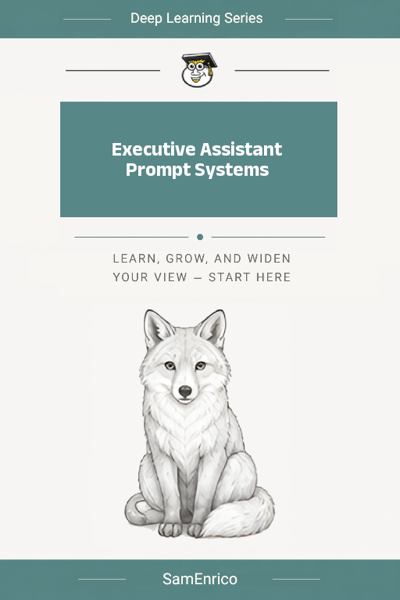
Non-FictionInformativeEducational
Executive Assistant Prompt Systems eBook
A Coursebook on Executive Assistant Prompt Systems
A Coursebook on Executive Assistant Prompt Systems
Formats
Free sample
Chapter 1: The Great Unlocking--The first time Sarah Miguel almost quit her job as an Executive Assistant, it wasn't because of the eighty-hour weeks, the last-minute international travel bookings, or even the executive who once asked her to find a vegan kosher caterer in rural Wyoming at 9 PM on a Sunday. It was because she had just spent forty-five minutes manually reformatting a fifteen-page board report — changing fonts, adjusting margins, merging cells, and cross-referencing footnotes — only to receive a Slack message from her executive that read: "Actually, can we make it a deck? Need it in an hour."In that moment, Sarah wasn't angry at her executive. She was angry at the gap. The gap between what her executive wanted — a polished, insightful, strategically sequenced presentation — and what Sarah could physically produce in an hour with only her own two hands and a lifetime of Microsoft Office muscle memory.
That gap is real. It has a name. This book calls it the Executive Sandwich, and for decades, Executive Assistants have been the filling — stretched thin, squeezed from both sides, holding everything together while receiving little credit for the structural integrity they provide.But something changed eighteen months before Sarah's nearly-quitting moment. Something that would turn that forty-five-minute formatting task into a five-second prompt. Something that would transform the Executive Assistant role from a career of reactive task-doing into a profession of strategic workflow architecture.
That something is generative AI, and this book is the instruction manual for the most important professional upgrade of your life.This is not a book about how to use Chat GPT to write cute birthday emails. This is a coursebook on Prompt Systems — reusable, secure, executive-specific workflows that leverage artificial intelligence to handle volume so you can focus on value. It is for the EA who is tired of being the fastest typist in the room and wants to become the most indispensable strategic partner at the table. It is for the executive who knows their assistant is capable of more but doesn't know how to unlock that potential. And it is for anyone who suspects that the old model of administrative support — the model where "good EA" meant "responds to emails within sixty seconds" — is about to become as obsolete as a filing cabinet full of paper memos.The 18-Month Earthquake Let’s put a stake in the ground.
The Executive Assistant role has changed more in the last eighteen months than in the previous thirty years. That is not an exaggeration; it is a documented function of technological displacement.Before 2023, an EA’s competitive advantage was speed of execution, accuracy of memory, and fluency with office software. The EA who could type fastest, remember the executive’s coffee order from three years ago, and build a pivot table without Googling was the gold standard. Those skills still matter, but they are no longer sufficient. They are no longer even the primary differentiator.Here is what changed: large language models (LLMs) like GPT-4, Claude, and Gemini can now draft, summarize, categorize, extract, translate, format, and even simulate your executive’s writing voice with startling accuracy.
They can do in three seconds what used to take you three minutes — and they never get tired, never ask clarifying questions, and never resent being asked to do the same task for the hundredth time.Does this mean AI will replace Executive Assistants? No. But it does mean that EAs who use AI will replace EAs who don't. The question is not whether AI belongs in your workflow. The question is whether you will be the one designing that workflow or the one being redesigned out of a job.The good news is that the skills required to thrive in this new environment are eminently learnable.
They are not coding skills. They are not data science skills. They are prompt design skills — the ability to write clear, structured, context-rich instructions that turn a general-purpose AI into a specialized executive support system. And those skills are the subject of every chapter that follows.Defining the Executive Sandwich Before we build solutions, we must name the problem. The Executive Sandwich is the structural gap between what an executive wants and what is operationally real.On the top slice of bread sits the executive’s request.
It is usually high-level, compressed, and delivered with urgency. It sounds like: "Get me the Q3 numbers," "Draft a response to the board," "Fix the calendar," "Make a deck." These requests are legitimate. The executive is paid to think strategically, not to specify font sizes or debate the correct placement of a comma in an email about supply chain disruptions.On the bottom slice of bread sits operational reality. Messy spreadsheets. Missing context.
Unspoken preferences. Conflicting stakeholder demands. Emails that contradict each other. A calendar that looks like a Jackson Pollock painting. This is the raw material the EA must work with.In the middle — the filling — sits the EA, stretched thin, trying to bridge a gap that has no natural bridge.
The executive thinks, "Just make the deck." The EA knows that "making the deck" requires finding the latest numbers, verifying their accuracy, checking the branding guidelines, reformatting the charts, rewriting the executive summary in the executive's voice, and cross-referencing with last quarter's deck to ensure consistency. That is not one task. That is seven tasks, each with sub-tasks, each vulnerable to interruption, each requiring a context switch.The cost of that gap is enormous. Every time an EA has to interrupt the executive to ask a clarifying question — "Which Q3 numbers? From the finance report or the sales report?
Do you want the year-over-year or quarter-over-quarter? Should I include the footnote about the accounting adjustment?" — the executive pays a cognitive switching penalty. And every time the EA manually bridges the gap by doing the seven sub-tasks themselves, they burn hours that could have been spent on judgment, relationship management, and strategic foresight.Prompt systems are the new filling. They are not thicker filling; they are structural filling — a layer of automation and intelligence that absorbs the complexity so the EA doesn't have to. When you have a prompt system for deck creation, the executive says "Make a deck" and you run a five-second prompt that outputs a 90%-complete first draft.
You then spend ten minutes on the final 10% — the judgment calls, the nuance, the executive-specific polish that AI cannot (and should not) automate. The gap shrinks. The sandwich becomes edible.The 5-Level Maturity Model for EAs Not all EAs are at the same stage of AI adoption. More importantly, not all EAs should be. The goal of this book is not to make everyone a Level 5 prompt engineer overnight.
The goal is to help you identify where you are now and build a deliberate path to where you want to be.Here is the 5-Level Maturity Model that will frame every chapter in this book. Each level is defined by a observable behavior, not a job title or years of experience.Level 1: The Typist The Level 1 EA does everything manually. They type emails from scratch, reformat documents by hand, copy numbers from one spreadsheet to another, and manage the calendar by dragging and dropping.…
This is the end of the free sample. Get the eBook to keep going. Buy now
About this book
Details
- Author
- Massey Santos
- Publisher
- SamEnrico
- Language
- English
- Genre
- Non-Fiction, Informative, Educational
- Released
- 2026-05-11
- Pages (approx.)
- 148
- Available as
- eBook, Audiobook

Read better in the ZLOADR app
Your eBooks on your phone or tablet. Sign in with your SamEnrico account and start reading.
More by Massey Santos
 Performance Stress Relationship GuideMassey Santos$11.99
 Student Exam Prep Distraction GuideMassey Santos$11.99
 The Restaurant BasementMassey Santos$11.99
 Listening In Mentoring GuideMassey Santos$11.99
 The Quit Smoking Secondhand KidsMassey Santos$11.99
 Psychological First Aid GuideMassey Santos$11.99
 The Brazilian CousinMassey Santos$11.99
 EQ for Empty Nest ParentsMassey Santos$11.99
 Dream Drawing Journal GuideMassey Santos$11.99
 The Virtuoso and the Court: Chevalier de Saint-Georges and the EnlightenmentMassey Santos$11.99
 The Snow Warriors: How Extreme Skiing Conquered the Mountains (1960s-1970s)Massey Santos$11.99
 The Blackout: When the Lights Went Out ForeverMassey Santos$11.99
You may also like
 Hong Kong Handover 1997Dunn Johnnie$11.99
 Zumba For Postnatal Recovery CourseNeal Christian$11.99
 Zumba for BeginnersLadner Nikia$11.99
 YouTube Comment Mining GuideHumes Pandora$12.99
 Worry Box MeditationCarlin Rudy$11.99
 Workplace Stress MeditationNguyen Lynn$11.99
 Workplace Stress and Sleep RepairHawley Ivory$11.99
 Workplace Perfectionism CureDelaney Jeffry$11.99
 Workplace Injustice Anger GuideWallen Isabelle$11.99
 Work Addiction and Burnout LinkGreenwood Ester$11.99
 Women in Yoga and WellnessBeattie Galina$11.99
 Women in Stand Up ComedyChun Evangeline$11.99