
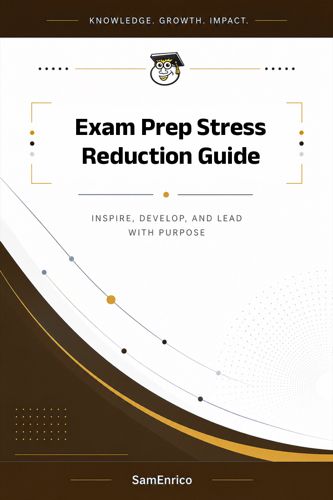
Non-FictionSelf-HelpTest Anxiety
Exam Prep Stress Reduction Guide eBook
Learn breathing techniques and study schedules to
Learn breathing techniques and study schedules to calm nerves before high-stakes tests.
Formats
Free sample
Chapter 1: The Breathing Trap--–- You are about to learn something that most high-achieving students discover too late: the difference between knowing the material and being able to access that knowledge under pressure can be as wide as a canyon, and the bridge across that canyon is not more studying—it is the breath you are taking right now.Picture this. You have studied for six weeks. You have reviewed every flashcard, taken every practice test, and slept exactly eight hours each night. You walk into the exam room feeling prepared, even confident. You sit down, the proctor says “begin,” and you flip to the first question.
You recognize the concept. You know you know this. But something strange happens. Your chest tightens. Your thoughts scatter like startled birds.
The words on the page seem to blur. You read the question three times and still cannot summon the answer that you know, with absolute certainty, is stored somewhere in your brain.What just happened?If you have experienced this, you have likely blamed yourself. You may have thought, “I didn’t study enough,” or “I’m just bad at tests,” or “My anxiety proves I’m not ready.” These are all wrong. The problem is not your knowledge and not your character. The problem is that your body hijacked your brain, and the hijacking began with a single, almost invisible change: your breathing pattern shifted.This chapter will reveal why that happens, how your breath silently betrays you in high-stakes moments, and—most importantly—why understanding this physiology transforms you from a victim of panic into a strategist who can turn anxiety into focus.
By the end of this chapter, you will never blame yourself for test anxiety again. Instead, you will understand exactly what went wrong in your nervous system and, more critically, why you have the power to fix it in seconds.The Moment Everything Changes Let us slow down time and walk through exactly what happens inside your body during the first sixty seconds of a high-stakes exam.You are seated. The exam booklet is closed. Your breathing is normal—steady, diaphragmatic, quiet. Your heart rate is likely around seventy to eighty beats per minute, depending on your fitness and baseline anxiety.
Your nervous system is in what physiologists call a balanced state, with the sympathetic and parasympathetic branches working in healthy opposition.Then the proctor says, “You may begin.”You open the booklet and scan the first question. Immediately, your brain performs a rapid, unconscious threat assessment. This is not a conscious choice. Your amygdala—an almond-shaped cluster of neurons deep in the temporal lobe—is scanning for danger. It evolved to detect predators in tall grass, not multiple-choice questions, but it cannot tell the difference.
When the amygdala perceives a threat, it sounds an alarm.Here is what that alarm triggers. Your hypothalamus activates the sympathetic-adrenal-medullary axis—a mouthful that simply means your body releases adrenaline. Within seconds, your heart rate spikes. Your pupils dilate to take in more light. Blood shunts away from your digestive system and toward your large muscles, preparing you to fight or flee.
This is the fight-or-flight response, and it is excellent if you are facing a bear. It is disastrous if you are facing a calculus exam.Because in the middle of this cascade, something else happens. Your breathing changes.The Hidden Hijacker Under threat, your body automatically shifts from diaphragmatic breathing (deep, belly-driven, slow) to thoracic breathing (shallow, chest-driven, rapid). This shift is so subtle that you almost never notice it happening. But its effects are not subtle at all.Thoracic breathing uses only the upper lobes of your lungs.
It is inefficient. It exchanges less oxygen and, more critically, does not fully expel carbon dioxide. As carbon dioxide levels rise in your blood, a cascade of physiological events unfolds. Your blood vessels constrict, reducing blood flow to your brain by up to fifteen percent. Your prefrontal cortex—the part of your brain responsible for executive function, reasoning, and impulse control—receives less oxygen.
Your hippocampus, the memory retrieval center, is particularly sensitive to this reduction.This is why you cannot remember the answer. Not because you forgot. Because the blood carrying that memory trace cannot reach the neural circuits that hold it.The irony is staggering. Your body created this response to protect you from a physical threat, but it is now actively sabotaging your performance on a cognitive task. Your sympathetic nervous system turned on the fire alarm, but there is no fire.
There is only a test. And your breath, now shallow and rapid, is keeping the alarm ringing.The Vagus Nerve Connection To understand why breath is the key, you need to meet one of the most important nerves in your body: the vagus nerve. The vagus is the main highway of the parasympathetic nervous system—the “rest and digest” branch that opposes fight-or-flight. It runs from your brainstem down through your neck and chest to your abdomen, touching your heart, lungs, and digestive tract along the way.Here is what most people do not know. The vagus nerve is bidirectional.
It carries signals from your brain to your organs, but it also carries signals from your organs back to your brain. This means that your body can tell your brain how to feel, not just the other way around.When you breathe slowly and deeply, the mechanical stretch of your lungs signals the vagus nerve. That signal travels to your brainstem and says, “Everything is calm. There is no threat.” In response, your brainstem inhibits the sympathetic nervous system and activates parasympathetic tone. Your heart rate slows.
Your blood pressure drops. Your prefrontal cortex gets the blood it needs.When you breathe rapidly and shallowly, the absence of that stretch signal says, “Something is wrong. Stay alert.” And the sympathetic nervous system stays engaged.You can see where this is going. Your breath is not just a reflection of your anxiety. Your breath is a direct control lever for your nervous system.
And you can pull that lever at any time, without anyone noticing, without any equipment, without any cost.The Cost of Chronic Test Anxiety Before we go further, let us be honest about what test anxiety costs you. This is not about feelings. This is about measurable, documented performance loss.Research consistently shows that students with high test anxiety score twelve to fifteen percent lower than students with low test anxiety, even when both groups have the same knowledge and preparation. Think about what that means. If you are a B+ student (eighty-seven percent), test anxiety alone could drop you to a C+ (seventy-four percent).
If you are on the border of passing a professional licensing exam, anxiety could be the difference between certification and another six months of studying.But the cost is not only on test day. Test anxiety creates a vicious cycle that begins weeks before the exam. Anticipatory anxiety—the dread of the upcoming test—triggers the same shallow breathing pattern while you study. That shallow breathing reduces your concentration, slows your memory consolidation, and makes you feel like you are not learning effectively. That feeling reinforces your belief that…
This is the end of the free sample. Get the eBook to keep going. Buy now
About this book
Details
- Author
- Shultz Wanetta
- Publisher
- SamEnrico
- Language
- English
- Genre
- Non-Fiction, Self-Help, Test Anxiety
- Released
- 2026-06-09
- Pages (approx.)
- 143
- Available as
- eBook, Audiobook

Read better in the ZLOADR app
Your eBooks on your phone or tablet. Sign in with your SamEnrico account and start reading.
More by Shultz Wanetta
 Sudanese Family Reunification JourneyShultz Wanetta$11.99
 The Senior Fashion Confidence PrimerShultz Wanetta$11.99
 Research Proposal Experimental Design GuideShultz Wanetta$11.99
 Body Scan for Work BurnoutShultz Wanetta$11.99
 Golden Visa Talent ImpactShultz Wanetta$11.99
 Mammoth Cave UndergroundShultz Wanetta$11.99
 Skiing Steep Descent HypnosisShultz Wanetta$11.99
 The Golden Arches of Progress: Ray Kroc and the McDonald's RevolutionShultz Wanetta$11.99
 Excalibur’s Forgotten Guardian: The Last Druid of AvalonShultz Wanetta$11.99
 How to Become a Buckler And LacerShultz Wanetta$11.99
 Cooperative Dissolution ProcedureShultz Wanetta$12.99
 UK Business Credit Building MistakesShultz Wanetta$12.99
You may also like
 Hong Kong Handover 1997Dunn Johnnie$11.99
 Zumba For Postnatal Recovery CourseNeal Christian$11.99
 Zumba for BeginnersLadner Nikia$11.99
 YouTube Comment Mining GuideHumes Pandora$12.99
 Worry Box MeditationCarlin Rudy$11.99
 Workplace Stress MeditationNguyen Lynn$11.99
 Workplace Stress and Sleep RepairHawley Ivory$11.99
 Workplace Perfectionism CureDelaney Jeffry$11.99
 Workplace Injustice Anger GuideWallen Isabelle$11.99
 Work Addiction and Burnout LinkGreenwood Ester$11.99
 Women in Yoga and WellnessBeattie Galina$11.99
 Women in Stand Up ComedyChun Evangeline$11.99