
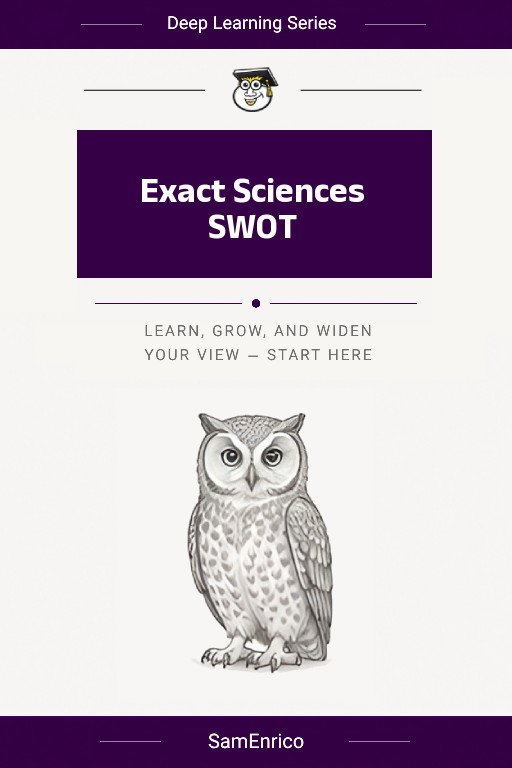
Non-FictionStrategic AtlasDiagnostics
Exact Sciences SWOT eBook
Evaluate Cologuard colon cancer screening, oncotyp
Evaluate Cologuard colon cancer screening, oncotype DX, commercial reimbursement, and market penetration growth.
Formats
Free sample
Chapter 1: The Plastic Bucket–- The Fed Ex truck pulled into the driveway at 11:47 AM on a Tuesday. James, a 59-year-old retired firefighter from Columbus, Ohio, watched from his kitchen window as the driver jogged to his front porch and dropped off a box approximately the size of a shoebox. James knew what was inside because he had ordered it himself after seeing a television commercial during a Cincinnati Bengals game. The box contained a plastic bucket, a collection wand, a biohazard bag, and a prepaid return shipping label. It was, by any objective measure, an unglamorous package.
But that plastic bucket would save his life.James had ignored eleven separate colonoscopy referrals over seven years. His primary care physician, Dr. Maria Chen, had recommended the procedure annually. Each time, James said the same thing: "I'm not doing that." He had watched his older brother undergo a colonoscopy after turning fifty. The preparation—the fasting, the laxatives, the hours in the bathroom—had been described in graphic detail at family gatherings.
His brother had emerged from the procedure complaining of gas pain and grogginess from the sedation. James, a man who had run into burning buildings without hesitation, found himself unable to schedule a medical procedure that might have saved his life ten years earlier.This is the central paradox of modern medicine. We have developed extraordinary technologies to detect and treat disease. Colonoscopy, when performed correctly, can prevent colorectal cancer by identifying and removing precancerous polyps before they ever become malignant. The five-year survival rate for localized colorectal cancer is 90 percent.
For distant metastasis, it drops to 14 percent. The clinical evidence is overwhelming. And yet, approximately one in three eligible Americans is not up to date with colorectal cancer screening. For some populations—rural communities, men, the uninsured—the rate is even worse.James was not irrational. He was not afraid of cancer.
He was afraid of the procedure. The difference is everything.The Accessibility Gap The story of James is not a story about science. It is a story about what happens when clinically superior products meet human psychology. In the world of medical diagnostics, we have traditionally measured success by accuracy: sensitivity, specificity, positive predictive value, negative predictive value. These are the metrics that win FDA approval, that get published in the New England Journal of Medicine, that earn plaudits at oncology conferences.
But these metrics measure only the test itself. They do not measure whether the test is actually used.This is what this book calls the Accessibility Gap.The Accessibility Gap is the difference between clinical efficacy and real-world adoption. It is the distance between what medicine can do and what patients will actually do. For colonoscopy, the Accessibility Gap is enormous. The procedure is clinically superior to every alternative.
It can detect and remove polyps in a single session. It has a false positive rate near zero. But it requires bowel preparation, sedation, a driver, time off work, and the willingness to undergo an invasive procedure that many people find embarrassing or frightening. When you measure colonoscopy by adoption rather than accuracy, it is not the gold standard. It is the standard that most people refuse.The Accessibility Gap exists across nearly every category of medical diagnostics.
Patients avoid mammograms because of discomfort and the anxiety of recall. Patients avoid prostate biopsies because of the fear of pain and infection. Patients avoid blood draws because of needle phobia. In each case, the clinical community responds by trying to improve the accuracy of the existing test or by educating patients about the importance of screening. Both responses miss the point.
The problem is not that patients don't understand the benefits. The problem is that the benefits are not weighted against the real and perceived costs of the procedure.Exact Sciences, the company that makes Cologuard and Oncotype DX, has built a multi-billion dollar business by understanding the Accessibility Gap better than almost any other diagnostic company in history. The company did not invent a new technology that outperforms colonoscopy on accuracy. It did not try to beat the gold standard at its own game. Instead, it created a new category: non-invasive screening that competes against non-compliance rather than against clinical perfection.
The plastic bucket that arrived at James's doorstep was not superior to colonoscopy. But it was superior to nothing. And nothing was what James had been choosing for seven years.The Three Barriers to Access To understand how Exact Sciences closed the Accessibility Gap, we must first understand the three barriers that keep patients from using medical tests. These barriers appear in every diagnostic category, from cancer screening to genetic testing to routine blood work. Companies that succeed in closing the Accessibility Gap do not try to overcome all three barriers at once.
They identify which barrier is most responsible for non-adoption in their specific market and design their product to address that barrier first.Barrier One: Fear and Pain The first barrier is the most primal. Patients avoid procedures because they anticipate physical discomfort or emotional distress. For colonoscopy, the fear is multifaceted: fear of the preparation, fear of the sedation, fear of the procedure itself, fear of the results. For mammography, the fear is compression and the anxiety of waiting for results. For prostate biopsy, the fear is pain and the risk of complications.Fear-based avoidance is not rational in the sense that patients often overestimate risk and underestimate benefit.
But it is predictable. The psychology of loss aversion tells us that people feel the pain of a potential negative outcome more intensely than they feel the pleasure of a potential positive outcome. A patient imagining the discomfort of a colonoscopy is experiencing that discomfort in their mind as if it were real. The future benefit of cancer detection is abstract and distant. The immediate cost of the procedure is vivid and near.Cologuard addressed the fear barrier by eliminating the most feared elements of colonoscopy: the preparation, the sedation, and the invasiveness.
The stool-based test requires no dietary restrictions beyond the day of collection. It requires no time off work beyond the minutes needed to use the kit. It requires no driver, no sedation, no recovery room. For patients like James, the difference between a colonoscopy and a stool test is the difference between a major medical event and a minor inconvenience.Barrier Two: Shame and Embarrassment The second barrier is social rather than physical. Patients avoid procedures because they feel embarrassed about the body part being examined or the specimen being collected.
Colonoscopy involves exposing intimate anatomy to a medical professional. Stool collection involves handling one's own waste. Both can trigger feelings of shame, particularly in cultures where bodily functions are private matters.Exact Sciences addressed the shame barrier through design and messaging. The Cologuard kit arrives in a discreet box. The collection process is performed in the privacy of the patient's own bathroom.
The specimen is sealed in a biohazard bag and placed inside a plastic bucket that is then placed inside a cardboard box. The patient never hands anything to anyone. The Fed Ex pickup is contactless. The television advertisements use neutral language and avoid graphic imagery. The…
This is the end of the free sample. Get the eBook to keep going. Buy now
About this book
Details
- Author
- Welker Ashlie
- Publisher
- SamEnrico
- Language
- English
- Genre
- Non-Fiction, Strategic Atlas, Diagnostics
- Released
- 2026-05-26
- Pages (approx.)
- 153
- Available as
- eBook, Audiobook

Read better in the ZLOADR app
Your eBooks on your phone or tablet. Sign in with your SamEnrico account and start reading.
More by Welker Ashlie
 The Broken Record Assertiveness TechniqueWelker Ashlie$11.99
 Feeling Taken For Granted GuideWelker Ashlie$11.99
 Postnatal Walking Meditation PlanWelker Ashlie$11.99
 Dairy Cooperative Milk CollectionWelker Ashlie$11.99
 Walking Meditation for CaregiversWelker Ashlie$11.99
 Beyond the Pitch: The Pioneers of the 1991 Women's World Cup in ChinaWelker Ashlie$11.99
 Food and Beverage ServerWelker Ashlie$11.99
 Understanding Omphalomesenteric CystWelker Ashlie$17.99
 Square Remote Internship BlueprintWelker Ashlie$12.99
 A Beginners Guide to Focus (Volume 1)Welker Ashlie$11.99
You may also like
 Hong Kong Handover 1997Dunn Johnnie$11.99
 Zumba For Postnatal Recovery CourseNeal Christian$11.99
 Zumba for BeginnersLadner Nikia$11.99
 YouTube Comment Mining GuideHumes Pandora$12.99
 Worry Box MeditationCarlin Rudy$11.99
 Workplace Stress MeditationNguyen Lynn$11.99
 Workplace Stress and Sleep RepairHawley Ivory$11.99
 Workplace Perfectionism CureDelaney Jeffry$11.99
 Workplace Injustice Anger GuideWallen Isabelle$11.99
 Work Addiction and Burnout LinkGreenwood Ester$11.99
 Women in Yoga and WellnessBeattie Galina$11.99
 Women in Stand Up ComedyChun Evangeline$11.99