
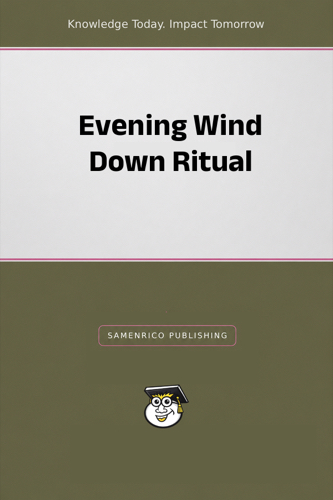
Non-FictionHealth & WellnessEvening Habits
Evening Wind Down Ritual eBook
Create a relaxing evening routine without screens
by Dix Amie
Create a relaxing evening routine without screens for better sleep.
Formats
Free sample
Chapter 1: The Digital Drug--–- The first time I truly understood the problem, I was crying over a blue light filter.It was 11:47 PM. I had been scrolling for two hours and seventeen minutes—not because I was enjoying myself, but because I couldn't stop. My thumb moved in automatic loops. My eyes burned. My brain felt like a browser with forty-seven tabs open, none of them relevant, all of them screaming for attention.
And there, glowing softly from my phone's settings menu, was the solution I had pinned all my hopes on: the night mode. The blue light filter. The thing that was supposed to save me.It didn't.I remember thinking: If this little orange tint is the best defense trillion-dollar tech companies can offer against sleep loss, we are all in trouble.That night was not a failure of willpower. It was not a character flaw. It was not evidence that I was "addicted" in some moral sense.
It was, instead, a perfectly predictable biological response to an environment that had been meticulously engineered to exploit my brain's oldest and most vulnerable circuits. I was not weak. I was outmatched.And so are you.This chapter is not a gentle suggestion to "maybe try putting your phone down earlier." This chapter is an autopsy of the mechanism. You will learn exactly how screens hijack your sleep—not metaphorically, but physiologically. You will learn why that cozy feeling of scrolling in bed is an illusion.
You will learn the difference between what feels relaxing and what actually restores. And you will complete a personal audit that will forever change how you see your evening hours.By the end of this chapter, you will never look at your phone the same way again.The Melatonin Heist Let us begin with a molecule you have probably heard of but may not fully understand: melatonin. It is not a sleeping pill. It is not a sedative. It is not something you can "take" to override bad habits, though millions of people try.
Melatonin is, more precisely, a hormone of darkness. It is your body's biological announcement that night has arrived and that sleep should soon follow.Here is what happens in a world without screens.As the sun sets, specialized cells in your retina—called intrinsically photosensitive retinal ganglion cells, though you do not need to remember that name—detect the shift from blue-rich daylight to warm, dim evening light. These cells send a signal to your brain's master clock, a tiny structure called the suprachiasmatic nucleus, located just above the optic chiasm. The suprachiasmatic nucleus then instructs the pineal gland, deep in the center of your brain, to begin releasing melatonin into your bloodstream.Melatonin levels rise slowly, peaking in the middle of the night, then fall as morning approaches. This rise and fall does not cause sleep by itself—think of it less as a hammer and more as a key.
Melatonin unlocks the door to sleep. Whether you walk through that door depends on other factors (stress, environment, your own willingness to close your eyes), but without the key, the door remains locked no matter how tired you feel.Now here is what happens in the world we actually inhabit.At 10:00 PM, you pick up your phone. Its screen emits light at a specific wavelength: 440 to 495 nanometers. That is blue light. Not all blue light is bad—daylight is rich in blue, which is why it wakes you up in the morning.
But at night, blue light is a biological lie. When those wavelengths hit your retina, your suprachiasmatic nucleus reads them as one thing and one thing only: daytime. It does not matter that the clock says 10:00 PM. It does not matter that you are tired. The signal is unambiguous.
Daytime means no melatonin. Daytime means wakefulness.The result is staggering. A landmark study from Harvard Medical School found that just two hours of blue-light exposure before bed suppresses melatonin by over 50 percent. Another study, this one from the University of Toronto, showed that people who read from a backlit screen for four hours before bed took ten minutes longer to fall asleep, had significantly reduced REM sleep, and reported higher levels of next-morning grogginess compared to those who read from a physical book.Ten minutes may not sound like much. But multiply that by three hundred sixty-five nights, then by ten years, and you have lost over six hundred hours of sleep—twenty-five full days of rest stolen one minute at a time.This is not an accident.The Dopamine Deception Melatonin suppression is only half the story.
The other half is more insidious because it feels good.Every time you open an app, scroll through a feed, watch a short video, or check a notification, your brain releases a small pulse of dopamine. Dopamine is often misunderstood as the "pleasure chemical," but that is not quite right. Dopamine is the anticipation chemical. It is what keeps you searching, scrolling, clicking, wanting. It is the reason you can spend forty-five minutes on a video platform watching content you do not even particularly enjoy.The tech industry has mastered dopamine release with surgical precision.
Variable rewards—the possibility that the next scroll might bring something interesting, funny, shocking, or validating—keep your brain in a state of perpetual wanting. This is the same neural mechanism that makes slot machines addictive. The only difference is that you carry the slot machine in your pocket, and it never stops offering another pull.Here is the deception that matters for sleep.When you are lying in bed with your phone, you are not relaxing. You are hunting. Your brain is in a state of low-grade arousal—not panic, not excitement, but a persistent, gnawing alertness.
Your heart rate is slightly elevated. Your cortisol (the stress hormone) is not falling the way it should at night. Your prefrontal cortex, which handles judgment and decision-making, is being bypassed by older, more primitive circuits that say keep looking, keep searching, do not stop now.This state feels like relaxation because it is familiar. You associate the comfort of your bed with the comfort of your phone. But physiologically, you are as far from true rest as you would be during a casual conversation or a slow walk.
You are not sleeping. You are not even truly winding down. You are idling with the engine running, burning fuel, going nowhere.I call this digital relaxation—and it is a lie.True restoration—the kind that lowers heart rate, reduces cortisol, and prepares your body for deep sleep—looks very different. It involves stillness. It involves boredom.
It involves the absence of variable rewards. It involves your brain's default mode network, which only activates when you are not focused on an external task. That network is where you process emotions, consolidate memories, and generate creative insights. Scrolling shuts it down. Staring at a wall activates it.We have traded restoration for stimulation and called it rest.The 90-Minute Rule You may have heard advice about turning off screens an hour before bed.
That is a good start. But the science suggests something more specific: the most critical window is the ninety minutes…
This is the end of the free sample. Get the eBook to keep going. Buy now
About this book
Details
- Author
- Dix Amie
- Publisher
- SamEnrico
- Language
- English
- Genre
- Non-Fiction, Health & Wellness, Evening Habits
- Released
- 2026-06-09
- Pages (approx.)
- 134
- Available as
- eBook, Audiobook

Read better in the ZLOADR app
Your eBooks on your phone or tablet. Sign in with your SamEnrico account and start reading.
More by Dix Amie
 Noting Technique For SleepDix Amie$11.99
 Career Gap HandbookDix Amie$11.99
 Dyspareunia Pain GuideDix Amie$11.99
 The British Steam Engine RevolutionDix Amie$11.99
 The Titan of Industry: Andrew Carnegie and the Gospel of WealthDix Amie$11.99
 The Breeder's Guide to Choctaw PigsDix Amie$11.99
 Nairobi Agritech StartupsDix Amie$12.99
 Multi Member Foreign LLC GuideDix Amie$12.99
 Customer Relations SpecialistDix Amie$11.99
You may also like
 Hong Kong Handover 1997Dunn Johnnie$11.99
 Zumba For Postnatal Recovery CourseNeal Christian$11.99
 Zumba for BeginnersLadner Nikia$11.99
 YouTube Comment Mining GuideHumes Pandora$12.99
 Worry Box MeditationCarlin Rudy$11.99
 Workplace Stress MeditationNguyen Lynn$11.99
 Workplace Stress and Sleep RepairHawley Ivory$11.99
 Workplace Perfectionism CureDelaney Jeffry$11.99
 Workplace Injustice Anger GuideWallen Isabelle$11.99
 Work Addiction and Burnout LinkGreenwood Ester$11.99
 Women in Yoga and WellnessBeattie Galina$11.99
 Women in Stand Up ComedyChun Evangeline$11.99