
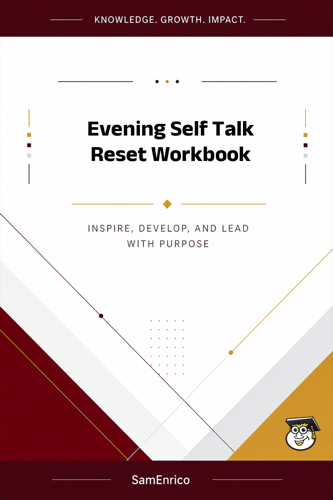
Non-FictionSelf-HelpEvening RoutineReflection
Evening Self Talk Reset Workbook eBook
Review daily negative thoughts and replace them wi
Review daily negative thoughts and replace them with kinder interpretations before sleep.
Formats
Free sample
Chapter 1: The Last Word--–- The day is over. The dishes are done. The lights are low. You climb into bed, pull the covers up to your chin, and close your eyes. This is the moment your body has been waiting for—the release, the rest, the reset.And then the thoughts come.They arrive without invitation.
A mistake at work, replayed in high definition. A conversation from three days ago, suddenly demanding a different ending. A worry about tomorrow that you cannot do anything about at 11:17 PM. A quiet, insidious whisper: I should have done better. They probably think I am incompetent.
What if everything falls apart? I am not good enough.The thoughts are not random. They are not meaningless noise. They are the voice of your inner critic, and it has chosen this moment—the moment when you are most tired, most vulnerable, most alone with your mind—to speak its loudest.This chapter is about why that happens. It is about the neuroscience of sleep and memory, the psychology of rumination, and the simple but powerful reason why the thoughts you have just before bed matter more than almost any other thoughts you think all day.
By the time you finish this chapter, you will understand why your last thoughts have the last word—and why changing them can change everything.The Librarian Who Works While You Sleep Let us start with a metaphor that will stick with you.Imagine your brain as a vast library. During the day, books are constantly arriving. Some are new experiences. Some are conversations. Some are worries.
Some are small moments of joy or frustration. These books pile up on a cart near the librarian's desk. By the end of the day, the cart is full—sometimes overflowing.The librarian works the night shift. While you sleep, the librarian sorts through every book that arrived during the day. Some books are filed into long-term storage.
Some are discarded as unimportant. Some are cross-referenced with older books, connecting new experiences to old memories. The librarian is meticulous, efficient, and completely invisible to you.Here is the critical detail: the librarian pays special attention to the books that were placed on the cart most recently. The thoughts you were holding as you drifted off—the last books to arrive—get the librarian's closest scrutiny. They are the ones most likely to be filed deeply, connected broadly, and strengthened overnight.This is not just a metaphor.
It is a description of what neuroscientists call memory consolidation. During sleep, particularly during deep sleep and REM sleep, your brain replays the experiences and thoughts of the day, strengthens the neural pathways associated with them, and integrates them into your existing web of memories and beliefs.If the last thoughts you held were self-critical, anxious, or fear-based, your brain literally strengthens those neural pathways overnight. The negative narrative becomes more entrenched. You wake up not with a fresh start, but with a heavier version of yesterday's burdens.If, on the other hand, your last thoughts were kind, balanced, or solution-focused, your brain consolidates those instead. You wake up with a slightly more resilient, compassionate internal voice.The difference is small each night.
But over weeks and months, it compounds. The librarian is not judging you. The librarian is simply doing its job. But you can influence what the librarian has to work with.The Evening Thought Replay Phenomenon You have likely noticed that negative thoughts are not evenly distributed across the day. They cluster.
They surge. And they are most active at two specific times: when you first wake up (if you wake up anxious) and when you are trying to fall asleep.The evening surge has a name. Psychologists call it rumination. Rumination is not the same as problem-solving. Problem-solving moves toward a solution.
It asks, "What can I do about this?" It has a beginning, a middle, and an end. Rumination moves in circles. It asks, "Why did this happen?" "What does this say about me?" "What if it happens again?" It revisits the same negative thoughts without resolution.Rumination is most common in the evening for three specific reasons.First, distractions disappear. During the day, your attention is occupied by work, conversations, emails, errands, and the endless small tasks of daily life. These distractions are not necessarily pleasant, but they keep your mind busy.
At night, with nothing to distract you, whatever was already simmering beneath the surface rises to the top. The thought that flickered across your mind at 2 PM and was immediately buried by a meeting now has the stage to itself.Second, fatigue impairs perspective. Your brain's prefrontal cortex—the region responsible for rational thinking, emotional regulation, and impulse control—is an energy-intensive organ. It consumes about 20% of your body's calories despite being only 2% of your body weight. By the end of the day, after hours of decision-making, social navigation, and task-switching, your prefrontal cortex is tired.
It does not work as well as it did at 10 AM. Thoughts that would seem manageable in the morning—I stumbled over a word in that meeting—feel catastrophic at night. The same thought, the same brain, different time of day, completely different emotional impact.Third, darkness and quiet amplify internal voices. Your brain is wired to pay attention to what is most salient in your environment. During the day, external stimuli—lights, sounds, movement, conversation—compete for your attention.
At night, with external stimuli reduced to near zero, your internal monologue becomes the loudest thing in the room. This is not a flaw in your brain. It is a feature of how attention works. But it means that negative self-talk gets a spotlight at exactly the moment you are least equipped to handle it.These three factors—the absence of distraction, the fatigue of your prefrontal cortex, and the amplification of internal voices—create the perfect storm for evening rumination. The storm is not your fault.
It is a predictable consequence of how human brains are built. But predictable does not mean unchangeable. Understanding the storm is the first step toward learning to calm it.Why "Just Think Positive" Does Not Work If you have ever tried to stop negative thoughts by telling yourself to just think positive, you know how well that works. (Spoiler: it does not.)You lie there, eyes closed, trying to summon a cheerful thought. I am capable.
I am worthy. Everything will be fine. But the words feel hollow. They sit on top of the negative thoughts like a thin layer of paint on a crumbling wall. You do not believe them.
Your brain, trained by years of experience, knows that the negative thought has more evidence behind it. The forced positive thought feels like a lie. And because it feels like a lie, it does not stick.This is not a failure of willpower. It is a failure of strategy. Forced positivity does not work because it tries to replace a negative thought with a positive one without addressing the structure underneath.
The negative thought is not just a random error. It is a conclusion your brain has reached based on evidence. To change the conclusion…
This is the end of the free sample. Get the eBook to keep going. Buy now
About this book
Details
- Author
- Sharkey Shawana
- Publisher
- SamEnrico
- Language
- English
- Genre
- Non-Fiction, Self-Help, Evening Routine, Reflection
- Released
- 2026-06-09
- Pages (approx.)
- 113
- Available as
- eBook, Audiobook

Read better in the ZLOADR app
Your eBooks on your phone or tablet. Sign in with your SamEnrico account and start reading.
More by Sharkey Shawana
 Benzodiazepine PAWS GuideSharkey Shawana$11.99
 Pay Inequity Anger GuideSharkey Shawana$11.99
 Breaking the Spending Cycle WorkbookSharkey Shawana$11.99
 The Fear of Darkness GuideSharkey Shawana$11.99
 The Arsenic Heiresses: Poison, Property, and Deceit in Victorian EnglandSharkey Shawana$11.99
 Understanding Tyrosine-oxidase Temporary DeficiencySharkey Shawana$17.99
 VAT Risk Assessment MatrixSharkey Shawana$12.99
 London VC Pre Seed GuideSharkey Shawana$12.99
 Ultimate Handbook Guide to Andorra la Vella : (Andorra) Travel GuideSharkey Shawana$11.99
 Earth Pea HarvestingSharkey Shawana$11.99
You may also like
 Hong Kong Handover 1997Dunn Johnnie$11.99
 Zumba For Postnatal Recovery CourseNeal Christian$11.99
 Zumba for BeginnersLadner Nikia$11.99
 YouTube Comment Mining GuideHumes Pandora$12.99
 Worry Box MeditationCarlin Rudy$11.99
 Workplace Stress MeditationNguyen Lynn$11.99
 Workplace Stress and Sleep RepairHawley Ivory$11.99
 Workplace Perfectionism CureDelaney Jeffry$11.99
 Workplace Injustice Anger GuideWallen Isabelle$11.99
 Work Addiction and Burnout LinkGreenwood Ester$11.99
 Women in Yoga and WellnessBeattie Galina$11.99
 Women in Stand Up ComedyChun Evangeline$11.99