
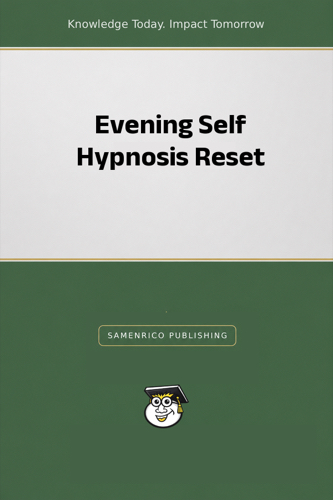
Non-FictionSelf-HelpEvening Rituals
Evening Self Hypnosis Reset eBook
Induce trance before bed to release daily stress a
Induce trance before bed to release daily stress and prepare for sleep.
Formats
Free sample
Chapter 1: The 1-Minute Emergency Reset--–- The bedroom is dark. The clock reads 11:47 PM. You have been lying here for ninety-seven minutes — not because you aren’t tired, but because your brain refuses to stop. A conversation from earlier replays on a loop. Tomorrow’s to-do list flashes like a screensaver you cannot turn off.
Your jaw is clenched. Your shoulders feel like concrete. And somewhere beneath the exhaustion, a small, angry voice whispers: What is wrong with me?Nothing is wrong with you. You are experiencing a perfectly predictable neurological event. Your brain has mistaken evening stress for a survival threat, activated your reticular activating system (RAS), and locked you into a state of high alert.
Willpower cannot fix this, because willpower is what keeps you awake. Trying harder to sleep is like trying harder to fall out of a tree — the effort itself is the problem.This chapter has two jobs. First: give you something that works tonight, in under sixty seconds, without any prior practice. Second: explain why that tiny intervention succeeds where hours of tossing and turning fail. You will learn the 1-Minute Emergency Reset — a portable, no-equipment, no-visualization-required trance induction that you can use the moment you recognize bedtime stress.
By the end of this chapter, you will also understand the hypnotic depth rating scale (1 to 10), which will serve as your personal compass throughout the 21-day program that follows.Let us begin with the emergency. The science can wait ninety seconds.The 1-Minute Emergency Reset – Step by Step Before we discuss why this works, perform it once. Read the instructions slowly, then close your eyes and try it. If you are reading in bed at 11:47 PM, you are already in the ideal environment.Step 1 (5 seconds): Sit up slightly. Propped on two pillows is fine.
Lying flat increases the chance of falling asleep before completing the reset — and while sleep is the goal, this particular exercise requires you to remain conscious for one minute. If you are already lying down, bend your knees or place one hand under your hip to create a slight postural change. This signals your brain: something different is happening now.Step 2 (10 seconds): Place your nondominant hand on your sternum (the flat bone in the center of your chest). Your dominant hand can rest on your belly or beside your hip. The hand on your sternum serves two purposes: it provides gentle proprioceptive feedback (your brain registers the weight and warmth), and it physically slows your breathing because chest compression discourages shallow, rapid breaths.Step 3 (30 seconds): Breathe in a 4-7-8 pattern.
Inhale through your nose for 4 seconds. Hold for 7 seconds. Exhale through your mouth for 8 seconds. Repeat this cycle exactly three times. Do not worry about perfect timing — approximate counts work.
If holding your breath for 7 seconds feels uncomfortable, reduce to 4-4-6 (inhale 4, hold 4, exhale 6). The critical element is the extended exhale, which activates the parasympathetic nervous system via vagal nerve stimulation.Step 4 (10 seconds): On the third exhale, silently say the following phrase: "I release what I cannot change tonight." Do not analyze it. Do not argue with it. Simply let the words pass through your mind like a subtitle.Step 5 (5 seconds): Press your thumb and index finger together (either hand) and hold that pressure for five seconds. Then release.
This is your emergency anchor — a kinesthetic trigger that you will now associate with the calm state you just created. With repetition, this simple finger touch will become a Pavlovian signal for trance.That is the entire protocol. Ninety seconds from start to finish, though with practice it compresses to under sixty. You have just induced a light trance state — what researchers call a focal absorption — characterized by alpha-theta brain wave activity, reduced heart rate variability, and a temporary decrease in cortisol.If you feel nothing dramatic, good. Trance rarely feels dramatic.
You may notice: a slight heaviness in your limbs, a softening around your eyes, a single sigh you did not consciously initiate, or a momentary gap in your internal monologue. Those subtle signals are the evidence. They are enough.Why This Works When Willpower Fails The 1-Minute Emergency Reset succeeds for three interconnected reasons: breath mechanics, anchor conditioning, and the strategic abandonment of effort.Breath mechanics. The 4-7-8 pattern is not arbitrary. The extended exhale (8 seconds) is twice as long as the inhale (4 seconds).
This ratio stimulates the vagus nerve, which runs from your brainstem to your abdomen, acting as the primary conduit for the parasympathetic nervous system — your body’s “rest and digest” network. When you exhale longer than you inhale, you physically lower your heart rate. Each exhale triggers a brief pause in cardiac acceleration. After three cycles, measurable bradycardia (slowed heart rate) occurs. You cannot be in a state of high alert with a resting heart rate below 60 beats per minute; the two are physiologically incompatible.Anchor conditioning.
The thumb-index finger press is a form of kinesthetic anchoring, borrowed from neuro-linguistic programming but supported by standard learning theory. When a neutral stimulus (finger pressure) is repeatedly paired with a desired state (calm trance), the neutral stimulus alone begins to elicit the state. After seven to ten repetitions across separate evenings, your emergency anchor will produce a noticeable shift within two seconds of contact. This is not mystical; it is classical conditioning, identical to Pavlov’s bells, except you are both the scientist and the dog.Strategic abandonment of effort. The most important mechanism is also the simplest: this protocol asks nothing of you except breath, touch, and a single sentence.
It does not ask you to stop thinking. It does not ask you to relax harder. It does not ask you to clear your mind. By removing performance demands, the reset sidesteps the very phenomenon that keeps you awake: paradoxical intention, or the tendency for effortful attempts to achieve a spontaneous state to produce the opposite result. Try to fall asleep, and you become hyperaroused.
Try to perform a mechanical breathing exercise, and sleep becomes a side effect rather than a target.The Hypnotic Depth Rating Scale (1 to 10)Before you practice any further technique in this book, you need a way to measure your progress. The hypnotic depth rating scale is a subjective self-assessment tool that predicts treatment outcomes more accurately than physiological measurements in most self-hypnosis studies. You will use it after every reset.1 – Fully awake, alert, no shift. You feel exactly as you did before starting. Your internal monologue is loud, your body feels normal, and you could easily open your eyes and resume conversation without any transition.2 – Subtle bodily awareness.
You notice something small: a tingling in your fingers, a slight heaviness in your eyelids, or the fact that you have not moved for thirty seconds. Your thoughts are still racing, but there is a thin layer of observation between you and the race.3 – Eye flutter or swallowing reflex. Your eyes twitch beneath closed lids. You swallow without meaning to. These are involuntary signs of early trance.
Most beginners hover between 2 and 3 for their first week.4 – Limb heaviness. One or both arms feel dense, as if slightly weighted. Your jaw has unclenched without your directing it. You could…
This is the end of the free sample. Get the eBook to keep going. Buy now
About this book
Details
- Author
- Janes Jaleesa
- Publisher
- SamEnrico
- Language
- English
- Genre
- Non-Fiction, Self-Help, Evening Rituals
- Released
- 2026-06-07
- Pages (approx.)
- 151
- Available as
- eBook, Audiobook

Read better in the ZLOADR app
Your eBooks on your phone or tablet. Sign in with your SamEnrico account and start reading.
More by Janes Jaleesa
 The Parent Comparison Trap GuideJanes Jaleesa$11.99
 The Ibn Ezra PoetJanes Jaleesa$11.99
 Emotion Regulation for Procrastination GuideJanes Jaleesa$11.99
 Self Sabotage Recovery Twelve StepsJanes Jaleesa$11.99
 Neon Lotus: The Cybernetic Samurai’s Last StandJanes Jaleesa$11.99
 Echoes of the Ice: The Unsung Heroes of the 1914 Franklin ExpeditionJanes Jaleesa$11.99
 Understanding Brain Cavernous AngiomaJanes Jaleesa$17.99
 How to Become a Diamond DrillerJanes Jaleesa$11.99
 Women In Coding Pathways GuideJanes Jaleesa$12.99
 Southeast Asia Ecommerce OutlookJanes Jaleesa$12.99
 Housewares ClerkJanes Jaleesa$11.99
You may also like
 Hong Kong Handover 1997Dunn Johnnie$11.99
 Zumba For Postnatal Recovery CourseNeal Christian$11.99
 Zumba for BeginnersLadner Nikia$11.99
 YouTube Comment Mining GuideHumes Pandora$12.99
 Worry Box MeditationCarlin Rudy$11.99
 Workplace Stress MeditationNguyen Lynn$11.99
 Workplace Stress and Sleep RepairHawley Ivory$11.99
 Workplace Perfectionism CureDelaney Jeffry$11.99
 Workplace Injustice Anger GuideWallen Isabelle$11.99
 Work Addiction and Burnout LinkGreenwood Ester$11.99
 Women in Yoga and WellnessBeattie Galina$11.99
 Women in Stand Up ComedyChun Evangeline$11.99