
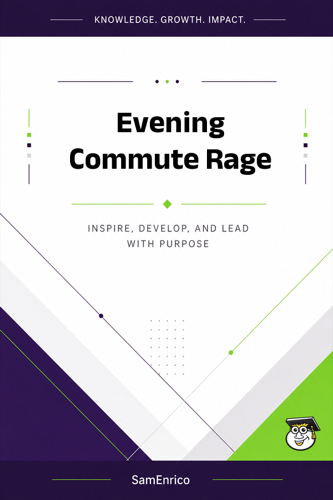
Free sample
Chapter 1: The 5 PM Hijack--–- The woman in the navy sedan had been having a perfectly reasonable day. She had negotiated a contract extension without raising her voice. She had talked her boss down from a panic spiral about Q3 projections. She had even resisted the urge to strangle the intern who microwaved fish in the breakroom. At 4:47 PM, she packed her bag, walked to her car, and felt something she rarely felt on a Thursday: competent.
In control. Like an adult.Forty-three minutes later, she was screaming at a minivan.The offense? The driver ahead had hesitated for 1.7 seconds at a green light before proceeding. Not stopped. Not reversed.
Hesitated. A pause so brief that if you described it to someone who hadn't been there, they would blink and ask, "That's it?" But inside the navy sedan, that hesitation was not a hesitation. It was a personal violation. It was proof that the world was filled with incompetent, oblivious, morally bankrupt people who had no business operating heavy machinery. Her knuckles were white on the steering wheel.
Her jaw ached from clenching. Her heart hammered against her ribs like a prisoner demanding release.She did not know it yet, but she had just been hijacked.Not by a carjacker. Not by road rage in the criminal sense. She had been hijacked by her own biology—by an ancient neural circuit that could not tell the difference between a saber-toothed tiger and a minivan with a slow reaction time. In the span of two seconds, her prefrontal cortex (the rational, planning, "adult" part of her brain) had been overridden by her amygdala (the threat-detecting, fight-or-flight, "lizard" part of her brain).
She was no longer a competent professional. She was an animal defending its territory.And here is the most important thing you will read in this entire book: That was not her fault.The 5 PM hijack is not a character flaw. It is not a sign that you are a bad person, an angry person, or a person who needs therapy (though therapy is lovely and everyone should go). It is a predictable, measurable, biological reaction to a specific set of conditions that converge every weekday evening for millions of commuters. Your brain at 5 PM is not your brain at 10 AM.
Your body at the end of a workday is not your body at the start. And the rage you feel in traffic is not evidence of moral failure. It is evidence that you are human.This chapter is about why that happens. It is the diagnosis. Before we can fix the evening commute rage, we have to understand its anatomy—the psychological whiplash, the biological crash, and the quiet violence of transitioning from "worker" to "driver" in sixty minutes.The Two Faces of the Same Person Let us return to the woman in the navy sedan.
Let us call her Maya. Maya is not real, but she is every real person who has ever screamed at a steering wheel and then felt ashamed of themselves five minutes later. Maya is you, and Maya is me, and Maya is the 87 percent of American commuters who report feeling "significant anger" during their evening drive.At 2:30 PM on the day of the minivan incident, Maya handled a genuinely stressful situation with grace. Her largest client had threatened to walk over a pricing dispute. Instead of panicking or lashing out, she took three deep breaths (unconsciously, the way adults do), asked clarifying questions, and proposed a compromise that saved the contract.
Her boss later sent her a Slack message that said, "Great save." She felt proud.At 5:30 PM, faced with a minivan that paused for less time than it takes to sneeze, Maya lost her mind.How do we explain this? The easy answer is that Maya is a hypocrite or that her calm at work was a performance. But that answer is wrong and, more importantly, useless. The useful answer lives in a concept I call the Cognitive Dissonance of Commuting.Cognitive dissonance, in psychology, is the discomfort we feel when we hold two conflicting beliefs or identities at the same time. At work, Maya held the identity of "competent professional." She had agency.
She made decisions that mattered. People listened to her. The environment was predictable (office layout, meeting rhythms, coffee machine location) and she had spent years mastering its quirks.In the car, Maya held a completely different identity: "anonymous driver." She had no agency over the system. Her decisions were constrained by traffic lights, lane closures, and the unpredictable behavior of strangers. The environment was chaotic and, crucially, unfair in ways that felt personal.
When the minivan hesitated, Maya's brain did not process it as "a random event in a complex system." It processed it as "that driver did something to me."The whiplash between these two identities—from respected worker to anonymous driver, from agency to powerlessness, from predictability to chaos—creates a low-grade anxiety that primes the brain for overreaction. You are not angry at the minivan. You are angry that the universe has demoted you in the span of a car ride. And because you cannot scream at the universe, you scream at the minivan.This dissonance is the first ingredient in the 5 PM hijack. But it is not the most powerful one.
For that, we have to look inside your body.The Biology of the Evening Crash At 8:00 AM, your brain is a well-fueled engine. You have probably eaten something (even if it was just coffee and a sad granola bar). You have slept (even if it was not enough). Your prefrontal cortex—the part of your brain responsible for impulse control, planning, and emotional regulation—is fully online. When someone cuts you off on the morning commute, you might mutter "seriously?" and then move on with your day.
Your prefrontal cortex has enough energy to intervene between the trigger (cut-off) and the response (rage).By 5:00 PM, everything has changed.Let me walk you through what has happened to your body over the course of a typical workday. This is not theoretical. This is endocrinology.Glucose Depletion: Your brain runs on glucose. It consumes about 120 grams of glucose per day—20 percent of your body's total energy budget despite being only 2 percent of your body weight. Every decision you make, every email you resist overreacting to, every meeting you sit through without interrupting, every snack you choose not to eat—all of it burns glucose.
By mid-afternoon, your glucose levels have dropped significantly. By 5:00 PM, your brain is running on fumes. A glucose-depleted brain is an impulsive brain. It cannot access the prefrontal cortex's braking system. It defaults to the amygdala's accelerator.Cortisol Accumulation: Cortisol is your body's primary stress hormone.
It is not inherently bad—it helps you wake up in the morning and respond to threats. But cortisol is supposed to spike and then recede. In a modern office job, cortisol does not recede. It accumulates. Every minor stressor—a passive-aggressive email, a looming deadline, a difficult conversation—adds a little more cortisol to the pool.
By 5:00 PM, your baseline cortisol level is significantly elevated. You are not actively stressed. You are primed for stress.…
This is the end of the free sample. Get the eBook to keep going. Buy now
About this book
Details
- Author
- Mansfield Trula
- Publisher
- SamEnrico
- Language
- English
- Genre
- Non-Fiction, Self-Help / Work Life
- Released
- 2026-06-06
- Pages (approx.)
- 147
- Available as
- eBook, Audiobook

Read better in the ZLOADR app
Your eBooks on your phone or tablet. Sign in with your SamEnrico account and start reading.
More by Mansfield Trula
 Self Love Affirmations GuideMansfield Trula$11.99
 The Emotional Regulation for ShameMansfield Trula$11.99
 Learning Weekly ReviewMansfield Trula$11.99
 Business Credit Card StrategyMansfield Trula$11.99
 Metabolic Adaptation RD GuideMansfield Trula$11.99
 Habit Formation for TeachersMansfield Trula$11.99
 Pocahontas Diplomatic BridgeMansfield Trula$11.99
 The Veles Conspiracy: A Spy Among the DeadMansfield Trula$11.99
 The Great White North Conspiracy: Canada's Insurance Fraud Panic of the 2000sMansfield Trula$11.99
 How to Start a Noodle Business (Beginners Guide)Mansfield Trula$11.99
 How to Produce LaTeX Interior PaintMansfield Trula$11.99
 How to Produce a TransmissionMansfield Trula$11.99
You may also like
 Hong Kong Handover 1997Dunn Johnnie$11.99
 Zumba For Postnatal Recovery CourseNeal Christian$11.99
 Zumba for BeginnersLadner Nikia$11.99
 YouTube Comment Mining GuideHumes Pandora$12.99
 Worry Box MeditationCarlin Rudy$11.99
 Workplace Stress MeditationNguyen Lynn$11.99
 Workplace Stress and Sleep RepairHawley Ivory$11.99
 Workplace Perfectionism CureDelaney Jeffry$11.99
 Workplace Injustice Anger GuideWallen Isabelle$11.99
 Work Addiction and Burnout LinkGreenwood Ester$11.99
 Women in Yoga and WellnessBeattie Galina$11.99
 Women in Stand Up ComedyChun Evangeline$11.99