
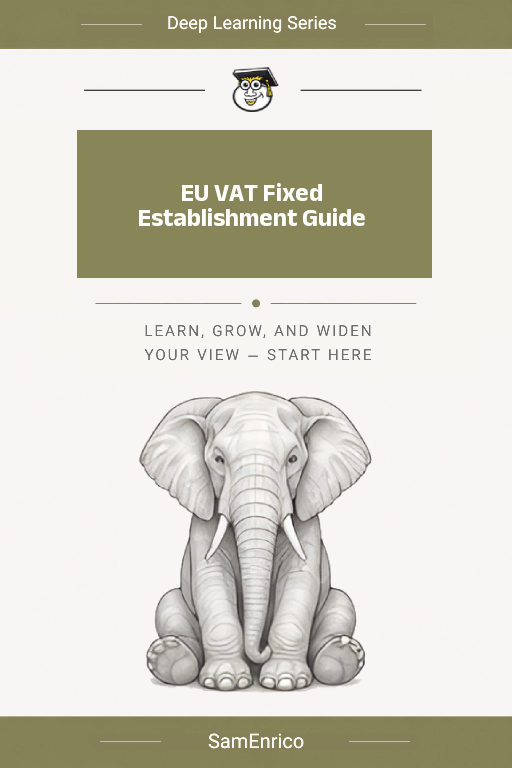
Non-FictionBusiness BriefFixed Establishment
EU VAT Fixed Establishment Guide eBook
Determine VAT registration based on fixed establis
Determine VAT registration based on fixed establishment not just legal seat. Remote warehouse or office triggers registration in that EU country for compliance.
Formats
Free sample
Chapter 1: The Legal Seat Lie...--The address on your VAT registration certificate is a lie. Not a malicious falsehood, but a dangerous half-truth that has lulled thousands of companies into a false sense of security. You believe that because your headquarters are in Germany, your VAT obligations begin and end in Germany. You believe that a warehouse in France operated by a third-party logistics provider has nothing to do with you. You believe that a remote employee working from a home office in Spain is just an employee, not a tax problem.You are wrong.
And the cost of this mistake can easily exceed half a million euros.This book exists because the traditional framework for determining where a company owes VAT has collapsed. The old rules were simple: you registered for VAT where your legal seat was located. Your customers knew which VAT number to use. Tax authorities knew which country had jurisdiction. It was predictable, if not always fair.But the economy changed.
Cross-border trade exploded. E-commerce turned every seller into a potential exporter. Remote work untethered employees from headquarters. Drop-shipping and third-party logistics allowed companies to hold inventory in countries where they had no legal presence. And the tax rules?
They struggled to keep up.The European Court of Justice stepped into this gap with a series of decisions that fundamentally rewrote the map of VAT obligations. The most important of these is Welmory (C-605/12), a case that sent shockwaves through the tax world and continues to confuse and terrify finance directors to this day.The Welmory Bomb The facts of Welmory seem almost mundane. A Polish company registered for VAT in Poland. It started selling goods through an online platform. It used a third party in another country to handle some of its operations.
The tax authority in that other country said: you owe us VAT. The company said: no, our legal seat is in Poland, so Poland is our only VAT home.The European Court of Justice disagreed. And in doing so, it established a principle that has become the foundation of modern fixed establishment law: a company can have a VAT presence in a country where it owns no property, employs no direct staff, and has no legal registration — simply by having sufficient human and technical resources available to it.Let me read that again, because it is that important. You can owe VAT in a country without owning a single desk, without signing a single lease, without putting a single person on your payroll. The resources do not need to be yours.
They simply need to be available to you, under your control, with sufficient permanence to support your business activities.The Polish company in Welmory thought it was safe. It was not. And unless you understand exactly what creates a fixed establishment, you are not safe either.The Rational Result Test How do tax authorities decide whether a fixed establishment exists? They do not rely on a simple checklist of ownership or employment contracts. Instead, they apply what this book calls the Rational Result Test.Here is how it works.
A tax authority looks at your operations in their country. They ask a single question: if we ignore this local presence, does the resulting tax treatment produce a rational result? Or does it lead to no VAT being paid anywhere, or to a distortion of competition between local and foreign businesses?If the answer is that ignoring the local presence produces an irrational result — meaning VAT falls through the cracks or foreign companies gain an unfair advantage — then the tax authority will deem a fixed establishment to exist. They will not ask whether you intended to create one. They will not ask whether you signed a lease.
They will ask only whether the substance of your operations, viewed objectively, requires a local VAT registration to make the system work.Consider a concrete example. A German company sells consumer electronics online to French customers. It holds inventory in a warehouse in Lyon operated by a third-party logistics provider. The 3PL picks, packs, and ships the goods. The German company owns the inventory, controls the pricing, and handles customer service from its headquarters in Berlin.Where should VAT be paid on those sales?
Under the old legal seat rule, the answer was Germany. The German company had no legal presence in France. It owned no property there. It employed no one there. So all VAT was due in Germany.But think about the rational result.
If the German company sells through its Lyon warehouse to French customers, it is competing directly with French retailers who hold inventory in France, employ French workers, and pay French VAT. If the German company pays only German VAT, it has a competitive advantage of roughly 20 percent — the difference between French and German VAT rates, plus the administrative burden of local compliance. French customers receive their goods faster, from a local warehouse, but the French government collects no tax on those transactions.Is that rational? No. And tax authorities will not permit it.The Rational Result Test explains why the German company almost certainly has a fixed establishment in France, why it must register for French VAT, and why its German VAT number is not sufficient for those sales.The Three Pillars of a Fixed Establishment Now that you understand the why — the Rational Result Test — we need to understand the what.
What exactly constitutes a fixed establishment in legal terms?The definitive source is Article 11 of the Implementing Regulation (EU) No 282/2011. This regulation provides that a fixed establishment exists when a company has, in a Member State, "a sufficient degree of permanence and a suitable structure in terms of human and technical resources to enable it to receive and use the services supplied to it for its own needs or to supply the services which it provides."This definition contains three pillars, not two. Most guides and even many tax professionals miss the third pillar, which is the most important.Pillar One: Sufficient degree of permanence. This means the presence cannot be temporary or sporadic. A one-week trade show does not create a fixed establishment.
A three-month pop-up shop might. The regulation does not specify a minimum duration, but case law suggests that anything less than two weeks per year is safe, while anything more than six months is almost certainly not. The grey area in between requires careful analysis of the specific facts.Pillar Two: Suitable structure of human resources. This means people. Staff.
Employees or contractors who perform work for your business in the local country. But here is where a critical distinction enters — a distinction that will save you from a major confusion found in many other guides.There are two types of human resources: own employees and third-party staff. Own employees — people on your payroll, directly hired and fired by you, receiving instructions from you — always count as human resources for fixed establishment purposes. It does not matter whether they work from a corporate office, a co-working space, or their kitchen table. If they are your employees, they count.Third-party staff — employees of a 3PL, an agent, a subcontractor — count only…
This is the end of the free sample. Get the eBook to keep going. Buy now
About this book
Details
- Author
- Randall Jeanelle
- Publisher
- SamEnrico
- Language
- English
- Genre
- Non-Fiction, Business Brief, Fixed Establishment
- Released
- 2026-05-30
- Pages (approx.)
- 155
- Available as
- eBook, Audiobook

Read better in the ZLOADR app
Your eBooks on your phone or tablet. Sign in with your SamEnrico account and start reading.
More by Randall Jeanelle
 Letting Go of Meditation GoalsRandall Jeanelle$11.99
 Legacy Project WorkbookRandall Jeanelle$11.99
 Counter Reformation Confessionalization HandbookRandall Jeanelle$11.99
 The Monk Who Died for DharmaRandall Jeanelle$11.99
 Gut Health for GERDRandall Jeanelle$11.99
 Growing Up on Welfare ChecksRandall Jeanelle$11.99
 Nightmare and IBSRandall Jeanelle$11.99
 The Assertiveness Fear LadderRandall Jeanelle$11.99
 Beauty Store Makeup AddictionRandall Jeanelle$11.99
 Silent Treaty: The Unseen War of the 1967 Glass NegotiationsRandall Jeanelle$11.99
 Neon Ghosts: The Rise and Fall of the Tokyo Cyberpunk UndergroundRandall Jeanelle$11.99
 The Celestial Dancers of the Nile: A Ballet of Kings and QueensRandall Jeanelle$11.99
You may also like
 Hong Kong Handover 1997Dunn Johnnie$11.99
 Zumba For Postnatal Recovery CourseNeal Christian$11.99
 Zumba for BeginnersLadner Nikia$11.99
 YouTube Comment Mining GuideHumes Pandora$12.99
 Worry Box MeditationCarlin Rudy$11.99
 Workplace Stress MeditationNguyen Lynn$11.99
 Workplace Stress and Sleep RepairHawley Ivory$11.99
 Workplace Perfectionism CureDelaney Jeffry$11.99
 Workplace Injustice Anger GuideWallen Isabelle$11.99
 Work Addiction and Burnout LinkGreenwood Ester$11.99
 Women in Yoga and WellnessBeattie Galina$11.99
 Women in Stand Up ComedyChun Evangeline$11.99