
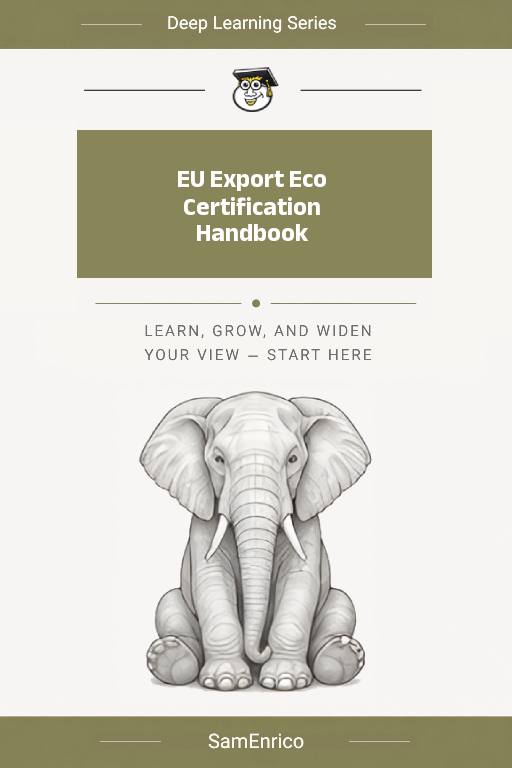
Non-FictionBusiness BriefEU Compliance
EU Export Eco Certification Handbook eBook
Meet European Union sustainability standards inclu
Meet European Union sustainability standards including EU Organic and Ecolabel for market entry.
Formats
Free sample
Chapter 1: The Green Wall–- Three years ago, Miguel Ortega stood in his olive grove in Seville, Spain, holding a bottle of his family's extra virgin olive oil. The label read "100% Natural – Eco-Friendly Production." He had used those words for twenty years. Forty-eight hours later, he received a notice from the Spanish consumer protection agency. The fine was €50,000. His buyer in Hamburg cancelled a container worth €120,000.
And the word "natural" was no longer allowed on his packaging.Miguel is not a criminal. He is not a polluter. He is a third-generation farmer who believed he was doing the right thing. But in 2026, the European Union drew a line in the sand. On one side: certified, verified, audited sustainability.
On the other side: fines, rejected containers, and locked markets.This book exists because Miguel didn't read it. You will not make his mistake.The Death of a Four-Letter Word For three decades, "green" was magic. Slap the word on a package, add a picture of a leaf, and consumers felt better about buying your product. Manufacturers called it "greenwashing" – and they got away with it because no one was checking.That era ended on January 1, 2026.The EU Green Claims Directive (Directive 2024/825/EU, fully enforced as of 2026) did what no regulation had done before: it made vague environmental claims illegal. Not restricted.
Not limited. Illegal. The text of the directive is unambiguous: "Any environmental claim that is not substantiated by recognized third-party verification or a comprehensive technical file shall be prohibited."Let me translate that from legal language into business reality. If you write "eco-friendly" on your packaging, you need a file on your desk proving exactly what "eco-friendly" means. If you write "natural," you need a lifecycle assessment showing that your product is, in fact, natural compared to what?
Natural compared to petrochemicals? Natural compared to the average product in your category? The directive requires you to answer those questions with data.Miguel learned this the hard way. His label said "natural." The Spanish authorities asked: natural by what standard? He had no answer.
The fine was €50,000.The Fine Print That Changes Everything The Green Claims Directive applies to every business selling into the EU. Not just EU companies. Not just large corporations. Every business. If your product is sold in Paris, Berlin, Milan, or Madrid, the directive applies to you.
And the enforcement mechanism is brutal: member states can impose fines of up to 4% of annual turnover for violations. For a small exporter, that is a business-ending event.But the directive is only the beginning. It sits on top of a growing stack of regulations that, taken together, form what I call the Green Wall.The Green Wall has three layers. The first layer is mandatory due diligence. These are laws that apply whether you want them to or not: the EU Deforestation Regulation (EUDR), which requires you to prove your products didn't come from deforested land; the Corporate Sustainability Due Diligence Directive (CSDDD), which requires you to audit your supply chain for human rights violations; and the Ecodesign for Sustainable Products Regulation (ESPR), which bans the destruction of unsold goods.The second layer is voluntary certification.
These are labels you choose to pursue: EU Organic, EU Ecolabel, Fairtrade, Bio Suisse. They are technically optional. But in practice, they are mandatory for market access. Retailers like Carrefour, Lidl, and Aldi now require certification as a condition of listing. Without it, you don't get a shelf.The third layer is consumer trust.
This is the invisible layer, but it is the most important. The European Commission's 2025 consumer survey found that 83% of EU consumers trust the EU Ecolabel. Only 14% trust generic claims like "green" or "eco-friendly." The gap is not small. It is a chasm. And it is growing every year.The Economics of Trust Let me give you a concrete example.
Two identical products sit on a shelf in a supermarket in Lyon, France. Product A has the EU Organic label. Product B says "all natural" in a green font. The consumer picks up both. They check the price.
Product A is €1.50 more expensive. Which one do they buy?According to a 2025 study by the European Consumer Organisation (BEUC), 67% of consumers choose Product A. They pay more for the certified product. They trust the label. They do not trust the vague claim.Now multiply that by a container ship.
If you are an exporter, every container carries tens of thousands of units. A 15% price premium on certified products translates into millions of euros in additional revenue. That is not a cost of compliance. That is an investment with a measurable return.But here is the catch. You cannot get the label without doing the work.
And the work is substantial. It requires documentation, audits, testing, and ongoing compliance. It requires you to know the difference between the EU Organic Regulation (2018/848) and the EU Ecolabel Regulation (EC 66/2010). It requires you to navigate the TRACES system, the ECAT platform, and the EUDR information system. It requires you to collect GPS coordinates for every plot of land in your supply chain.This book is your roadmap through that work.Voluntary vs.
Mandatory – The False Distinction You will hear people say that certifications like EU Organic and EU Ecolabel are "voluntary." That is true in the strict legal sense. No one will arrest you for not having an EU Ecolabel license. But in the commercial sense, voluntary certification is dead.Here is why. Major EU retailers – Carrefour (France), Lidl (Germany), Coop (Italy), Tesco (UK, though not EU, aligned) – have all announced that by 2027, they will only accept products with third-party verified sustainability claims. Their internal policies go further.
Carrefour's 2025 supplier manual states: "Any product bearing an environmental claim must be certified under a recognized EU or national ecolabel scheme."This means that if you want to sell to Carrefour – which operates 12,000 stores in 30 countries – you need a certification. It is not optional. It is a commercial requirement.Similarly, public tenders at the EU, national, and municipal levels now require EU Ecolabel certification for categories including textiles, cleaning products, office supplies, and furniture. If you want to sell to a government buyer – schools, hospitals, military, public transport – you need the label.So yes, the certification is "voluntary." But your access to the market is not.The Three Kinds of Exporter – Which One Are You?Every exporter falls into one of three categories. The first category is the Unaware.
This exporter has not heard of the Green Claims Directive. They are still using "eco-friendly" on their packaging. They will be fined. Their containers will be rejected. Their buyers will cancel.
They are the walking dead of international trade – they just don't know it yet.The second category is the Overwhelmed. This exporter knows the regulations exist but does not know where to start. They have heard of EU Organic and EU Ecolabel but cannot tell you the difference. They have a stack of unread PDFs from their trade association. They are frozen by complexity.
They will miss deadlines, submit incomplete applications, and fail audits. They will survive, but they will bleed money doing it.The third category is the Certified. This exporter has read this book. They understand…
This is the end of the free sample. Get the eBook to keep going. Buy now
About this book
Details
- Author
- Hawthorne Taunya
- Publisher
- SamEnrico
- Language
- English
- Genre
- Non-Fiction, Business Brief, EU Compliance
- Released
- 2026-06-01
- Pages (approx.)
- 136
- Available as
- eBook, Audiobook

Read better in the ZLOADR app
Your eBooks on your phone or tablet. Sign in with your SamEnrico account and start reading.
More by Hawthorne Taunya
 Influence Techniques for Product ManagersHawthorne Taunya$11.99
 Legal Marijuana Road RageHawthorne Taunya$11.99
 Comparison Trap PostpartumHawthorne Taunya$11.99
 Breast Health For Non Binary PeopleHawthorne Taunya$11.99
 People Pleasing Fawn ResponseHawthorne Taunya$11.99
 Tech Layoff RecoveryHawthorne Taunya$11.99
 Cloud Floating RelaxationHawthorne Taunya$11.99
 Group Creativity for Social WorkersHawthorne Taunya$11.99
 Bloodhounds of the Penitentiary: The K9 War Against 19th-Century Prison GangsHawthorne Taunya$11.99
 When the World Was a Dream: The Navajo EmergenceHawthorne Taunya$11.99
 How to Start a Agricultural Machinery and Equipment Rental With Operator Business (Beginners Guide)Hawthorne Taunya$11.99
 Dormice: Tiny RodentsHawthorne Taunya$11.99
You may also like
 Hong Kong Handover 1997Dunn Johnnie$11.99
 Zumba For Postnatal Recovery CourseNeal Christian$11.99
 Zumba for BeginnersLadner Nikia$11.99
 YouTube Comment Mining GuideHumes Pandora$12.99
 Worry Box MeditationCarlin Rudy$11.99
 Workplace Stress MeditationNguyen Lynn$11.99
 Workplace Stress and Sleep RepairHawley Ivory$11.99
 Workplace Perfectionism CureDelaney Jeffry$11.99
 Workplace Injustice Anger GuideWallen Isabelle$11.99
 Work Addiction and Burnout LinkGreenwood Ester$11.99
 Women in Yoga and WellnessBeattie Galina$11.99
 Women in Stand Up ComedyChun Evangeline$11.99