
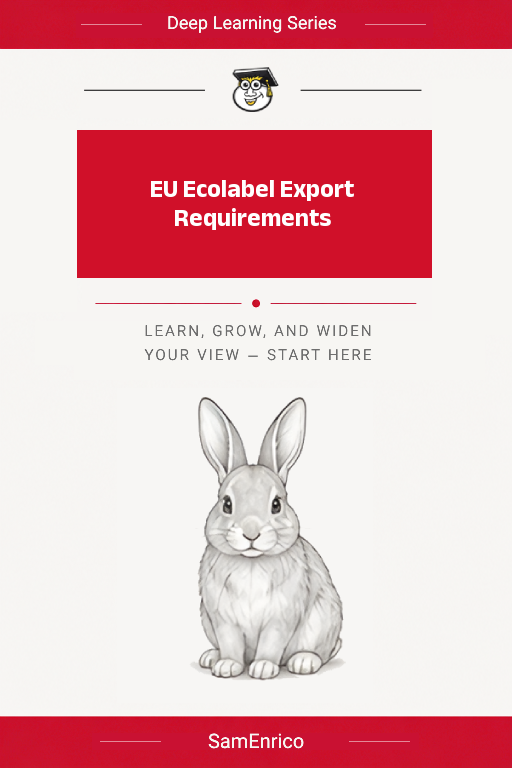
EU Ecolabel Export Requirements eBook
Certify products under EU Ecolabel for access to 2
Certify products under EU Ecolabel for access to 27 member states, meeting life-cycle criteria for cleaning, textiles, and electronics exporters.
Formats
Free sample
Chapter 1: The Golden Fleece--–- Every year, thousands of shipping containers leave factories in Vietnam, Turkey, China, and India carrying textiles, cleaning products, and electronics bound for Europe. Inside each container sits a product that someone spent months designing, sourcing, manufacturing, and packaging. The factory owner has paid for raw materials, labor, electricity, water, and freight. The logistics provider has booked space on a vessel, arranged customs clearance, and scheduled last-mile delivery. By the time that container reaches Rotterdam or Hamburg or Marseille, the exporter has invested tens of thousands of euros in getting it there.Then the buyer opens the container.
They inspect the goods. They test a sample. If everything meets specifications, they pay the invoice. The exporter makes perhaps a five to eight percent margin. The buyer sells the product to a hospital, a school district, or a government agency.
And somewhere in that sales process, an invisible transaction occurs. The buyer asks the seller: "Is this product certified under the EU Ecolabel?" If the answer is no, the buyer moves on to the next supplier. The exporter never even knows they lost the opportunity.This is the reality of European green public procurement in 2026. The EU Ecolabel is no longer a niche marketing tool for environmentally conscious consumers. It has become the default compliance pathway for selling into the estimated €220 billion per year market of government tenders across twenty-seven member states.
Hospital disinfectants, school uniforms, office computers, hotel detergents, and military-grade textiles increasingly require the little flower logo. Not as a preference. As a condition of entry.The tragedy is that most exporters discover this requirement only after they have lost their first tender. They spend months developing a product, shipping samples, negotiating prices, and building a relationship with a buyer only to hear: "We love your quality and your pricing, but our procurement rules require the EU Ecolabel. Can you get it?" The exporter scrambles.
They call consultants who quote fifteen thousand euros and six months. The buyer cannot wait. The contract goes to a competitor who already has the certification.This book exists to ensure that never happens to you. But before you can master the technical requirements of life-cycle assessment, chemical restrictions, and Competent Body applications, you need to understand something more fundamental. You need to understand why the EU Ecolabel exists, how it transformed from voluntary label to mandatory passport, and why the three sectors covered in this book—cleaning products, textiles, and electronics—represent both the greatest challenge and the greatest opportunity for exporters today.The Accidental Trade Barrier The European Union did not set out to create a trade barrier when it launched the Ecolabel in 1992.
The original regulation was modest in ambition and weak in enforcement. Any manufacturer could apply, any product that met basic environmental criteria could carry the flower, and any consumer who noticed the logo might feel slightly better about their purchase. Fewer than two hundred products carried the label after eight years of operation.The turning point came in 2008. The European Commission published its Sustainable Consumption and Production action plan, which quietly elevated the Ecolabel from a consumer information tool to a procurement instrument. The legal mechanism was simple but powerful: the Commission began developing Green Public Procurement criteria for product categories and explicitly named the EU Ecolabel as the primary way for suppliers to prove compliance.For example, a city government that wants to buy environmentally friendly cleaning products can now write its tender to require "EU Ecolabel certified or equivalent." In practice, "or equivalent" becomes nearly impossible for a supplier to prove, because equivalency requires demonstrating that a private label meets the same life-cycle criteria as the EU label.
The legal burden shifts to the supplier. Most cannot meet it. The buyer defaults to requiring the Flower.By 2015, ten product categories had binding GPP criteria referencing the EU Ecolabel. By 2020, twenty categories. As of 2026, the Commission has published criteria for twenty-eight product groups, and national governments have incorporated the Flower into their procurement laws.
France's Law on Energy Transition requires the EU Ecolabel for cleaning products purchased by state agencies. Germany's Blue Angel label is increasingly harmonized with the Flower. Italy's public health system mandates EU Ecolabel certified disinfectants.The result is an accidental trade barrier. Not accidental in the sense that the EU intended to exclude foreign suppliers, but accidental in the sense that the legal architecture evolved so quickly that most exporters never saw it coming. A textile factory in Bangladesh that has been selling to German buyers for twenty years suddenly finds that its best customer requires a certification it has never heard of.
A cleaning products manufacturer in Turkey that supplies French hotels learns that its contract will not be renewed without the flower logo. An electronics assembler in China that has shipped millions of units to Dutch retailers discovers that the new tender requires spare parts availability for ten years and software updates for seven.These exporters are not being punished. They are being outmaneuvered. Their competitors in Europe, who had a front-row seat to the regulatory evolution, started certifying five years ago. They locked up the public tenders.
They built the flower logo into their packaging. They trained their sales teams to lead with certification. By the time the Bangladeshi factory learns about the requirement, the European competitor has already won a three-year contract with the Berlin school district.This book cannot turn back time. But it can give you the tools to catch up and overtake. The remainder of this chapter will explain why the cleaning, textile, and electronics sectors are the most strategically important for exporters, and why the next eighteen months represent a narrow window of opportunity before the market becomes permanently divided between the certified and the excluded.The Three Battlegrounds The EU Ecolabel covers twenty-eight product groups, from lubricants to furniture to tourist accommodation services.
But three sectors dominate the volume of certification applications, the value of public procurement contracts, and the competitive advantage available to exporters.Cleaning Products Cleaning products were the first category to receive mandatory GPP criteria, and they remain the most heavily regulated. Laundry detergents, dishwashing liquids, all-purpose cleaners, hand soaps, industrial degreasers, and disinfectants all fall under the scope of the EU Ecolabel.The market pull is extraordinary. According to a 2024 survey of European procurement officials conducted by the European Environmental Bureau, seventy-eight percent of public tenders for cleaning supplies in France, Germany, and the Netherlands now require the EU Ecolabel as a condition of bidding. Not a preference. Not a point-scoring criterion.
A binary pass-fail requirement.For exporters, this creates a stark landscape. A Turkish manufacturer of industrial degreasers that supplies automotive plants in Germany cannot bid on new contracts without the Flower. A Vietnamese producer of laundry detergent that ships to French hypermarkets will find its shelf space shrinking as retailers consolidate around certified suppliers. A Chinese formulator of disinfectants that sells to Italian hospitals will be excluded from public tenders entirely.The technical requirements for cleaning products are demanding but not impossible. The most challenging criterion is the Critical Dilution Volume calculation, which measures how much water is required to dilute a product's ingredients to non-toxic…
This is the end of the free sample. Get the eBook to keep going. Buy now
About this book
Details
- Author
- Hitchcock Miquel
- Publisher
- SamEnrico
- Language
- English
- Genre
- Non-Fiction, Business Brief
- Released
- 2026-05-29
- Pages (approx.)
- 124
- Available as
- eBook, Audiobook

Read better in the ZLOADR app
Your eBooks on your phone or tablet. Sign in with your SamEnrico account and start reading.
More by Hitchcock Miquel
 Telecom Multiples Transaction GuideHitchcock Miquel$11.99
 Trench Poetry AnalysisHitchcock Miquel$11.99
 Physical Warmth PersuasionHitchcock Miquel$11.99
 Food Addiction Recovery for SeniorsHitchcock Miquel$11.99
 Cost Per Use CalculationHitchcock Miquel$11.99
 The Church Trafficking SurvivorHitchcock Miquel$11.99
 Dune Crossing EnduranceHitchcock Miquel$11.99
 Bipolar Master GuideHitchcock Miquel$11.99
 The Shot Heard 'Round the World: The Iconic Photo That Captured Rugby's Greatest MomentHitchcock Miquel$11.99
 The Camelot of Cairo: How a Bookstore United a Nation’s VoicesHitchcock Miquel$11.99
 A Collector's Handbook to the Ford SquireHitchcock Miquel$11.99
 How to Produce Test TubesHitchcock Miquel$11.99
You may also like
 Hong Kong Handover 1997Dunn Johnnie$11.99
 Zumba For Postnatal Recovery CourseNeal Christian$11.99
 Zumba for BeginnersLadner Nikia$11.99
 YouTube Comment Mining GuideHumes Pandora$12.99
 Worry Box MeditationCarlin Rudy$11.99
 Workplace Stress MeditationNguyen Lynn$11.99
 Workplace Stress and Sleep RepairHawley Ivory$11.99
 Workplace Perfectionism CureDelaney Jeffry$11.99
 Workplace Injustice Anger GuideWallen Isabelle$11.99
 Work Addiction and Burnout LinkGreenwood Ester$11.99
 Women in Yoga and WellnessBeattie Galina$11.99
 Women in Stand Up ComedyChun Evangeline$11.99