
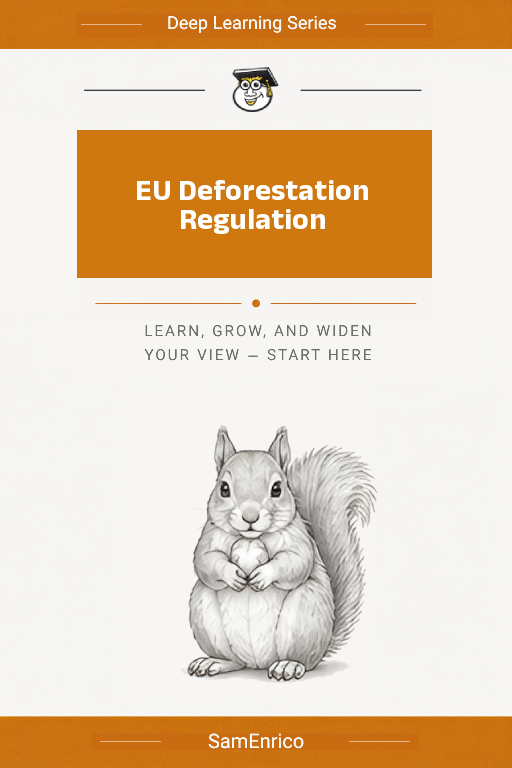
EU Deforestation Regulation eBook
Comply with EU Deforestation Regulation using cert
by Chung Jolie
Comply with EU Deforestation Regulation using certification for cattle, cocoa, coffee exports.
Formats
Free sample
Chapter 1: The Rotterdam Test...--The shipping container arrived at the Port of Rotterdam on a cold Tuesday morning in March. It was unremarkable—a standard forty-foot steel box, one of 15 million that pass through Europe's largest port each year. Inside were 60,000 bags of green coffee beans, harvested six months earlier from a cooperative of 1,200 smallholder farmers in the highlands of eastern Ethiopia. The beans had been cupped at 88 points, a specialty grade that would fetch a premium price from a German roaster. The paperwork was in order: bills of lading, phytosanitary certificates, commercial invoices.
The coffee had been in transit for five weeks.At 9:47 AM, the container was pulled for inspection. Not a random check—there were too many containers for random sampling. This was targeted, based on a risk algorithm that the European Union had quietly deployed three months earlier. The algorithm had flagged the shipment because the cooperative's GPS coordinates overlapped with a polygon of forest cover loss detected by the European Space Agency's Sentinel-2 satellites. Somewhere in the cooperative's supply area, a patch of canopy the size of two football fields had been cleared between 2018 and 2020.
The clearing was legal under Ethiopian law. The farmer who did it had a permit. The trees were not protected.None of that mattered under the EU Deforestation Regulation.By 2:15 PM, the container was sealed with a red customs tag. The coffee would not reach the German roaster. The cooperative would not be paid.
The buyer, a mid-sized Italian importer, faced a fine of 4 percent of its annual EU turnover—roughly €2.3 million. The cooperative's relationship with the buyer, painstakingly built over seven harvests, was over.This is not a hypothetical scenario. It is a preview of what will become routine starting in late 2025, when the EUDR's compliance deadlines begin to bite. And it is the reason you are reading this book.The Regulation That Changes Everything The EU Deforestation Regulation is not an environmental law. That is the first thing you must understand.
Yes, it is dressed in the language of sustainability—carbon emissions, biodiversity loss, climate neutrality. Yes, it was born from the European Green Deal, the EU's ambitious plan to become the first carbon-neutral continent by 2050. But at its core, the EUDR is a trade regulation, and a brutally effective one at that. It does not ask companies to reduce their environmental impact. It does not encourage sustainable practices through incentives or tax breaks.
It simply says this: if your product is grown on land that was forested after December 31, 2020, you cannot sell it in the European Union. Period.Not "you should not." Not "you will face a tariff." You cannot sell it. The product will be seized at the border, destroyed, and you will pay a fine. Your name will be published on a public register, and your other shipments will be inspected at a rate of 100 percent for the next 12 months. In practical terms, your business in Europe is finished.This is extraterritoriality in its most aggressive form.
A regulation drafted in Brussels—in a glass-and-steel building on the Rue de la Loi, where bureaucrats drink espresso and debate the finer points of customs classification—now dictates land-use decisions on a smallholder farm in the Ivory Coast, a cattle ranch in the Brazilian Amazon, and a coffee plot in the Vietnamese highlands. The EU has effectively outsourced its deforestation policy to its trading partners. If you want access to 450 million consumers and €15 trillion in annual GDP, you will keep your forests standing after 2020. The EU does not care how you do it. It only cares that you do it.From EUTR to EUDR: A Short History of Escalation To understand where we are, you need to understand where we came from.
The EU's first attempt at regulating commodity-driven deforestation was the EU Timber Regulation (EUTR), which took effect in 2013. The EUTR was modest. It banned illegally harvested timber from the EU market. That's it. If a tree was cut down legally under the laws of its country of origin—even if that country had weak environmental protections, even if the logging destroyed primary forest—the timber could be sold in Europe.
The EUTR was a paperwork exercise. Importers needed a due diligence statement, but the bar was low, enforcement was spotty, and the penalties were laughable. A few companies were fined. No one went bankrupt.The EUDR is the EUTR on steroids, amphetamines, and a controlled substance not yet named. Where the EUTR covered only timber, the EUDR covers seven commodities: cattle, cocoa, coffee, palm oil, soy, rubber, and wood.
Where the EUTR banned illegal deforestation, the EUDR bans all deforestation—legal or illegal—after December 31, 2020. The distinction is seismic. In many producer countries, deforestation is perfectly legal. Brazil's Forest Code allows landowners to clear up to 20 percent of their property in the Amazon biome. Indonesia permits clearing for oil palm plantations under its plantation licenses.
The EUDR sweeps aside these national laws and imposes a single standard: no deforestation, anywhere, after the cut-off date.The cut-off date itself is a masterstroke of regulatory design. December 31, 2020. Why that date? Because it is the end of the year before the regulation was proposed. It is not retroactive—you are not responsible for deforestation that happened in 2010, or even 2019.
But it is close enough to the present that most supply chains cannot simply ignore it. If your cattle ranch cleared forest in 2021 to expand pasture, that beef is banned. If your cocoa cooperative converted a patch of woodland to planting in 2022, those beans are blocked. The cut-off date creates a hard line in time. Before 2021, you get a pass.
After 2020, you are out.The Three Gates You Cannot Bypass The EUDR's compliance framework rests on three pillars, which the rest of this book will explore in agonizing detail. But you need the high-level picture first, so here it is.Gate One: Deforestation-Free. You must prove that none of your production plots—every single one—experienced deforestation or forest degradation after the cut-off date. Deforestation means the conversion of forest to agricultural use. If a farmer cut down trees to plant coffee, that is deforestation.
If a rancher cleared forest to create pasture for cattle, that is deforestation. If a cocoa farmer thinned the forest canopy to increase yield, that is forest degradation. Both are banned. You prove compliance using satellite imagery—Sentinel, Landsat, Planet, Global Forest Watch—and geolocation coordinates for every plot. No exceptions.Gate Two: Legal Production.
You must prove that your product was produced in accordance with all applicable laws of the country of origin. This goes far beyond environmental law. It includes land rights, labor laws, human rights, tax compliance, anti-corruption statutes, and even zoning regulations. If a cocoa farmer has a deforestation-free plot but does not have a formal land title, that is a problem. If a coffee cooperative pays its workers less than the minimum wage, that is a problem.
If a cattle ranch avoids taxes on its land transactions, that is a problem. The EUDR does not require perfection, but it does require documentation and a good-faith effort to comply.Gate Three: Traceable. You must know exactly where your product came from. Not…
This is the end of the free sample. Get the eBook to keep going. Buy now
About this book
Details
- Author
- Chung Jolie
- Publisher
- SamEnrico
- Language
- English
- Genre
- Non-Fiction, Business Brief, EUDR
- Released
- 2026-05-27
- Pages (approx.)
- 146
- Available as
- eBook, Audiobook

Read better in the ZLOADR app
Your eBooks on your phone or tablet. Sign in with your SamEnrico account and start reading.
More by Chung Jolie
 Genetic Test Privacy GuideChung Jolie$11.99
 Pitch Feedback Rejection Resilience CourseChung Jolie$11.99
 Paleo On A Carnivore SpectrumChung Jolie$11.99
 Group Therapy Self Worth CourseChung Jolie$11.99
 Parental Grief and Marriage StrainChung Jolie$11.99
 Echoes of the Cosmic Dawn: The Voyager Golden Record's Secret MessageChung Jolie$11.99
 Fenrir's Howl: The Wolf Who Shattered the Chains of FateChung Jolie$11.99
 Estée Lauder Cash Gift GuideChung Jolie$12.99
 Understanding GigantismChung Jolie$17.99
 Greenockite MiningChung Jolie$11.99
 How to Start a Broom Business (Beginners Guide)Chung Jolie$11.99
You may also like
 Hong Kong Handover 1997Dunn Johnnie$11.99
 Zumba For Postnatal Recovery CourseNeal Christian$11.99
 Zumba for BeginnersLadner Nikia$11.99
 YouTube Comment Mining GuideHumes Pandora$12.99
 Worry Box MeditationCarlin Rudy$11.99
 Workplace Stress MeditationNguyen Lynn$11.99
 Workplace Stress and Sleep RepairHawley Ivory$11.99
 Workplace Perfectionism CureDelaney Jeffry$11.99
 Workplace Injustice Anger GuideWallen Isabelle$11.99
 Work Addiction and Burnout LinkGreenwood Ester$11.99
 Women in Yoga and WellnessBeattie Galina$11.99
 Women in Stand Up ComedyChun Evangeline$11.99