
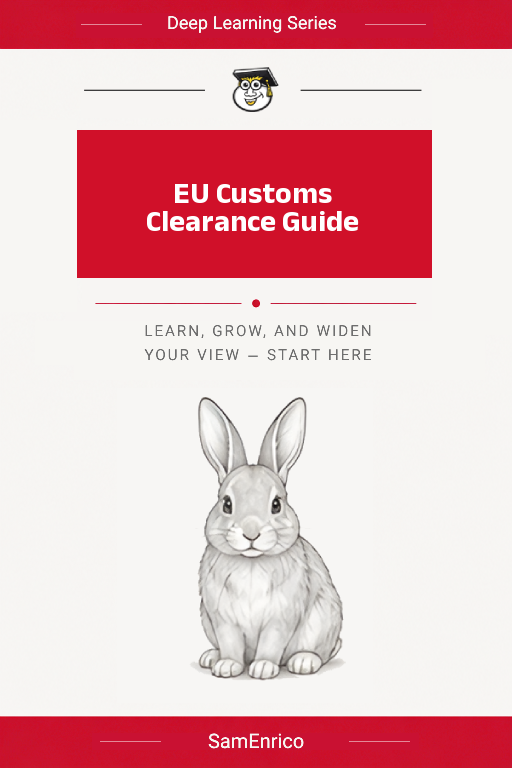
Non-FictionBusiness BriefAgricultural Trade
EU Customs Clearance Guide eBook
Clear shea butter and coffee through EU customs. D
Clear shea butter and coffee through EU customs. Documentation and inspection process.
Formats
Free sample
Chapter 1: The €47,000 Mistake--–- The humid Ghanaian morning of March 15, 2023, started like any other for Kwame Asare, a third-generation shea butter producer from Tamale. His container of 20 metric tons of crude shea butter had arrived at the Port of Rotterdam three days earlier. The buyer, a German cosmetics company, had already paid a 40% deposit. Kwame had done everything right—or so he believed. He had the commercial invoice.
He had the packing list. He had the certificate of origin. His freight forwarder, a small operation in Accra, assured him that "customs would be fine."Thirty-seven days later, Kwame's container was still sitting in a bonded warehouse. The German buyer had cancelled the order. The shea butter, exposed to temperature fluctuations during the prolonged delay, had begun to show signs of oxidation.
The total loss: €47,000. Plus storage fees. Plus legal costs. Plus the destroyed relationship with a buyer he had spent two years cultivating.What went wrong? Kwame had committed three errors that this book will teach you to avoid.
First, he had no EORI number of his own and relied entirely on his freight forwarder's fiscal representation, signing away his right to appeal customs decisions. Second, his certificate of origin Form A was missing a critical stamp from the Ghana Chamber of Commerce, making it invalid for GSP preference. Third, his commercial invoice declared the shea butter as "cosmetic grade refined" when in fact it was crude—a misclassification that triggered an entirely different set of inspection requirements and duty rates. By the time customs completed their physical inspection (a process extended by the misdeclaration), the damage was done.Kwame's story is not an exception. It is the rule.
Every year, thousands of containers of shea butter and coffee from Africa, Latin America, and Southeast Asia are delayed, rejected, or destroyed at EU borders because importers and exporters fail to understand a system that is simultaneously logical and unforgiving. The European Union operates the world's most sophisticated customs regime—the Union Customs Code (UCC)—a sprawling legal framework that governs everything from the moment a container is loaded at a foreign port to the moment it is released for free circulation in Hamburg, Rotterdam, or Antwerp.This book exists because most of the available information about EU customs is written for lawyers, large corporations, or customs brokers. It is dense. It is dry. And it assumes a level of prior knowledge that small and medium-sized shea butter cooperatives and coffee farmers simply do not have.
This chapter will give you what Kwame did not have: a clear, practical, and actionable introduction to the EU customs territory, the legal framework that governs it, and the single most important administrative number you will ever need—your EORI.Whether you are a shea butter exporter in Burkina Faso, a coffee cooperative in Uganda, a small-batch roaster in Berlin importing directly from Vietnam, or a logistics manager at a European beauty brand sourcing from Nigeria, the fundamentals in this chapter will determine whether your next shipment clears customs in three days or three months. Let us begin with a map.The EU Customs Territory: More Than Just 27 Countries When most people think of the European Union, they think of 27 member states with a common flag, a common currency (for 20 of them), and open borders under the Schengen Agreement. For customs purposes, however, the EU customs territory is both larger and smaller than the political map suggests. Understanding its boundaries is the first step to avoiding surprises.The EU customs territory includes all 27 member states: Austria, Belgium, Bulgaria, Croatia, Cyprus, Czech Republic, Denmark, Estonia, Finland, France, Germany, Greece, Hungary, Ireland, Italy, Latvia, Lithuania, Luxembourg, Malta, Netherlands, Poland, Portugal, Romania, Slovakia, Slovenia, Spain, and Sweden. Goods that enter any of these countries and are released for free circulation can move to any other member state without further customs formalities.
This is the fundamental promise of the customs union: a single border, a single set of rules, a single tariff.However, there are exceptions that regularly trip up shea butter and coffee importers. Several territories are part of the EU for political purposes but outside the customs territory. These include the Canary Islands (Spain), French overseas departments (French Guiana, Guadeloupe, Martinique, Mayotte, Réunion), the Åland Islands (Finland), and the Channel Islands (Jersey, Guernsey—which are not even EU members but have special protocols). If your container of green coffee is destined for a roaster in Las Palmas (Canary Islands), you cannot clear customs in mainland Spain and then ship it duty-free. You must clear customs specifically for the Canary Islands, which may have different duty rates, VAT rules, and inspection regimes.
Similarly, if your shea butter is destined for French Guiana, it enters a separate customs territory with its own border controls.Conversely, several territories are not EU members but are inside the customs territory for certain goods. These include Turkey (for industrial goods under the EU-Turkey Customs Union), Andorra, and San Marino. For shea butter and coffee, however, these are edge cases. The practical rule is simple: unless you know otherwise, assume that customs clearance must occur at the first point of entry into the 27 member states, and that goods can then move freely among those 27 without additional duties.The Union Customs Code (UCC): The Rulebook You Cannot Ignore Before 2016, EU customs law was a patchwork of national regulations, directives, and implementing acts that varied subtly from one member state to another. A customs broker in Rotterdam might interpret a rule differently from a broker in Hamburg.
An importer in France might file different paperwork than the same importer in Italy. This fragmentation created opportunities for arbitrage but also massive uncertainty.The Union Customs Code (UCC) , which came into full effect on May 1, 2016, changed everything. The UCC (Regulation (EU) No 952/2013) is the single, binding, directly applicable customs law for all 27 member states. It establishes uniform definitions, procedures, and obligations. When you read this book, every reference to customs law—every deadline, every form, every penalty—derives from the UCC.The UCC is built on several core principles that you must understand as a shea butter or coffee importer:Principle 1: Electronic Declarations Only.
With very narrow exceptions (postal shipments, certain low-value goods), all customs declarations must be filed electronically. The paper SAD (Single Administrative Document) still exists as a legal concept, but in practice you will file via national electronic systems like Germany's ATLAS, France's DELTA, or the Netherlands' AGS. Your customs broker will handle this, but you must provide the data.Principle 2: Self-Assessment with Risk-Based Controls. The UCC assumes that importers are honest and competent. You declare the value, origin, HS code, and procedure.
Customs then runs your declaration through the Import Control System (ICS2, covered in Chapter 8) to assign a risk score. Most declarations (over 80%) receive a low risk score and are released with minimal checks. However, if your declaration is incomplete, inconsistent, or flagged by prior RASFF notifications, you will face documentary, identity, or physical checks.Principle 3: Authorised Economic Operator (AEO). The UCC created a voluntary certification program for trusted traders. AEO status (AEO-C for customs simplification, AEO-S for security and safety, or AEO-F for full) gives you faster clearance, fewer…
This is the end of the free sample. Get the eBook to keep going. Buy now
About this book
Details
- Author
- Medeiros Quinn
- Publisher
- SamEnrico
- Language
- English
- Genre
- Non-Fiction, Business Brief, Agricultural Trade
- Released
- 2026-05-29
- Pages (approx.)
- 160
- Available as
- eBook, Audiobook

Read better in the ZLOADR app
Your eBooks on your phone or tablet. Sign in with your SamEnrico account and start reading.
More by Medeiros Quinn
 Pattern Recognition for TherapistsMedeiros Quinn$11.99
 Solomon Islands TimberMedeiros Quinn$11.99
 Seronegative Arthritis GuideMedeiros Quinn$11.99
 The US Phone Number for BanksMedeiros Quinn$11.99
 Burnout Prevention Energy AuditMedeiros Quinn$11.99
 Love in the Crossfire: The Cuban Campaign of the Spanish-American WarMedeiros Quinn$11.99
 Understanding Sezary SyndromeMedeiros Quinn$17.99
 Private Scholarships for JapanMedeiros Quinn$12.99
 How to Become a Dye-house SupervisorMedeiros Quinn$11.99
 Salt TaxMedeiros Quinn$11.99
You may also like
 Hong Kong Handover 1997Dunn Johnnie$11.99
 Zumba For Postnatal Recovery CourseNeal Christian$11.99
 Zumba for BeginnersLadner Nikia$11.99
 YouTube Comment Mining GuideHumes Pandora$12.99
 Worry Box MeditationCarlin Rudy$11.99
 Workplace Stress MeditationNguyen Lynn$11.99
 Workplace Stress and Sleep RepairHawley Ivory$11.99
 Workplace Perfectionism CureDelaney Jeffry$11.99
 Workplace Injustice Anger GuideWallen Isabelle$11.99
 Work Addiction and Burnout LinkGreenwood Ester$11.99
 Women in Yoga and WellnessBeattie Galina$11.99
 Women in Stand Up ComedyChun Evangeline$11.99