
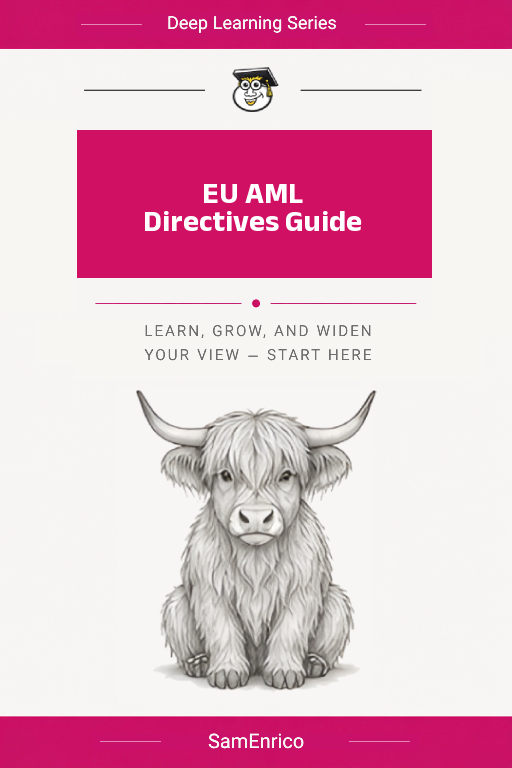
Non-FictionAnnual CheckupEuropean UnionAML
EU AML Directives Guide eBook
Track European Union anti money laundering directi
Track European Union anti money laundering directives including beneficial ownership register requirements.
Formats
Free sample
Chapter 1: The €10 Million Question...--–- The money arrived on a Tuesday. Not in suitcases or crypto wallets, but through a series of impeccably legal-looking wire transfers. A shell company in Cyprus sent €2.5 million to a trading firm in Latvia. The Latvian firm, which existed only on paper, forwarded €2.3 million to a real estate developer in Berlin. The developer bought a luxury apartment building near Alexanderplatz.
The building’s rental income flowed back to the Cypriot shell company as “investment returns.” The original source of the money? A government contract fraud in a non-EU country. The ultimate beneficiary? A politically exposed person whose name appeared on no document, no bank account, and no register.–- This is not a hypothetical scenario. It is a composite of dozens of real investigations conducted by European prosecutors, journalists, and financial intelligence units between 2015 and 2024.
The total value of suspicious transactions flowing through the EU’s financial system in a single year exceeds €200 billion by conservative estimates. The actual figure is almost certainly higher because undetected money laundering, by definition, does not appear in statistics.–- This chapter opens with a deceptively simple question: Why does the European Union care where a criminal hides €10 million? The short answer is that money laundering is not a victimless “paper crime.” It is the financial engine that powers drug trafficking, human smuggling, political corruption, and terrorist financing. Every euro laundered through the legitimate financial system subsidizes another crime somewhere else. The longer answer, which this chapter will explore in depth, is that the EU’s entire anti-money laundering framework—from the First Directive in 1991 to the newly adopted AML Regulation of 2024—exists because answering the €10 million question turned out to be much harder than anyone expected.The Crime That Pays for All Other Crimes–- Money laundering is often misunderstood as a sophisticated financial crime reserved for cartel leaders and offshore bankers.
In reality, it is a universal enabling mechanism. Drug traffickers cannot use cash to buy real estate. Corrupt officials cannot deposit bribes directly into their personal accounts. Fraudsters cannot explain sudden wealth without a plausible story. Money laundering provides the bridge between criminal profit and legitimate appearance.–- The United Nations Office on Drugs and Crime estimates that between 2 and 5 percent of global GDP is laundered annually.
For the European Union, which represents approximately 15 percent of world GDP, this translates to between €300 billion and €750 billion in laundered funds each year. To put that figure in perspective, the entire EU budget for the 2021-2027 period is €1.2 trillion. Every seven years, criminals launder the equivalent of the EU’s entire seven-year budget.–- But statistics obscure the human reality. Every heroin shipment sold on the streets of Hamburg was purchased with laundered money from a previous shipment. Every migrant smuggled across the Mediterranean in an overcrowded boat paid a fee that was funneled through a shell company.
Every bribe that secures a public procurement contract is hidden behind a nominee shareholder. The fight against money laundering is not about protecting banks from paperwork. It is about dismantling the economic infrastructure that makes organized crime profitable.The Three Stages of the Laundering Process–- To understand why the EU’s directives evolved as they did, one must first understand how money moves from dirty to clean. Financial intelligence professionals describe three classic stages: placement, layering, and integration. These stages are not always sequential in practice, and sophisticated launderers may repeat or combine them, but the framework remains the essential analytical tool.Placement: Entering the System–- Placement is the moment when illicit cash first enters the legitimate financial system.
This is theoretically the most vulnerable stage for the launderer because cash is physical, traceable, and subject to reporting requirements. A person depositing €50,000 in a bank account triggers a currency transaction report. A business accepting unusually large cash payments risks an audit. Placement is therefore the stage where anti-money laundering controls have the greatest potential impact.–- In practice, launderers have developed dozens of placement techniques to evade detection. Structuring, also known as smurfing, involves breaking a large cash deposit into many smaller deposits below reporting thresholds.
Trade-based laundering overstates the value of imported goods to move value across borders. Crypto-asset purchases convert cash into pseudonymous digital tokens that can be transferred anywhere in the world. Casinos, which historically accepted large cash buy-ins without rigorous source-of-funds checks, became a favored placement mechanism until 2AMLD expanded coverage.–- The Danske Bank Estonia scandal, which this chapter will return to several times, illustrated placement on an industrial scale. Between 2007 and 2015, the bank’s Estonian branch processed €200 billion in transactions from non-resident portfolios, the vast majority of which should never have been accepted. Investigators later determined that cash from Russia, Azerbaijan, and Moldova was placed into the Estonian banking system through shell companies with no genuine economic activity.
The placement stage succeeded because the bank’s controls were essentially nonexistent.Layering: Obscuring the Trail–- Once cash has entered the system, layering begins. This stage involves moving funds through a complex series of transactions to obscure their origin. The launderer’s goal is to create a web of transfers, accounts, and entities so tangled that no investigator can trace the original source.–- Common layering techniques include wire transfers through multiple jurisdictions, rapid movement between accounts, conversion into different currencies, and the use of professional intermediaries such as lawyers and trust service providers. A single €1 million layering operation might pass through ten accounts in seven countries over the course of an hour, with each transaction adding a layer of apparent legitimacy.–- The rise of online banking and cross-border payment systems has made layering dramatically easier. A launderer in Moscow can open an account in Cyprus online, transfer funds to a Latvian fintech via a UK payment processor, and convert to cryptocurrency through an Estonian exchange—all before lunch.
Each jurisdiction has different reporting requirements, different supervisory authorities, and different levels of enforcement. The layering stage exploits these differences ruthlessly.–- This is why the EU’s directives progressively expanded the circle of Obliged Entities. Lawyers, accountants, trust service providers, and crypto-exchanges all became subject to anti-money laundering duties because launderers were using them as layering tools. A law firm that forms a shell company in Luxembourg, a notary who certifies a property transfer in Spain, a crypto exchange that converts bitcoin to ether in Lithuania—each is a potential layering node. The directives grew to cover them because launderers forced the issue.Integration: The Clean Exit–- Integration is the final stage, when laundered funds re-enter the economy as apparently legitimate wealth.
The launderer can now buy real estate, invest in businesses, purchase luxury goods, or simply hold the money in an account without fear of seizure. Integration is the stage where criminal profit becomes indistinguishable from legitimate capital.–- Real estate is the most common integration vehicle in Europe. A shell company buys an apartment building, a villa, or a commercial property. The property generates rental income, which is declared as legitimate business revenue. The property appreciates over time, creating capital gains that are taxed at preferential rates.
The launderer can borrow against the property’s value, converting dirty money into clean credit. The physical asset provides a plausible…
This is the end of the free sample. Get the eBook to keep going. Buy now
About this book
Details
- Author
- Plante Darline
- Publisher
- SamEnrico
- Language
- English
- Genre
- Non-Fiction, Annual Checkup, European Union, AML
- Released
- 2026-06-01
- Pages (approx.)
- 158
- Available as
- eBook, Audiobook

Read better in the ZLOADR app
Your eBooks on your phone or tablet. Sign in with your SamEnrico account and start reading.
More by Plante Darline
 Title Insurance Agency DirectoryPlante Darline$11.99
 Metta for Suicide Loss GuidePlante Darline$11.99
 The Belonging Brain GuidePlante Darline$11.99
 Beginner Fitness Class GuidePlante Darline$11.99
 Housing Wealth Withdrawal PlanPlante Darline$11.99
 The Frozen Enigma: The Lost Franklin Expedition's Final BroadcastsPlante Darline$11.99
 Love, Lies, and the Crown: The Secret Marriage of Princess Margaret and Peter TownsendPlante Darline$11.99
 Temporary Store ManagerPlante Darline$11.99
 Understanding Desmoid TumorPlante Darline$17.99
 HR Certification Institute GuidePlante Darline$12.99
 A Beginners Guide to Backstroke (Volume 1)Plante Darline$11.99
You may also like
 Hong Kong Handover 1997Dunn Johnnie$11.99
 Zumba For Postnatal Recovery CourseNeal Christian$11.99
 Zumba for BeginnersLadner Nikia$11.99
 YouTube Comment Mining GuideHumes Pandora$12.99
 Worry Box MeditationCarlin Rudy$11.99
 Workplace Stress MeditationNguyen Lynn$11.99
 Workplace Stress and Sleep RepairHawley Ivory$11.99
 Workplace Perfectionism CureDelaney Jeffry$11.99
 Workplace Injustice Anger GuideWallen Isabelle$11.99
 Work Addiction and Burnout LinkGreenwood Ester$11.99
 Women in Yoga and WellnessBeattie Galina$11.99
 Women in Stand Up ComedyChun Evangeline$11.99