
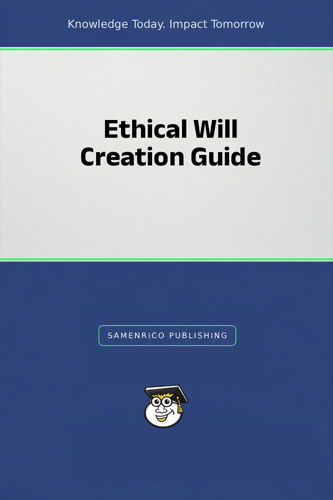
Non-FictionSelf-HelpSpiritual Legacy
Ethical Will Creation Guide eBook
Passes down spiritual and moral inheritance.
Passes down spiritual and moral inheritance.
Formats
Free sample
Chapter 1: The Inheritance You Didn’t Know You Had...--You have likely spent years thinking about your legacy in terms of what you own. The house. The savings account. The life insurance policy. The antique dining table passed down from your grandmother.
The watch your father wore every day. These are the tangible markers of a life lived, the objects that will outlive you and find new homes in the hands of those you love. You have probably updated your legal will, or at least told yourself you should. You have named beneficiaries, designated executors, and wrestled with the awkward question of who gets the good china. All of this matters.
All of this is responsible, loving, and practical.But here is a question you may not have considered as deeply: What about everything else? What about the beliefs that carried you through your darkest nights? What about the lessons you learned from failure that no resume could ever capture? What about the forgiveness you finally extended after twenty years of silence? What about the specific, hard-won wisdom about what makes a life worth living—not just a comfortable one, but a meaningful one?
What about the stories your grandchildren have never heard, the ones that explain not just where you came from but who you actually are?This chapter is about that invisible inheritance. The one you cannot put in a safety deposit box. The one no court will enforce. The one that has no cash value and yet, in the hearts of those who receive it, may be worth more than every asset you own combined. This chapter introduces the ethical will, also known as a legacy letter or spiritual will.
By the time you finish these pages, you will understand not only what an ethical will is, but why the very act of writing one may change you as much as it changes those who read it.The Missing Half of Your Legacy Let us start with a simple distinction that will serve as the foundation for everything that follows. A legal will distributes what you own. An ethical will distributes who you are. That single sentence is the entire premise of this book, and it is worth sitting with for a moment.A legal will is a document of property. It lists assets, names beneficiaries, designates guardians for minor children, and specifies who gets the car, the house, the bank accounts, and the collection of vintage vinyl records.
It is enforceable by law. If you leave your daughter the house and your son the car, the court will make sure your wishes are honored. This is essential work. No responsible adult should die without a legal will. It is an act of love to spare your family the confusion, conflict, and expense of intestacy laws.But a legal will cannot tell your daughter why you always believed in her, even when she doubted herself.
It cannot explain to your son that the reason you worked so many weekends was not because you loved the office more than him, but because you were terrified of repeating your own father's financial failures. It cannot apologize for the harsh words spoken in anger fifteen years ago. It cannot express the hope that your grandchildren will grow up knowing the value of kindness over achievement. It cannot describe the moment you finally understood what really matters.That is the work of the ethical will. And here is the liberating truth: an ethical will has no legal standing whatsoever.
That is not a weakness. It is the source of its power. Because it operates entirely in the realm of relationship, not obligation. No one is forced to read it. No one is bound by it.
It is a gift, freely offered, freely received or freely set aside. That very freedom is what makes it capable of carrying love in a way no legally binding document ever could.What Exactly Is an Ethical Will?The term "ethical will" comes from the Latin ethica and the Hebrew Zava'ah, both pointing toward the same idea: a testament of values rather than valuables. Throughout history, it has been called many names—a legacy letter, a spiritual will, a moral testament, a life legacy letter, an ethical testament. The names vary, but the core remains consistent across cultures and centuries.An ethical will is a written document, video recording, audio recording, or other medium in which you articulate the values, life lessons, hopes, blessings, and spiritual inheritance you wish to pass down to your loved ones. It is not a diary or a memoir, though it may contain autobiographical elements.
It is not a religious tract, though it may express your faith. It is not a collection of advice, though it will certainly include guidance. Rather, it is a holistic expression of what you have learned about living—and what you hope your loved ones will carry forward.Consider what an ethical will typically includes. Most ethical wills contain some combination of the following elements: a statement of your core values and why they matter to you; specific memories that shaped your character; lessons learned from failures, not just successes; hopes for the future of your loved ones; apologies and expressions of forgiveness; blessings and expressions of love; and sometimes, explanations of decisions made in your legal will to prevent misunderstanding or resentment.Notice what is not included. An ethical will is not a place to settle scores, deliver final judgments, or manipulate loved ones into behaving the way you wish they would.
It is not a weapon. It is not a last word in an argument. It is not a tool for guilt. When written well, an ethical will leaves the reader feeling seen, loved, and free—free to accept your wisdom, free to adapt it, free to reject it entirely. That freedom is essential.Who Is an Ethical Will For?The audience for an ethical will is broader than you might initially imagine.
Most people assume an ethical will is for children and grandchildren. And yes, those are the most common recipients. But the ethical will tradition has expanded significantly, and your audience might include any or all of the following.Your children, of course, regardless of their age. Adult children often receive ethical wills with profound gratitude, finally understanding aspects of their parent's life that were always mysterious. Your grandchildren, including those not yet born.
Many ethical wills address future generations directly, offering wisdom to people the writer will never meet. Your spouse or life partner. Some ethical wills are written not to the next generation but to the person with whom you shared your life, expressing love and gratitude that daily routine may have obscured.Your close friends who became family. For those without biological children or for whom chosen family is central, ethical wills can be addressed to the friends who showed up during cancer treatments, who helped you move seven times, who held your hand during loss. Your mentees, students, or younger colleagues.
If you have guided others professionally or personally, an ethical will can extend that guidance beyond your lifetime. Your community or religious congregation. Some ethical wills are…
This is the end of the free sample. Get the eBook to keep going. Buy now
About this book
Details
- Author
- Forsyth Erwin
- Publisher
- SamEnrico
- Language
- English
- Genre
- Non-Fiction, Self-Help, Spiritual Legacy
- Released
- 2026-06-05
- Pages (approx.)
- 140
- Available as
- eBook, Audiobook

Read better in the ZLOADR app
Your eBooks on your phone or tablet. Sign in with your SamEnrico account and start reading.
More by Forsyth Erwin
 Real Estate Negotiation GuideForsyth Erwin$11.99
 Detox Packing ListForsyth Erwin$11.99
 Gambling Addiction Aftercare PlanningForsyth Erwin$11.99
 Trello Labels and Filters SystemForsyth Erwin$11.99
 HIIT for Depression GuideForsyth Erwin$11.99
 Child Death AnniversaryForsyth Erwin$11.99
 Moving Out After DivorceForsyth Erwin$11.99
 Inanna's Descent: The Goddess Who Walked Through HellForsyth Erwin$11.99
 The Iron Spires of Chartres: Gothic Architects and the Divine GeometryForsyth Erwin$11.99
 How to Produce Motor Vehicle Exhaust SystemsForsyth Erwin$11.99
 How to Become a Protective-signal InstallerForsyth Erwin$11.99
 A Collector's Handbook to the Renault PrimaquatreForsyth Erwin$11.99
You may also like
 Hong Kong Handover 1997Dunn Johnnie$11.99
 Zumba For Postnatal Recovery CourseNeal Christian$11.99
 Zumba for BeginnersLadner Nikia$11.99
 YouTube Comment Mining GuideHumes Pandora$12.99
 Worry Box MeditationCarlin Rudy$11.99
 Workplace Stress MeditationNguyen Lynn$11.99
 Workplace Stress and Sleep RepairHawley Ivory$11.99
 Workplace Perfectionism CureDelaney Jeffry$11.99
 Workplace Injustice Anger GuideWallen Isabelle$11.99
 Work Addiction and Burnout LinkGreenwood Ester$11.99
 Women in Yoga and WellnessBeattie Galina$11.99
 Women in Stand Up ComedyChun Evangeline$11.99