
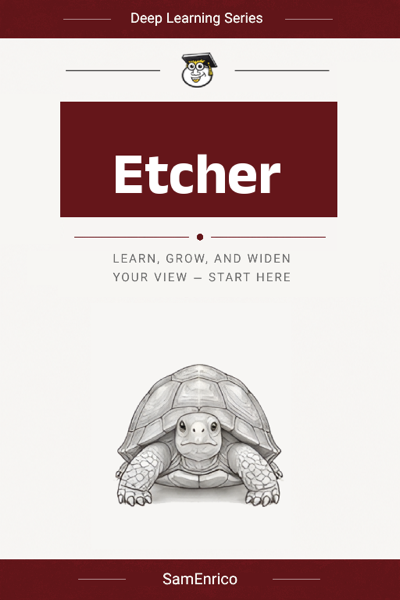
Non-FictionInformativeEducational
Etcher eBook
A Coursebook on Etcher
A Coursebook on Etcher
Formats
Free sample
Chapter 1: The Blank Plate...--The plate lies before you—a rectangle of copper or zinc, smooth as still water, cool to the touch, and utterly blank. In that blankness, there is both terror and possibility. Every printmaker remembers the moment of making the first mark: the slight hesitation, the careful breath, the scratch of the needle through the ground, and the strange thrill of seeing bright metal exposed where moments before there was only darkness. This chapter is about that first mark—and every mark that follows. It is about the materials you will need to make those marks, the space in which you will make them, and the mindset that will carry you from blank plate to finished print.Before we dive into tools and techniques, let me tell you something that no other etching book will say with such bluntness: you do not need a fully equipped studio to begin.
You do not need a thousand-dollar press, a room full of chemicals, or a decade of experience. What you need is a flat surface, a few basic tools, a small plate, and the willingness to fail—because you will fail, and that failure will teach you more than any success. The best printmakers are not the ones who never make mistakes; they are the ones who learn to love the accident, the unexpected bite, the happy serendipity that could never have been planned. Etching is a conversation with chance, and chance is an excellent teacher.This book will guide you through every stage of that conversation, from the selection of your first plate to the signing of your hundredth print. But this first chapter is about foundations.
It is about choosing materials that will serve you well without bankrupting you. It is about setting up a workspace that is safe, functional, and inspiring. And it is about understanding, at a visceral level, what happens when a sharp point meets a metal surface—because that understanding is the beginning of mastery.Choosing Your First Plate: The Great Metal Debate The most important decision you will make as a beginning etcher is also the simplest: what metal will you cut your teeth on? Two metals dominate the world of intaglio printmaking, and they could not be more different in character, cost, and handling. Copper is the aristocrat of the etching world—dense, durable, responsive to the finest needle work, and capable of yielding hundreds of crisp, perfect impressions.
Zinc is the scrappy newcomer—cheaper, faster to bite, more forgiving of beginner mistakes, but softer, less durable, and ultimately limited in its potential for fine detail.Let me be precise about these differences because they will shape everything you do.Copper (typically 16 to 20 gauge, or about 1.2 to 1.6 millimeters thick) has been the preferred plate material for etchers since the sixteenth century, and for good reason. Its crystalline structure is dense and uniform, which means that when you draw through the ground with an etching needle, the exposed line is clean, sharp, and consistent. When you submerge a copper plate in ferric chloride, the acid bites evenly and predictably, producing lines that hold their width and depth without undercutting or spreading. A well-executed copper plate can be steel-faced and printed in editions of five hundred or more without noticeable loss of quality. The downside is cost: at current market prices, copper costs three to four times as much as zinc for the same size plate.
Copper is also heavier and more resistant to manual manipulation, which means that correcting mistakes (a process we will cover in Chapter 5) requires more effort and more specialized tools.Zinc (typically 18 to 20 gauge, or about 1.0 to 1.6 millimeters thick) is the metal I recommend for your first plates, and I will tell you exactly why. Zinc bites two to three times faster than copper, which means you can go from drawing to printing in an afternoon rather than a week. This speed is not just a convenience; it is an educational accelerator. When you are learning, you want rapid feedback. You want to see the relationship between bite time and line depth within minutes, not hours.
Zinc is also significantly cheaper, which matters because your first plates will almost certainly be ugly. They will have mistakes, unwanted marks, over-bitten lines, and pitted surfaces. That is fine. That is learning. And it is much easier to learn on a plate that cost you eight dollars than on one that cost you thirty.But zinc comes with trade-offs that you must understand from the beginning.
Zinc is softer than copper, which means it scratches more easily during plate preparation and printing. Those accidental scratches will print as unwanted marks—a fact that will either frustrate you or, if you have the right temperament, become a signature element of your style. Zinc also produces softer, less crisp lines than copper. Where a copper line has sharp, clean edges, a zinc line has a slightly fuzzy, granular quality. Some artists love this character; others find it unacceptable.
Zinc plates also wear down more quickly under the pressure of the press. An unsteel-faced zinc plate may only yield fifty to one hundred good impressions before the lines begin to flatten and lose their ink-holding capacity.Throughout this book, you will see a small icon in the margins: a triangle containing the letters "Zn." This is the Zinc Alert. Whenever you see this icon, the surrounding text contains information that applies specifically to zinc plates—usually a warning about faster biting times, different ground adhesion properties, or alternative handling techniques. Pay attention to these alerts. They are the difference between success and failure on zinc.For your first plate, I recommend starting with zinc.
Buy a small plate—four inches by six inches, or six inches by eight inches. Small plates are easier to handle, require less acid, fit in smaller trays, and produce prints that fit in standard frames. More importantly, small plates force you to focus. You cannot hide a bad composition in a small plate. You cannot wander aimlessly with your needle.
Every mark must earn its place. That discipline will serve you well when you eventually move to larger plates.The Etching Needle: Extending Your Hand If the plate is your canvas, the etching needle is your brush. Choose it carefully because you will spend hundreds of hours holding it. The relationship between your hand and the needle is intimate, almost physiological. A good needle feels like an extension of your fingers; a bad needle feels like a foreign object, a barrier between intention and execution.The simplest and most traditional etching needle is nothing more than a steel point set into a wooden or brass handle—essentially a very sharp, very stiff pencil.
Steel needles are inexpensive (often under ten dollars), hold a fine point, and can be resharpened on a fine whetstone or diamond file. Their only significant drawback is that steel dulls relatively quickly, especially on copper plates, requiring frequent resharpening. For a beginner working on zinc, a steel needle is perfectly adequate for your first dozen plates. The act of resharpening, far from being a chore, will teach you about the nature of the tool. You…
This is the end of the free sample. Get the eBook to keep going. Buy now
About this book
Details
- Author
- Pritchett Almeta
- Publisher
- SamEnrico
- Language
- English
- Genre
- Non-Fiction, Informative, Educational
- Released
- 2026-05-11
- Pages (approx.)
- 140
- Available as
- eBook, Audiobook

Read better in the ZLOADR app
Your eBooks on your phone or tablet. Sign in with your SamEnrico account and start reading.
More by Pritchett Almeta
 Parental Anger After Work HoursPritchett Almeta$11.99
 Remote Communication For ADHDPritchett Almeta$11.99
 Weekly Calorie Budget PlanPritchett Almeta$11.99
 Rewiring Reward PathwaysPritchett Almeta$11.99
 Presidential Health and MedicinePritchett Almeta$11.99
 The Codebreakers Who Outsmarted the MachinesPritchett Almeta$11.99
 Frozen Secrets: The Medieval Quest for Antarctica’s Hidden RiversPritchett Almeta$11.99
 Ultimate Handbook Guide to Sri Jayawardenepura Kotte : (Sri Lanka) Travel GuidePritchett Almeta$11.99
 Schedule B Donor DisclosurePritchett Almeta$12.99
 Mighty Networks Pricing GuidePritchett Almeta$12.99
 Understanding David SyndromePritchett Almeta$17.99
You may also like
 Hong Kong Handover 1997Dunn Johnnie$11.99
 Zumba For Postnatal Recovery CourseNeal Christian$11.99
 Zumba for BeginnersLadner Nikia$11.99
 YouTube Comment Mining GuideHumes Pandora$12.99
 Worry Box MeditationCarlin Rudy$11.99
 Workplace Stress MeditationNguyen Lynn$11.99
 Workplace Stress and Sleep RepairHawley Ivory$11.99
 Workplace Perfectionism CureDelaney Jeffry$11.99
 Workplace Injustice Anger GuideWallen Isabelle$11.99
 Work Addiction and Burnout LinkGreenwood Ester$11.99
 Women in Yoga and WellnessBeattie Galina$11.99
 Women in Stand Up ComedyChun Evangeline$11.99