
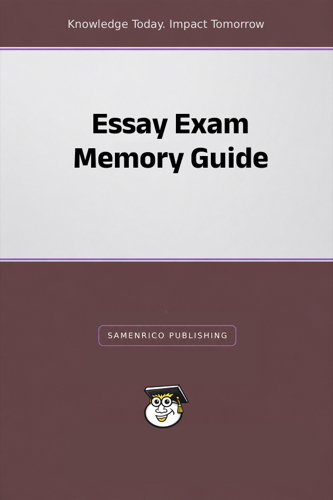
Essay Exam Memory Guide eBook
Recall key arguments and evidence quickly to write
by Snead Angle
Recall key arguments and evidence quickly to write structured responses.
Formats
Free sample
Chapter 1: The Prediction Engine--–- The morning of his final exam in Cognitive Psychology, Marcus had done everything right. He had read the textbook twice. He had highlighted every definition in yellow, then gone back over the highlights in pink. He had re-read his notes until the ink smeared. He had even recorded himself reading key terms and listened to the recording while falling asleep.
When he walked into the exam hall, he felt a kind of exhausted confidence — the certainty of someone who had sacrificed sleep, social life, and sanity for the sake of preparation.Then he turned over the exam booklet.The prompt read: "Compare and contrast the working memory models of Baddeley and Cowan. Using at least three empirical studies, evaluate which model better accounts for attentional control in dual-task paradigms."Marcus stared at the page. He knew Baddeley. He knew Cowan. He knew studies — or he had known them.
But now, sitting in the cold blue light of the exam hall, his mind was a wall of fog. The names were there, somewhere. The findings were there. But the connections — the argument that would link them into a coherent essay — had evaporated. He wrote a halting introduction, then erased it.
He started again. He produced something that looked like an essay but felt like a confession of failure.Three weeks later, his grade arrived. He had scored in the 34th percentile on the essay section — far below his multiple-choice performance, which had been in the 70s. The discrepancy made no sense to him. He had studied the same material.
He had known the same facts. Why could he recognize correct answers but not produce them?This book exists to answer that question — and to give you what Marcus lacked: a systematic method for predicting what will be asked, encoding arguments specifically for retrieval, and walking into any essay exam with the confidence of someone who has already rehearsed the exact performance required.The Recognition-Recall Chasm The first and most important distinction you must understand is the difference between recognition and recall. Recognition is the ability to identify correct information when you see it. Multiple-choice questions test recognition. You scan four options, and the right one looks familiar.
Your brain does not need to produce anything from scratch; it only needs to match an external cue to an internal trace. Recognition is relatively easy. It is also deeply misleading.Recall is the ability to produce information without external cues. Essay exams test recall exclusively. When a prompt asks you to "compare," "analyze," or "evaluate," you cannot simply recognize the correct answer among options.
You must generate the thesis, retrieve supporting evidence, order arguments logically, and produce connective prose — all from internal memory. Recall is significantly harder than recognition. Studies in cognitive psychology consistently show that recall performance is roughly 50-70 percent of recognition performance for the same material, even under ideal conditions.Most students study as if they are preparing for a recognition test. They read. They highlight.
They re-read. These methods increase familiarity, which feels like learning. But familiarity does little for recall. You can read a chapter ten times and still be unable to summarize its central argument without looking. The reason is simple: reading is passive input.
Recall requires active output. You cannot train a retrieval muscle by only receiving information.This is why Marcus failed. He had studied for recognition but was tested on recall. The facts were in his head — his multiple-choice score proved that — but he could not access them in the form of a structured argument. The difference between recognition and recall is not a matter of effort.
It is a matter of method. And the method begins not with memorization, but with prediction.Reverse-Engineering the Exam Successful essay exam preparation starts weeks before the test, and it starts with a single question: What is likely to be asked? Most students approach this question naively. They assume that anything in the readings or lectures is fair game. That assumption leads to the single greatest error in exam preparation: studying everything equally.
When you study everything, you remember nothing with sufficient structure to write about it under time pressure. You become a generalist in a test that rewards specialists in specific arguments.The solution is to reverse-engineer the exam from the syllabus and course materials. Every syllabus is a prediction engine. It contains, explicitly or implicitly, the questions your professor will ask. Your job is to decode those signals before you study a single fact.Begin with the learning objectives.
Many syllabi list them explicitly: "By the end of this course, students will be able to evaluate competing theories of X" or "analyze the causes of Y." These are not administrative boilerplate. They are direct statements of what your professor values enough to test. Convert each learning objective into a question. "Evaluate competing theories of X" becomes a prompt: "Evaluate Theory A and Theory B. Which better accounts for the evidence?
Support your answer with specific findings."Next, examine the structure of the course. How much time was spent on each topic? Professors allocate lecture time and reading pages according to their sense of importance. A topic that occupied three weeks of lectures is more likely to appear on the exam than a topic that occupied one week. This seems obvious, but students routinely ignore it, treating a passing mention with the same weight as a unit's central theory.
Create a rough weighting system: for each major topic, note the number of lectures, required readings, and class discussions devoted to it. Topics in the top 20 percent of time allocation are your high-probability candidates.Third, look for repetition across modalities. Did the professor mention the same study in lecture and in the reading? Did a student question lead to a lengthy discussion of a particular experiment? Repetition across different formats — lecture, reading, discussion, assignment — signals that the professor considers that material fundamental.
Fundamental material is exam material. Make a list of every concept, study, or theory that appears in at least two different course modalities. That list is your exam blueprint.Finally, mine past exams if they are available. Many professors reuse question formats, if not exact questions. Look for patterns in the verbs used: "compare," "contrast," "evaluate," "analyze," "trace the development of." These verbs specify the cognitive operation required.
A professor who consistently asks "evaluate" questions is testing your ability to weigh evidence and make judgments. A professor who asks "trace" questions is testing your understanding of sequences and causal chains. You cannot prepare for an evaluation prompt with timeline memorization. The verb tells you what kind of argument structure you need to encode.The Concept Web: Moving from Topics to Arguments Once you have identified high-probability topics, you face a second problem: topics are not arguments. A topic is a subject area.
An argument is a claim supported by evidence. Essay exams reward arguments. Students who write lists of facts about a topic fail. Students who make a clear claim and defend it succeed. Therefore, you must transform each predicted topic into a set of arguable claims before you memorize anything.The Concept Web is the tool for this transformation.
Start with a high-probability topic written in the center of a page. For example: "Working Memory." Around it, draw lines…
This is the end of the free sample. Get the eBook to keep going. Buy now
About this book
Details
- Author
- Snead Angle
- Publisher
- SamEnrico
- Language
- English
- Genre
- essays, Self-Help, Essay Writing
- Released
- 2026-06-10
- Pages (approx.)
- 146
- Available as
- eBook, Audiobook

Read better in the ZLOADR app
Your eBooks on your phone or tablet. Sign in with your SamEnrico account and start reading.
More by Snead Angle
 Digital Planner Mockup Scene CreationSnead Angle$11.99
 Rental Housing Retirement Strategy GuideSnead Angle$11.99
 Morning Recall PracticeSnead Angle$11.99
 Plague Vaccine Black DeathSnead Angle$11.99Plague Vaccine Black DeathSnead Angle$11.99
 The Last Voyage of the SS Marine Sulphur Queen: A Mystery at SeaSnead Angle$11.99
 The Last Oracle of Delphi: A Mentor’s Final ProphecySnead Angle$11.99
 Understanding Cholemia, FamilialSnead Angle$17.99
 Lead Strategic Program ManagerSnead Angle$11.99
 Global Team Rollout CommsSnead Angle$12.99
 Physical Health Board ConnectionSnead Angle$12.99
 Ultimate Handbook Guide to Perth : (Australia) Travel GuideSnead Angle$11.99
You may also like
 YouTube Video Essay DepthLeon Lala$11.99
 TOEFL Independent Essay GuideMintz Alex$11.99
 Music Theory Essay GuideWilkinson Maisha$11.99
 Expository Essay AI PromptsApplegate Dalia$11.99
 Exam Essay MemorizationMcgovern Johna$11.99
 Compare Contrast Essay PromptsOntiveros Marx$11.99
 College Application Essay GuideSisson Aimee$11.99College Application Essay GuideSisson Aimee$11.99
 The 100 Word Essay ChallengeAli Luciana$11.99
 Journalism Essay PromptsThatcher Williemae$11.99
 Finance Essay PromptsShrader Lamont$11.99
 Cause Effect Essay GPT GuideBland Jacelyn$11.99