
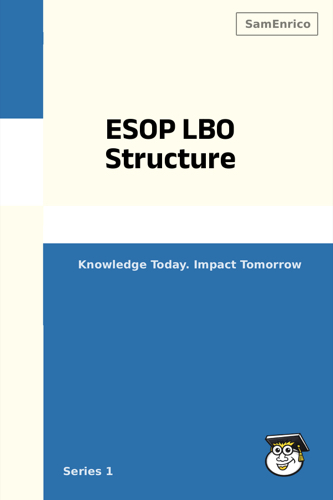
Non-FictionCapital & Valuation Register
ESOP LBO Structure eBook
Documents employee stock ownership plan leveraged
by Caso Codi
Documents employee stock ownership plan leveraged buyouts.
Formats
Free sample
Chapter 1: The Great Transfer...--–- On a humid Tuesday morning in September 2019, Carl Jenkins walked into the break room of his family's manufacturing plant in Akron, Ohio, and gathered sixty-two employees for an announcement that would change every one of their lives. He was sixty-two years old, his father had started the business in 1987, and for the past decade Carl had been waking up at 3:00 AM with the same question: what happens to these people when I leave? His two children had no interest in running a metal stamping company. The private equity firms that called him weekly promised cash but warned of "synergies" that meant layoffs. And the giant strategic buyer who had flown in from Germany last month made an offer that would have made Carl rich and every one of his employees expendable.
Instead, Carl did something that 99% of American business owners have never heard of. He sold his company to his employees through a structure called an ESOP Leveraged Buyout. Four years later, the company's revenue had grown forty-three percent, turnover had dropped by more than half, and the receptionist who started at twenty-two dollars an hour had an account balance approaching three hundred thousand dollars. Carl's story is not an anomaly. It is a preview of the largest wealth transfer in American history—and one of the most powerful financial tools that almost nobody understands.This book is about that tool.
It is called the ESOP Leveraged Buyout, or ESOP-LBO for short. It combines the tax efficiency of an Employee Stock Ownership Plan with the financial discipline of a leveraged buyout. If you have never heard of it, you are in excellent company. Most business school graduates cannot explain how it works. Most investment bankers have never executed one.
And yet, for the right company—typically a mature, stable, closely held business with a committed management team and a retiring owner—an ESOP-LBO can produce outcomes that seem almost magical: the selling shareholder pays no capital gains tax (or defers it indefinitely), the company gets a tax deduction for both principal and interest on its acquisition debt, the employees build retirement wealth without contributing a dollar of their own money, and the business remains independent, culturally intact, and anchored in its community.The opening chapters of this book will feel like a slow unraveling of a mystery. The first chapter establishes the historical and conceptual groundwork by tracing the separate evolutions of ESOPs and LBOs. It explains why an ESOP is not a retirement plan—it is a corporate finance tool wearing a retirement plan's clothing. It contrasts the often-destructive leveraged buyouts of the 1980s with the cooperative model of employee ownership. And it introduces the hybrid solution that emerged from the collision of these two worlds.
The second chapter provides a decision-making framework for business owners and executives, comparing the ESOP-LBO route against traditional exit strategies such as sales to strategic buyers, private equity firms, or management buyouts. The chapters that follow walk through the legal requirements, the financial engineering, the step-by-step mechanics, the valuation challenges, the fiduciary duties, the repurchase obligation that distinguishes ESOPs from all other ownership structures, real-world case studies of corporate divestitures and distressed companies, the participant experience and cultural transformation, and finally the exit horizon when the ESOP eventually sells, goes public, or terminates.But before any of that, this first chapter must answer a more fundamental question: why does this structure exist at all, and why has it remained so invisible to so many?The Two Strangers That Never Meant to Meet To understand the ESOP-LBO, you must first understand its parents: the Employee Stock Ownership Plan and the Leveraged Buyout. These two financial innovations emerged from completely different ideological traditions, served completely different purposes, and were invented by completely different kinds of people. Their eventual marriage was accidental, unlikely, and extraordinarily powerful.The Employee Stock Ownership Plan was the brainchild of Louis Kelso, a San Francisco investment banker and economic theorist who believed that capitalism had a fatal flaw: it concentrated ownership in fewer and fewer hands. In a series of books and articles beginning in the 1950s, Kelso argued that the only way to save capitalism from socialism was to democratize ownership.
His solution was a plan that would allow corporations to borrow money to buy stock on behalf of employees, then repay the loan with pre-tax corporate dollars. Kelso sold this idea to Senator Russell Long of Louisiana, the powerful chairman of the Senate Finance Committee, who shepherded the ESOP into law through a series of legislative provisions beginning with the Employee Retirement Income Security Act of 1974 (ERISA). Long called ESOPs "the most important piece of social legislation since the Social Security Act."The Leveraged Buyout came from a very different place. It was the weapon of corporate raiders, financial engineers, and the private equity industry that would eventually make household names of firms like KKR, Blackstone, and Bain Capital. The basic idea was simple: borrow as much money as possible to acquire a company, use the company's own cash flow to repay the debt, and pocket the difference.
The LBO exploded into public consciousness with the 1988 battle for RJR Nabisco, chronicled in Bryan Burrough and John Helyar's book Barbarians at the Gate. That deal was valued at $25 billion, involved a staggering amount of debt, and became a symbol of 1980s excess. The LBO was not about democratizing ownership. It was about concentrating it in the hands of a few general partners while extracting efficiency (and often jobs) from the acquired company.These two worlds—the idealistic ESOP and the ruthless LBO—should never have met. One was about sharing wealth.
The other was about capturing it. And yet, they did meet, because both discovered the same mathematical truth: leverage, when combined with tax deductibility, creates extraordinary financial power.The Accidental Hybrid The Leveraged ESOP—what we will call the ESOP-LBO throughout this book, acknowledging that the older term "LESOP" (Leveraged ESOP) is a historical synonym—emerged gradually in the late 1970s and early 1980s as practitioners realized that Kelso's original vision and the LBO model could be combined. Here was the insight: if a company could borrow money on behalf of an ESOP, and if that borrowing was structured as a leveraged buyout of the existing shareholders, then the selling shareholders could achieve liquidity, the company could achieve 100% employee ownership, and the tax code would subsidize the entire transaction.The mechanism was elegant. The ESOP trust would borrow money from a bank. The ESOP would then use that borrowed money to buy the stock of the selling shareholders.
The company would then make tax-deductible contributions to the ESOP, and the ESOP would use those contributions to repay the bank loan. Because the contributions were tax-deductible, the effective after-tax cost of borrowing was roughly half the stated interest rate for a C corporation in the 21% tax bracket.Consider the numbers. A standard LBO might borrow $10 million at 8% interest. The company would need to generate roughly $15 million in pre-tax income to repay that $10 million principal plus interest, because corporate income taxes take a large bite. An ESOP-LBO borrowing the same $10…
This is the end of the free sample. Get the eBook to keep going. Buy now
About this book
Details
- Author
- Caso Codi
- Publisher
- SamEnrico
- Language
- English
- Genre
- Non-Fiction, Capital & Valuation Register
- Released
- 2026-06-06
- Pages (approx.)
- 155
- Available as
- eBook, Audiobook

Read better in the ZLOADR app
Your eBooks on your phone or tablet. Sign in with your SamEnrico account and start reading.
More by Caso Codi
 Alcoholism and Imposter Syndrome RecoveryCaso Codi$11.99
 Parenting Self Care After TraumaCaso Codi$11.99
 Shopping Addiction for BipolarCaso Codi$11.99
 The Torso Murders of Toronto: Prohibition, Corruption, and Canada's Darkest TrialCaso Codi$11.99
 How to Produce an Anchoring CompoundCaso Codi$11.99
 Technical Facility ManagerCaso Codi$11.99
 Ghana Delivery Exception HandlingCaso Codi$12.99
 Ultimate Handbook Guide to Dodoma : (Tanzania) Travel GuideCaso Codi$11.99
You may also like
 Hong Kong Handover 1997Dunn Johnnie$11.99
 Zumba For Postnatal Recovery CourseNeal Christian$11.99
 Zumba for BeginnersLadner Nikia$11.99
 YouTube Comment Mining GuideHumes Pandora$12.99
 Worry Box MeditationCarlin Rudy$11.99
 Workplace Stress MeditationNguyen Lynn$11.99
 Workplace Stress and Sleep RepairHawley Ivory$11.99
 Workplace Perfectionism CureDelaney Jeffry$11.99
 Workplace Injustice Anger GuideWallen Isabelle$11.99
 Work Addiction and Burnout LinkGreenwood Ester$11.99
 Women in Yoga and WellnessBeattie Galina$11.99
 Women in Stand Up ComedyChun Evangeline$11.99