
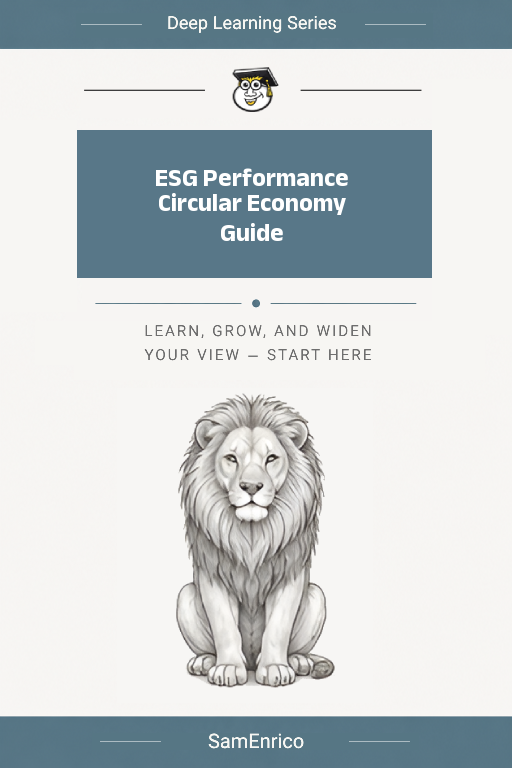
Non-FictionStrategic AtlasCircular Economy
ESG Performance Circular Economy Guide
Compare waste reduction, recycling rates, and prod
by Rivas Martin
Compare waste reduction, recycling rates, and product circularity among public consumer goods and electronics firms.
Formats
About this book
Free sample
Chapter 1: The Zero Lie--The first problem with “zero waste” is that zero is not a number. It is a performance. A piece of theatre. And like all good theatre, it requires the audience to suspend disbelief.Walk into any corporate sustainability briefing, and you will hear the phrase with mechanical regularity. “We have achieved zero waste to landfill.” The words land with the weight of moral certainty.
The presenter smiles. The slides advance. The audience nods. But here is what the slide does not show: the incinerator burning that “waste” at 1,000 degrees Celsius, converting solid material into airborne carbon dioxide. The slide does not show the shipping container labeled “recycling” that left Long Beach, California, and arrived six weeks later in Malaysia, where it was dumped in a field and burned by workers earning two dollars per day.
And the slide certainly does not show the shredder that turned a high-grade aluminum component into low-grade mixed dust—technically “diverted from landfill,” practically destroyed as a resource.Zero waste is not a metric. It is a magic trick. And this chapter is going to show you exactly how the trick works, why almost every public company is performing it, and what real waste reduction looks like when you stop pretending that zero means zero.The Three Faces of Zero To understand why “zero waste to landfill” has become the most gamed metric in corporate ESG, you must first understand the three mechanisms by which companies achieve it. None of these mechanisms is illegal. All of them are permitted under current reporting frameworks.
And all of them are fundamentally misleading.Face One: Incineration as Recovery The first mechanism is incineration, politely rebranded as “waste-to-energy” or “energy recovery.” Here is how it works. A company sends its non-recyclable waste to a combustion facility. The facility burns the waste at extremely high temperatures. The heat generates steam. The steam turns a turbine.
The turbine generates electricity. The company counts the waste as “diverted from landfill” because, technically, the ash that remains (roughly 10-15 percent of the original volume) goes to landfill, not the original…
This is the end of the free sample. Get the eBook to keep going. Buy now
Contents
- Chapter 1
- Chapter 2
- Chapter 3
- Chapter 4
- Chapter 5
- Chapter 6
- Chapter 7
- Chapter 8
- Chapter 9
- Chapter 10
- Chapter 11
- Chapter 12
Details
- Author
- Rivas Martin
- Publisher
- SamEnrico
- Language
- English
- Genre
- Non-Fiction, Strategic Atlas, Circular Economy
- Released
- 2026-05-29
- Pages (approx.)
- 125
- Available as
- eBook, Audiobook

Read better in the ZLOADR app
Your eBooks on your phone or tablet. Sign in with your SamEnrico account and start reading.
More by Rivas Martin
 Free Creator Media Monitoring StackRivas Martin$11.99
 Nursing Home Loneliness GuideRivas Martin$11.99
 Sleep and Emotion RegulationRivas Martin$11.99
 Order Solar Temple Europol Investigation PrimerRivas Martin$11.99
 Mindfulness for Chronic LonelinessRivas Martin$11.99
 Love, Lies, and a Billion-Dollar Split: The Untold Story of Jeff Bezos and MacKenzie ScottRivas Martin$11.99
 Blood Moon Prophecy: The Viking Oracle Who Predicted the End of the WorldRivas Martin$11.99
 Evening And Weekend ProgramsRivas Martin$12.99
 Understanding Cerebro Reno Digital SyndromeRivas Martin$17.99
 ColoristRivas Martin$11.99
You may also like
 Hong Kong Handover 1997Dunn Johnnie$11.99
 Zumba For Postnatal Recovery CourseNeal Christian$11.99
 Zumba for BeginnersLadner Nikia$11.99
 YouTube Comment Mining GuideHumes Pandora$12.99
 Worry Box MeditationCarlin Rudy$11.99
 Workplace Stress MeditationNguyen Lynn$11.99
 Workplace Stress and Sleep RepairHawley Ivory$11.99
 Workplace Perfectionism CureDelaney Jeffry$11.99
 Workplace Injustice Anger GuideWallen Isabelle$11.99
 Work Addiction and Burnout LinkGreenwood Ester$11.99
 Women in Yoga and WellnessBeattie Galina$11.99
 Women in Stand Up ComedyChun Evangeline$11.99