
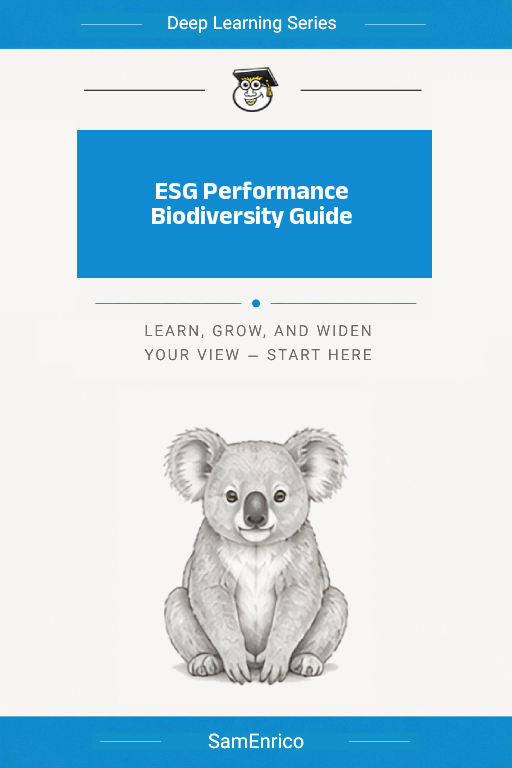
Non-FictionStrategic AtlasBiodiversity
ESG Performance Biodiversity Guide eBook
Compare land use, habitat impact, and biodiversity
Compare land use, habitat impact, and biodiversity commitments among public firms in mining, agribusiness, and construction.
Formats
Free sample
Chapter 1: The Billion-Dollar Blind Spot--The email arrived at 11:47 PM on a Tuesday. Elena Vestergaard, a 41-year-old portfolio manager for a Norwegian sovereign wealth fund, had been expecting good news. Her team had spent eighteen months constructing what they believed was the most sustainable agriculture fund in Europe—carefully screened for carbon emissions, water usage, and labor practices. The email was from their largest investor, a Danish pension fund with $2.3 billion under management.It was not good news."Effective immediately, we are withdrawing our commitment," the email read. "Our internal audit has identified a material biodiversity risk that your due diligence missed.
We cannot in good conscience remain invested."Elena stared at the screen. She had read every sustainability report. She had hired third-party verifiers. She had personally signed off on the environmental, social, and governance (ESG) criteria for every farm in the portfolio. What could she have possibly missed?The answer came three weeks later, when a forensic ecologist submitted a 147-page report.
The farms in Elena's fund had been carefully selected for low carbon emissions and efficient water use. But no one had looked at what was happening to the insects. Over the previous seven years, the region's native bee population had collapsed by 84 percent—driven by the very "sustainable intensification" practices her fund had championed. Without those bees, the farms' pollination-dependent crops were becoming unviable. The land itself was losing its productive capacity.Elena lost her job.
Her investors lost approximately $400 million in value. And when she asked the third-party ESG rating agency how this had happened, they handed her a 200-page report that never once mentioned the word "bee."This book is for everyone who doesn't want to be Elena.The Materiality of the Invisible Biodiversity is not a niche environmental concern. It is not something to be addressed after carbon, after water, after labor. It is the foundation upon which all economic activity rests. Yet it remains the single largest blind spot in modern investing and corporate governance.Let us be precise about what we mean.
Biodiversity is the variety of life on Earth—the genes, species, and ecosystems that together create the conditions for human prosperity. It is the pollinator that fertilizes one out of every three bites of food you eat. It is the soil microbiome that transforms organic matter into plant-available nutrients. It is the mangrove forest that absorbs storm surges and the coral reef that supports fisheries. It is, in the most literal sense, the infrastructure of the global economy.And it is collapsing.The World Economic Forum has consistently ranked biodiversity loss as one of the top five global risks by likelihood and impact—not in some distant future, but in the present decade.
The Dasgupta Review, commissioned by the UK Treasury and led by economist Partha Dasgupta, concluded that humanity has been living beyond the means of nature since the 1970s, consuming its biological capital without accounting for the cost. The review placed it in stark terms: "Nature is our most precious asset. Yet we have collectively mismanaged it as if it were free."Consider what "free" has meant in practice. Between 1970 and 2018, global populations of mammals, birds, amphibians, reptiles, and fish declined by an average of 69 percent, according to the World Wildlife Fund's Living Planet Report. Freshwater populations fell by 83 percent.
Latin America and the Caribbean saw declines of 94 percent. These are not abstract statistics. They are the unraveling of the web of life that supports agriculture, fisheries, water purification, flood control, and climate regulation.The financial sector is beginning to notice, but only barely. In 2022, the Taskforce on Nature-related Financial Disclosures (TNFD) launched its final framework, creating a structure for companies to report nature-related risks similar to what the TCFD did for climate. By 2024, over 400 organizations had committed to nature-related disclosures.
But commitment is not action, and action is not accountability. Most corporate biodiversity reporting remains what the financial industry calls "greenwashing with a green thumb"—vague commitments to "net positive impact" without any measurable metric, timeline, or verification.This book is not about vague commitments. It is about measurement, comparison, and accountability. It is about the three sectors that drive more land-use change and habitat loss than any others: mining, agribusiness, and construction. And it is about how to distinguish between companies that are genuinely leading on biodiversity and those that are merely decorating their annual reports with pictures of trees.Why These Three Sectors?The choice of sectors is not arbitrary.
Mining, agribusiness, and construction collectively account for the majority of human-caused land-use change and habitat degradation. They operate at different scales, create different types of impact, and face different regulatory pressures. But they share one thing: each is indispensable to the modern economy, and each is currently on a collision course with the biological systems that sustain it.Mining creates what ecologists call "zero to sterile" landscapes—open pits, tailings ponds, and waste rock dumps that have no natural ecological analog. Unlike a forest fire, which can regenerate, or a farm field, which retains soil biology, a mine removes the land from any ecological function for decades or centuries. A typical open-pit copper mine disturbs 10,000 to 20,000 hectares of land over its lifetime.
The Bingham Canyon Mine in Utah, one of the largest in the world, is 4.5 kilometers wide and 1.2 kilometers deep—visible from space. And yet, the demand for critical minerals is accelerating, not abating. A single electric vehicle battery requires approximately 8 kilograms of lithium, 14 kilograms of cobalt, and 50 kilograms of nickel. A wind turbine contains 4.7 tons of copper. The energy transition, for all its climate benefits, is a mining-intensive project.Agribusiness has the largest total land footprint of any sector.
Agriculture occupies approximately 40 percent of the Earth's ice-free land surface. It is the primary driver of deforestation in the Amazon, the Congo Basin, and Southeast Asia. Unlike mining's concentrated scars, agriculture creates diffuse, landscape-scale transformation. A mine might destroy a few thousand hectares; an agricultural supply chain might clear a million. The global soy trade, for example, has driven the conversion of 30 million hectares of the Brazilian Cerrado—a savanna ecosystem that is home to 5 percent of the world's species.
And yet, the world must be fed. The challenge is not to eliminate agriculture but to radically transform it.Construction specializes in a different kind of impact: fragmentation. The built environment—roads, buildings, dams, and other infrastructure—covers approximately 1 to 2 percent of the Earth's land surface directly, but its ecological footprint is far larger. A single highway can fragment a wildlife corridor, isolating populations and preventing genetic exchange. A dam can block fish migration routes, destroying fisheries that have supported human communities for millennia.
The United States alone has 4.2 million miles of roads, enough to circle the Earth 168 times. Tens of millions of animals are killed on these roads annually, but the more insidious impact is the opening of intact areas to exploitation. A road through a forest invites logging, poaching, and agricultural encroachment.Each sector presents a different profile of risk and impact. Each requires different metrics and different accountability mechanisms. But they are united by a common failure: none currently faces the level of scrutiny, disclosure, and accountability that the materiality…
This is the end of the free sample. Get the eBook to keep going. Buy now
About this book
Details
- Author
- Avery Florine
- Publisher
- SamEnrico
- Language
- English
- Genre
- Non-Fiction, Strategic Atlas, Biodiversity
- Released
- 2026-06-01
- Pages (approx.)
- 152
- Available as
- eBook, Audiobook

Read better in the ZLOADR app
Your eBooks on your phone or tablet. Sign in with your SamEnrico account and start reading.
More by Avery Florine
 Order Solar Temple Time Bomb HandbookAvery Florine$11.99
 Central Sensitization GuideAvery Florine$11.99
 Emotional Regulation Workbook for KidsAvery Florine$11.99
 Free Creator Sponsorship Prep StackAvery Florine$11.99
 Mindfulness for Law EnforcementAvery Florine$11.99
 The Silk Road Navigators: Secrets of the Desert NomadsAvery Florine$11.99
 From the Ashes: The Unlikely Rise of the 'Miracle on the Hudson' PilotAvery Florine$11.99
 Capitalization FixerAvery Florine$11.99
 Weather Preparation For StudentsAvery Florine$12.99
 Understanding Cerebral Gigantism Jaw CystsAvery Florine$17.99
 10 Ways to Use Celery Seeds (Recipe Book)Avery Florine$11.99
You may also like
 Hong Kong Handover 1997Dunn Johnnie$11.99
 Zumba For Postnatal Recovery CourseNeal Christian$11.99
 Zumba for BeginnersLadner Nikia$11.99
 YouTube Comment Mining GuideHumes Pandora$12.99
 Worry Box MeditationCarlin Rudy$11.99
 Workplace Stress MeditationNguyen Lynn$11.99
 Workplace Stress and Sleep RepairHawley Ivory$11.99
 Workplace Perfectionism CureDelaney Jeffry$11.99
 Workplace Injustice Anger GuideWallen Isabelle$11.99
 Work Addiction and Burnout LinkGreenwood Ester$11.99
 Women in Yoga and WellnessBeattie Galina$11.99
 Women in Stand Up ComedyChun Evangeline$11.99