
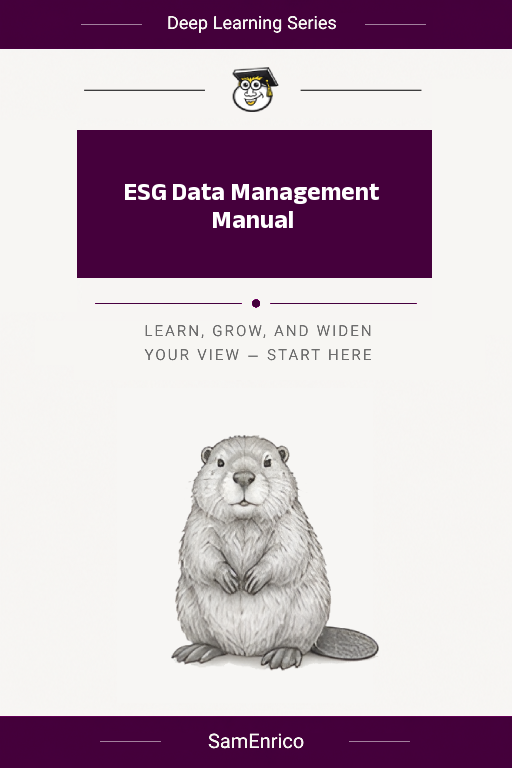
Non-FictionAnnual CheckupSustainability ComplianceData Guide
ESG Data Management Manual eBook
Collect, verify, and report sustainability data us
Collect, verify, and report sustainability data using affordable SME software for 2025. Covers gap assessments, third-party assurance options, and green claims regulation compliance.
Formats
Free sample
Chapter 1: The February 14th Email--The email arrived on a Friday afternoon, three days before Valentine's Day.Maria Torres, operations director of a 47-person manufacturing firm outside Barcelona, had just finished approving payroll when her phone buzzed. The subject line read: URGENT: Supplier Sustainability Compliance – Action Required by March 15th.She opened it. It was from Inditex, the parent company of Zara – her largest customer, representing 62% of annual revenue. The email was polite but firm. By March 15th – exactly 29 days away – her company was required to submit a verified ESG data report covering Scope 1, Scope 2, and material Scope 3 emissions for calendar year 2024.
The report needed to be structured according to the VSME framework, include an audit trail, and be signed off by a responsible officer. Failure to comply would result in "a review of the supplier relationship" – corporate code for losing the contract.Maria had never heard of VSME. She didn't know what Scope 3 meant. Her sustainability data, to the extent it existed, lived in three places: a spreadsheet of utility bills on the shared drive (last updated in November), a folder of PDF invoices from her logistics provider (unorganized), and a notebook in the plant manager's office where he tracked waste disposal by hand.She had 29 days.This chapter is written for every Maria. Every business owner, operations manager, or sustainability lead who just received that email – or knows it's coming.
If you are reading this book because you want to be prepared before the email arrives, you are already ahead of 80% of your peers. If you are reading this because the email already arrived and you are panicking, take a breath. You have enough time. This chapter will show you exactly what you need to do, in what order, and how to avoid the expensive mistakes that consultants hope you'll make.The Cascading Compliance Effect: Why 2025 Is Different Let's start with a fundamental truth that most ESG consultants will not tell you: the vast majority of sustainability regulations were not written for you. The EU's Corporate Sustainability Reporting Directive (CSRD) applies to large companies with over 250 employees and €40 million in revenue.
The U.S. SEC climate disclosure rules apply to publicly traded companies. If you run a small or medium enterprise, these regulations do not directly apply to your business.But they apply to your customers.And your customers are now required to report their Scope 3 emissions – which include the emissions generated by their suppliers. That means you. A large company cannot report its own carbon footprint without data from the companies in its supply chain.
This is what experts call the cascading compliance effect, though Maria, sitting in her Barcelona office, would have called it something less polite.Consider the math. A single large manufacturer might have 5,000 direct suppliers. Each of those suppliers might have dozens of their own suppliers. When the large manufacturer receives a regulatory deadline, that deadline cascades down the supply chain like a wave. The large manufacturer gives its Tier 1 suppliers 90 days.
Those suppliers give their Tier 2 suppliers 60 days. And at the bottom of the chain, a 47-person manufacturing firm gets an email with 29 days' notice.This is not a flaw in the system. This is how the system was designed. Regulators knew that they could not directly regulate millions of SMEs, so they regulated the large companies that buy from SMEs, creating a contractual chain of compliance. By 2025, this chain has become ironclad.Which industries are feeling this first?
Based on data from CDP's 2024 supply chain report, the most advanced sectors are:Retail and apparel (Walmart, Target, Inditex, H&M)Electronics (Apple, Samsung, Dell, HP)Automotive (Ford, Volkswagen, Toyota, Tesla)Food and beverage (Nestlé, Unilever, Pepsi Co, Danone)Logistics and transportation (DHL, Fed Ex, Maersk, UPS)If you supply any company in these sectors, your "February 14th email" is not a matter of if, but when. The only question is whether you receive it with 90 days' notice (because you are a strategic supplier) or 29 days' notice (because you are further down the chain).The Three Tiers of SME Pressure Not all SMEs face the same level of pressure. Throughout this book, we will distinguish between three tiers of small and medium enterprises, using the European Union definition as our baseline (fewer than 250 employees and annual revenue below €50 million), but with important subdivisions.Micro SME: Fewer than 10 employees, under €2 million annual revenue These businesses are rarely direct targets of compliance demands, but they often supply larger SMEs that are targets. A micro-SME might be asked for data by a small manufacturer that received a request from a large retailer. The pressure is indirect but real.
Micro-SMEs cannot afford dedicated sustainability staff and rarely have formal HR or procurement systems. Their solutions must be nearly free and require almost no training.Small SME: 10–49 employees, €2 million to €10 million annual revenue These businesses are frequently direct suppliers to large corporations. They have some formal systems (basic ERP, payroll software, possibly an HRIS) but no dedicated sustainability function. Someone – often the operations manager, quality manager, or finance controller – gets the ESG data responsibility added to their existing workload. Maria's company falls into this tier.
These businesses can afford modest software investment (5,000–5,000–5,000–15,000 per year) but cannot justify full-time headcount.Medium SME: 50–249 employees, €10 million to €50 million annual revenue These businesses are almost always direct targets of compliance demands from large customers. They may have one person (or a small team) working on sustainability part-time or full-time. They have formal systems across most functions and can afford more sophisticated software (15,000–15,000–15,000–30,000 per year). However, they still cannot afford the consultant-driven approach that works for enterprise companies.Throughout this chapter and the rest of the book, we will be explicit about which recommendations apply to which tier. When a recommendation is marked with [All Tiers] , it applies to everyone.
When marked with [Small-Medium] , it is targeted at businesses with 10+ employees and budgets above 5,000.Whenmarkedwith∗∗[Medium Only]∗∗,itappliesonlytobusinesseswith50+employeesandbudgetsabove5,000. When marked with **[Medium Only]** , it applies only to businesses with 50+ employees and budgets above 5,000.Whenmarkedwith∗∗[Medium Only]∗∗,itappliesonlytobusinesseswith50+employeesandbudgetsabove15,000. Micro-SMEs should look for the [Micro] label.The Cost of Doing Nothing: Quantified Consultants love to talk about the "reputational risk" of ignoring sustainability. Reputational risk is vague. Let's talk about specific, measurable costs instead.Cost 1: Lost B2B contracts In 2024, a procurement survey of 500 large European manufacturers found that 73% now include sustainability performance as a formal criterion in supplier selection.
The weight of sustainability in the overall score averages 22%. This means a supplier with excellent quality, price, and delivery – but poor or missing sustainability data – can lose to a competitor with adequate performance across all four categories. The survey also found that 41% of procurement leaders had deselect a supplier in the past 12 months specifically due to sustainability data gaps. Not poor performance – missing data. A blank scorecard is worse than a low score.[All Tiers] If your largest customer sends you an ESG questionnaire and you cannot answer it, you are telling them that you are not a strategic partner for the future.
You are a transactional supplier at best, and easily replaced.Cost 2: Higher cost of capital Green loans, sustainability-linked loans, and ESG-linked credit lines now represent over $1 trillion in outstanding lending.…
This is the end of the free sample. Get the eBook to keep going. Buy now
About this book
Details
- Author
- Goldman Kennith
- Publisher
- SamEnrico
- Language
- English
- Genre
- Non-Fiction, Annual Checkup, Sustainability Compliance, Data Guide
- Released
- 2026-05-30
- Pages (approx.)
- 153
- Available as
- eBook, Audiobook

Read better in the ZLOADR app
Your eBooks on your phone or tablet. Sign in with your SamEnrico account and start reading.
More by Goldman Kennith
 Instagram Explore Page DetoxGoldman Kennith$11.99
 Volunteering for ConnectionGoldman Kennith$11.99
 Values And Mission Alignment Legal ComplianceGoldman Kennith$11.99
 Rhythm of Rebellion: The Untold Story of the Dancing Defiance in 1980s PolandGoldman Kennith$11.99
 Excalibur’s Shadow: The Forgotten Knight of the Perilous ChapelGoldman Kennith$11.99
 Supply Chain Risk IntelligenceGoldman Kennith$12.99
 Associate Software Technical AnalystGoldman Kennith$11.99
 Understanding HypolipoproteinemiaGoldman Kennith$17.99
 How to Become a ChurnerGoldman Kennith$11.99
You may also like
 Hong Kong Handover 1997Dunn Johnnie$11.99
 Zumba For Postnatal Recovery CourseNeal Christian$11.99
 Zumba for BeginnersLadner Nikia$11.99
 YouTube Comment Mining GuideHumes Pandora$12.99
 Worry Box MeditationCarlin Rudy$11.99
 Workplace Stress MeditationNguyen Lynn$11.99
 Workplace Stress and Sleep RepairHawley Ivory$11.99
 Workplace Perfectionism CureDelaney Jeffry$11.99
 Workplace Injustice Anger GuideWallen Isabelle$11.99
 Work Addiction and Burnout LinkGreenwood Ester$11.99
 Women in Yoga and WellnessBeattie Galina$11.99
 Women in Stand Up ComedyChun Evangeline$11.99