

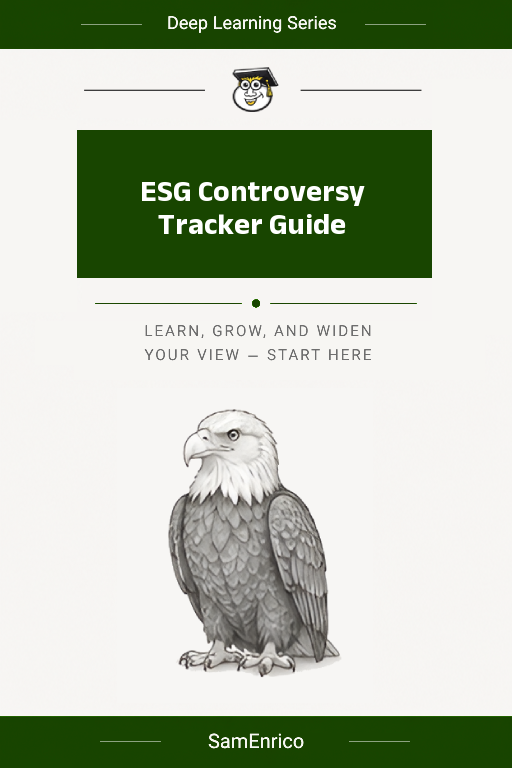
Non-FictionStrategic AtlasControversy Analysis
ESG Controversy Tracker Guide Audiobook
Monitor public firms with active ESG-related scand
Monitor public firms with active ESG-related scandals, lawsuits, and regulatory actions affecting scores.
Formats
Free sample
Chapter 1: The Receipts Revolution--–- On a Tuesday morning in June 2020, a company with an "AA" ESG rating for governance collapsed so fast that investors lost 2billionbeforelunch.Thestockhadbeenafavoriteamongsustainablefunds.Theannualreportboastedrobustinternalcontrols,anindependentauditcommittee,andawhistleblowerhotline.Yetnoneofthosepoliciesstoppedthefraud.Whatstoppedthecompanywasasinglepieceofpaper:abankstatementshowingthat2 billion before lunch. The stock had been a favorite among sustainable funds. The annual report boasted robust internal controls, an independent audit committee, and a whistleblower hotline. Yet none of those policies stopped the fraud. What stopped the company was a single piece of paper: a bank statement showing that 2billionbeforelunch.Thestockhadbeenafavoriteamongsustainablefunds.Theannualreportboastedrobustinternalcontrols,anindependentauditcommittee,andawhistleblowerhotline.Yetnoneofthosepoliciesstoppedthefraud.Whatstoppedthecompanywasasinglepieceofpaper:abankstatementshowingthat2 billion in cash did not exist.
The policies were promises. The bank statement was a receipt. And receipts, not promises, are what destroy shareholder value.This is the central truth that most ESG investing gets backward. Every day, asset managers, risk analysts, and compliance officers rely on static ESG scores to tell them which companies are sustainable. These scores reward companies for publishing ambitious policies—net-zero pledges, human rights statements, diversity commitments.
But policies are cheap. Anyone can write a code of conduct. The question that matters is not what a company says it will do. The question is what a company has actually done, and whether it is being held accountable for what it did wrong.This chapter makes a simple, provocative argument: a single verified controversy will destroy more market capitalization than years of positive ESG scores ever built. The companies that lose the most value are not the ones with bad policies.
They are the ones with good policies on paper and active scandals in reality. If you are monitoring public firms for ESG risk, you need to stop treating ESG ratings as your primary signal. You need to start tracking controversies in real time. This chapter explains why controversies trump policies, introduces the concept of double materiality, and shows you how the policy-practice gap has become the single greatest source of hidden risk in modern portfolios.The ESG Rating Paradox: Why Good Scores Protect Nothing Let us start with an uncomfortable fact. ESG rating agencies—MSCI, Sustainalytics, Refinitiv, and others—rely heavily on what companies disclose.
If a company publishes a sustainability report, it gets points. If it adopts a net-zero target, it gets more points. If it establishes a board-level ESG committee, it gets even more points. All of these are policies and structures. None of them are proof of actual behavior.Consider a…
This is the end of the free sample. Get the Audiobook to keep going. Buy now
About this book
Details
- Author
- Moeller Berniece
- Publisher
- SamEnrico
- Language
- English
- Genre
- Non-Fiction, Strategic Atlas, Controversy Analysis
- Released
- 2026-05-28
- Pages (approx.)
- 145
- Available as
- eBook, Audiobook

Listen in the VoxFlicks app
Audiobooks and audio dramas wherever you go. Sign in with your SamEnrico account and press play.
More by Moeller Berniece
 Free Creator Community BuildingMoeller Berniece$11.99
 Solar Temple Star Chamber PrimerMoeller Berniece$11.99
 Migraine Meditation ReliefMoeller Berniece$11.99
 LBO Model Macros GuideMoeller Berniece$11.99
 Gluten Free Pasta Making GuideMoeller Berniece$11.99
 The Billionaire's Secret War: How Mike Lazaridis Built BlackBerry and Lost It AllMoeller Berniece$11.99
 The Frozen Cartographers: Mapping the Last Unknown Shores of AustraliaMoeller Berniece$11.99
 Understanding Cerebellar AgenesisMoeller Berniece$17.99
 Australian University Dubai GuideMoeller Berniece$12.99
 Algorithm-Aware Content PlanningMoeller Berniece$11.99
 How to Become a Automatic-machine AttendantMoeller Berniece$11.99
You may also like
 Hong Kong Handover 1997Dunn Johnnie$11.99
 Zumba For Postnatal Recovery CourseNeal Christian$11.99
 Zumba for BeginnersLadner Nikia$11.99
 YouTube Comment Mining GuideHumes Pandora$12.99
 Worry Box MeditationCarlin Rudy$11.99
 Workplace Stress MeditationNguyen Lynn$11.99
 Workplace Stress and Sleep RepairHawley Ivory$11.99
 Workplace Perfectionism CureDelaney Jeffry$11.99
 Workplace Injustice Anger GuideWallen Isabelle$11.99
 Work Addiction and Burnout LinkGreenwood Ester$11.99
 Women in Yoga and WellnessBeattie Galina$11.99
 Women in Stand Up ComedyChun Evangeline$11.99