
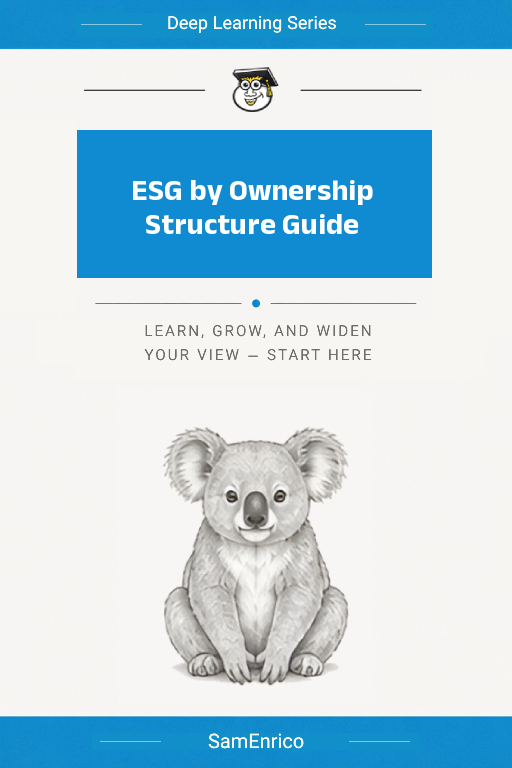
Non-FictionStrategic AtlasOwnership
ESG by Ownership Structure Guide
Compares ESG performance between family-owned, sta
Compares ESG performance between family-owned, state-owned, and widely-held public firms, analyzing ownership impact on sustainability.
Formats
About this book
Free sample
Chapter 1: The Ownership Blind Spot...-- The most dangerous words in sustainable investing are not "greenwashing" or "impact washing." They are "widely held."Consider two companies. Both are Fortune 500 manufacturers. Both operate in the same industry—automotive parts. Both have received identical ESG ratings from MSCI: a respectable "AA," placing them in the top decile of their industry for environmental, social, and governance performance. Both have published glossy sustainability reports, committed to net-zero by 2050, and hired former government officials to lead their ESG committees.On paper, they are indistinguishable.
A quantitative fund screening on ESG scores would treat them as interchangeable. A retail investor buying an ESG ETF would own both and assume equal sustainability exposure. A consultant benchmarking corporate responsibility would rank them as peers.But here is what the ESG rating does not tell you.Company A is controlled by a founding family that has owned the business for four generations. The current CEO is the founder's great-granddaughter, who grew up visiting the factory floor, knows every supplier by name, and expects to pass the company to her children. She has personally rejected three acquisition offers from private equity because, she explains, "they would strip the environmental investments we have been building for twenty years."Company B is widely held, with no single shareholder owning more than three percent of its stock.
Its CEO was hired eighteen months ago from a competitor. His compensation package includes a bonus tied entirely to the company's ESG rating improvement. He has quadrupled the sustainability reporting budget, hired two new ESG consultants, and announced an ambitious carbon offset program. Last quarter, he cut the capital budget for the new electric vehicle component生产线 by forty percent to meet earnings targets.Both companies have the same ESG score. But their sustainability trajectories could not be more different.This book is about why that difference exists, how to measure it, and why almost every investor—from the world's largest pension funds to individual retirement accounts—has been systematically misled by ignoring the single most important variable in corporate sustainability: ownership structure.The $40 Trillion Blind Spot Let us start with…
This is the end of the free sample. Get the eBook to keep going. Buy now
Contents
- Chapter 1
- Chapter 2
- Chapter 3
- Chapter 4
- Chapter 5
- Chapter 6
- Chapter 7
- Chapter 8
- Chapter 9
- Chapter 10
- Chapter 11
- Chapter 12
Details
- Author
- Beaudoin Charisse
- Publisher
- SamEnrico
- Language
- English
- Genre
- Non-Fiction, Strategic Atlas, Ownership
- Released
- 2026-05-29
- Pages (approx.)
- 159
- Available as
- eBook, Audiobook

Read better in the ZLOADR app
Your eBooks on your phone or tablet. Sign in with your SamEnrico account and start reading.
More by Beaudoin Charisse
 PCOS Period Regulation GuideBeaudoin Charisse$11.99
 Peg System for FormulasBeaudoin Charisse$11.99
 Gait and Walk Style NonverbalBeaudoin Charisse$11.99
 Scott Peterson Alibi Christmas DayBeaudoin Charisse$11.99
 Power of Attorney Legal GuideBeaudoin Charisse$11.99
 The Rose and the Saber: Love Letters from the Siege of ChittorgarhBeaudoin Charisse$11.99
 Iodargyrite MiningBeaudoin Charisse$11.99
 Dot Africa Eligibility ChecklistBeaudoin Charisse$12.99
 Understanding Partington–mulley SyndromeBeaudoin Charisse$17.99
 How to Start a Hydroelectric Power Generation BusinessBeaudoin Charisse$11.99
You may also like
 Hong Kong Handover 1997Dunn Johnnie$11.99
 Zumba For Postnatal Recovery CourseNeal Christian$11.99
 Zumba for BeginnersLadner Nikia$11.99
 YouTube Comment Mining GuideHumes Pandora$12.99
 Worry Box MeditationCarlin Rudy$11.99
 Workplace Stress MeditationNguyen Lynn$11.99
 Workplace Stress and Sleep RepairHawley Ivory$11.99
 Workplace Perfectionism CureDelaney Jeffry$11.99
 Workplace Injustice Anger GuideWallen Isabelle$11.99
 Work Addiction and Burnout LinkGreenwood Ester$11.99
 Women in Yoga and WellnessBeattie Galina$11.99
 Women in Stand Up ComedyChun Evangeline$11.99