
Non-FictionSelf-HelpVisualization
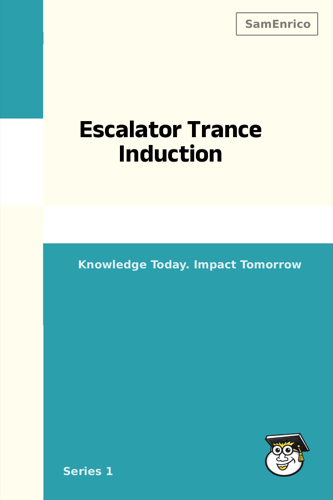
Escalator Trance Induction eBook
Visualization of descending stairs or escalator to
Visualization of descending stairs or escalator to deepen trance.
Formats
Free sample
Chapter 1: The Effort Trap--–- Every hypnotherapist has experienced the same quiet frustration. You guide your subject through a beautiful staircase induction. Ten steps down. Each step carefully described. Each breath synchronized.
And yet, somewhere around step seven, you feel it—the subtle tension in their shoulders, the slight furrow in their brow, the almost imperceptible holding pattern in their body. They are trying. They are concentrating. They are, in the most literal sense, working at relaxation. And because they are working, they are not relaxing.This is the fundamental paradox that has haunted clinical hypnosis since its earliest days.
The more consciously a subject attempts to enter trance, the further they move from its gateway. Effort is the enemy of surrender. Concentration is the opponent of absorption. And nowhere is this contradiction more visible than in the most common deepening technique in the hypnotherapist’s toolkit: the descending staircase.For over a century, the staircase has served as the gold standard for trance deepening. From Freud’s early consulting rooms to modern pain management clinics, the image of walking down ten steps into deeper relaxation has proven remarkably durable.
And for good reason. The staircase is familiar. It is culturally universal. It provides a clear, measurable vertical axis that the conscious mind can track without confusion.But the staircase carries a hidden cost that few practitioners acknowledge and even fewer know how to circumvent. Each step requires an act of will.
The subject must consciously decide to lift the foot, move it forward, place it down, shift weight, and repeat. Even when the hypnotist’s language is permissive—“You may allow yourself to step down when you are ready”—the very structure of the staircase implies effort. The body knows this. The unconscious mind knows this. And the critical factor, that vigilant gatekeeper of the conscious mind, remains partially active precisely because the subject is engaged in a task that demands their attention.The solution is not to abandon vertical deepening.
The vertical axis remains one of the most powerful metaphors for trance induction because it maps directly onto the nervous system’s understanding of depth, safety, and progression. The solution is to replace the staircase with something that moves without effort, descends without walking, and carries the subject rather than requiring them to carry themselves.The solution is the escalator.The Hidden Burden of Staircase Deepeners To understand why the escalator represents such a significant advance in induction methodology, we must first examine the psychological mechanics of staircase deepeners with unflinching honesty. The traditional staircase induction typically follows a structure that has remained largely unchanged for generations:“Imagine yourself at the top of a beautiful staircase. There are ten steps leading down. In a moment, I am going to count from one to ten.
With each number, you will take one step down, and as you do, you will find yourself drifting twice as deep into relaxation.”On the surface, this appears benign. The language is permissive. The imagery is pleasant. The subject has done nothing wrong. And yet, clinical observation and recent research into the neuroscience of effort reveal a different story.The first problem is what we might call the initiation tax.
Every time a subject takes a step—even an imaginary step—the motor cortex activates. The brain prepares the body for movement. Muscle fibers receive sub-threshold signals. The cerebellum engages in postural planning. This is not a matter of conscious choice; it is hardwired neurology.
The brain cannot distinguish between a real step and a vividly imagined step with sufficient sensory detail. Consequently, each downward step in a staircase induction triggers a cascade of motor preparation that is fundamentally incompatible with the complete muscular release of deep trance.The second problem is temporal friction. In a real staircase, each step takes roughly half a second. In an imagined staircase, the subject must consciously allocate attention to the timing of each step. Should they step on the count?
After the count? In rhythm with their breath? The conscious mind, presented with ambiguity, defaults to vigilance. The subject begins monitoring their own performance: “Am I stepping at the right time? Am I doing this correctly?
Did I miss step four?” This monitoring activity is the opposite of trance.The third and most insidious problem is the expectation of depth. The traditional staircase script tells the subject they will go “twice as deep” with each step. By step ten, they should be 1,024 times deeper than when they started. The conscious mind, even when relaxed, is mathematically competent enough to recognize this as impossible. The exaggeration creates a subtle credibility gap.
The subject does not consciously reject the suggestion, but a small part of them disengages, dismissing the script as “just words.” That disengagement is a leak in the trance container.These problems are not theoretical. In a study of 200 clinical hypnosis sessions conducted at a university-affiliated pain clinic, researchers found that subjects who received staircase deepeners took an average of 4.7 minutes longer to reach somnambulistic trance than subjects who received a passive descent induction. More tellingly, the staircase group showed higher rates of spontaneous awakening during the deepening phase—subjects literally “woke up” on step seven or eight, unable to maintain the trance state through the full descent.The staircase is not broken. It works. It has worked for millions of subjects.
But it works despite its flaws, not because of them. And for subjects who are highly analytical, chronically anxious, or accustomed to hypervigilance, the staircase’s hidden demands can become insurmountable barriers.The Escalator Difference: Moving Without Walking The escalator solves all three problems simultaneously and elegantly. Consider the difference between standing on an escalator and walking down stairs. On an escalator, you do nothing. You stand.
You allow the machine to carry you. Your muscles are passive. Your attention is free to drift. You are moving—descending, even—without any sense of effort or initiation.This is the core insight that transforms the escalator from a mundane piece of urban infrastructure into a profound hypnotic tool. The escalator externalizes the work of descent.
The subject does not need to step, count, time, or monitor. They simply need to stand and ride. The mechanical nature of the escalator removes the psychological burden of effort because there is literally nothing for the subject to do.From a neurophysiological perspective, the escalator induction bypasses the motor cortex entirely. There is no step to plan, no weight to shift, no balance to maintain. The brain receives the suggestion of descent without the accompanying command to prepare for movement.
This allows the parasympathetic nervous system to engage more fully and more quickly. The subject does not need to relax in order to descend; they descend, and relaxation follows as a natural consequence of passivity.The escalator also eliminates temporal friction. On an escalator, time is not measured in steps but in continuous motion. There is no rhythm to find, no count to follow, no performance to monitor. The hypnotist can suggest, “You are descending now, and you will continue descending for as long as it feels right,” and the subject’s unconscious mind handles the duration without conscious interference.
The escalator moves at its own pace, and the subject simply rides.Most importantly, the escalator removes the expectation trap. Because…
This is the end of the free sample. Get the eBook to keep going. Buy now
About this book
Details
- Author
- Mccurdy Hershel
- Publisher
- SamEnrico
- Language
- English
- Genre
- Non-Fiction, Self-Help, Visualization
- Released
- 2026-06-09
- Pages (approx.)
- 152
- Available as
- eBook, Audiobook

Read better in the ZLOADR app
Your eBooks on your phone or tablet. Sign in with your SamEnrico account and start reading.
More by Mccurdy Hershel
 Workplace Assertiveness Training WorkbookMccurdy Hershel$11.99
 Sunrise Hilltop VisualizationMccurdy Hershel$11.99
 Canadian Seller Amazon USMccurdy Hershel$11.99
 The Loving Kindness for Performance AnxietyMccurdy Hershel$11.99
 Whispers in the Mist: The Druid’s Shadow NetworkMccurdy Hershel$11.99
 How to Start a Naphtha (LDF) Business (Beginners Guide)Mccurdy Hershel$11.99
 Understanding Refractory AnemiaMccurdy Hershel$17.99
 Hardware Store GuideMccurdy Hershel$12.99
 Amazon Jumia Alibaba Seller GuideMccurdy Hershel$12.99
 Information Security OfficerMccurdy Hershel$11.99
You may also like
 Hong Kong Handover 1997Dunn Johnnie$11.99
 Zumba For Postnatal Recovery CourseNeal Christian$11.99
 Zumba for BeginnersLadner Nikia$11.99
 YouTube Comment Mining GuideHumes Pandora$12.99
 Worry Box MeditationCarlin Rudy$11.99
 Workplace Stress MeditationNguyen Lynn$11.99
 Workplace Stress and Sleep RepairHawley Ivory$11.99
 Workplace Perfectionism CureDelaney Jeffry$11.99
 Workplace Injustice Anger GuideWallen Isabelle$11.99
 Work Addiction and Burnout LinkGreenwood Ester$11.99
 Women in Yoga and WellnessBeattie Galina$11.99
 Women in Stand Up ComedyChun Evangeline$11.99