
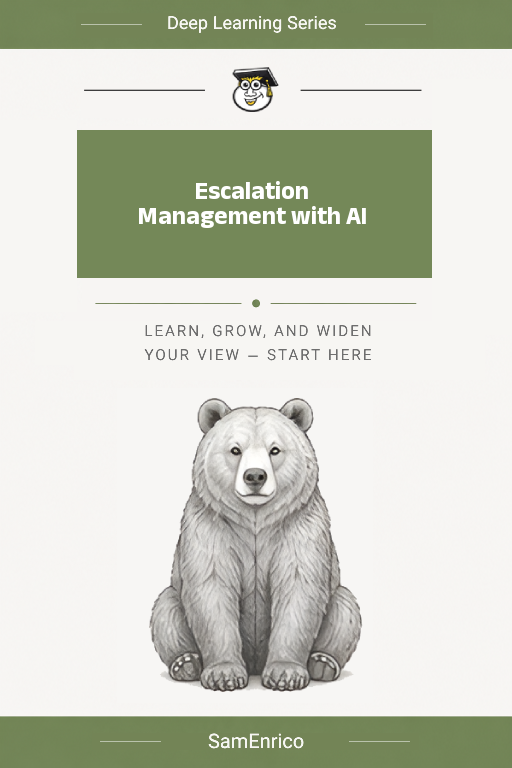
Non-FictionAI OperatorSupport Operations
Escalation Management with AI eBook
Design handoff workflows between AI agents and hum
by Mayer Avril
Design handoff workflows between AI agents and human reps. Ensure seamless customer experience.
Formats
Free sample
Chapter 1: The 68% Problem...--Every customer service leader has heard the pitch. A vendor sits across the table, projecting confidence, and clicks to the slide that makes executives lean forward. "Our AI handles 80% of conversations end to end. No human touch required. Think of the savings." The room nods.
The math is seductive. Eighty percent automation means twenty percent of the cost. Twenty percent of the agents. Twenty percent of the training budget. The vendor smiles.
The deal moves forward.There is just one problem. The customers hate it.Not all customers. Not all the time. But enough customers, often enough, that the 80% automation number becomes a trap rather than a triumph. Because here is what the vendor slide does not show: the customer who typed "AGENT" six times before realizing the bot was programmed to ignore the word.
The customer who spent thirteen minutes in a loop, being asked the same three questions, before finally locating a phone number that went to a different bot. The customer who canceled an eleven-year relationship because the machine would not let them talk to a person.This book is about what happens after the bot fails. Because the bot will fail. Not because AI is bad—in many ways, it is extraordinary—but because customer service is not a game of chess with finite moves and perfect information. It is a game of human emotion, broken processes, ambiguous requests, and situations where the right answer is not in the knowledge base.
The question is not whether your AI will need to escalate. The question is whether you have designed for that moment or whether you have pretended it will never come.The Seduction of 100% Automation Let us begin with a number: sixty-eight percent. According to a 2024 cross-industry study of twenty thousand consumers, 68% of customers still prefer speaking to a human agent for complex or emotionally charged issues. Not "would accept a human if forced." Prefer. Given a choice between a competent AI and a competent human, more than two out of three customers choose the person.Here is another number: sixty-three percent.
The same study found that 63% of consumers would take their business elsewhere if a company completely eliminated human customer support. Not "might consider leaving." Would leave. For the average mid-sized business, that represents millions in annual revenue at risk. For a large enterprise, it is billions.Yet companies are racing toward exactly that outcome. The logic is understandable.
Contact center costs are among the largest operational expenses for many businesses. Agent turnover often exceeds 40% annually. Training a new agent takes weeks and costs thousands of dollars. A bot costs fractions of a penny per conversation. The financial incentive to automate is enormous.But the financial incentive to retain customers is larger.
And customers who feel trapped by automation do not stay.The problem is not that AI lacks capability. Modern large language models can answer questions, process returns, update addresses, and even detect sentiment with reasonable accuracy. The problem is that capability is not the binding constraint. Trust is. A customer who does not trust the AI will not accept its answers, will not follow its instructions, and will not stay with the brand.
And trust is not built by better algorithms. It is built by respecting the customer's judgment about when a human is needed.The Three Escalation Types You Must Design For Before we go further, we need a common language for what escalation actually means. Most organizations think of escalation as a single event: the customer asks for a human, and the system transfers them. This binary view is responsible for most of the frustration in customer service today.In reality, escalation exists on a spectrum. The organizations that excel at escalation management design for all three types.Soft Escalation is the most sophisticated and the most rarely implemented.
In a Soft Escalation, the AI flags an issue for human review before the customer even knows a review is happening. The customer continues interacting with the AI as normal. But behind the scenes, a human supervisor is watching. The human may approve the AI's proposed path, correct it, or provide missing information. The AI then executes the human's guidance as if it had found the answer itself.
The customer never knows a human was involved. This pattern preserves automation rates while ensuring quality. It is the secret weapon of best-in-class operations.Warm Handoff is what most organizations think they are doing but rarely do correctly. In a Warm Handoff, the AI transfers the customer to a human with full context preserved. The customer does not repeat themselves.
The human sees the complete conversation history, the actions the AI already took, the data the customer already provided, and the specific reason for escalation. The human opens with a statement that demonstrates they already understand the situation. The customer feels heard, respected, and relieved.Hard Escalation is for scenarios where the AI should not attempt resolution at all. These include legal threats, safety concerns, bereavement, discrimination complaints, and any conversation where the customer explicitly asks "are you a real person?" in a way that suggests fundamental distrust. In a Hard Escalation, the AI stops collecting data, stops attempting resolution, and transfers immediately.
The transfer is unconditional. No confidence score threshold overrides it. No attempt count resets it.Most organizations only do Hard Escalation. They wait for the customer to become angry enough to demand a human, then transfer with minimal context. This is not escalation management.
It is escalation survival.The $38 Billion Tax on Bad Handoffs Let us put some numbers around the cost of getting this wrong.American consumers spend an average of thirteen hours per year in customer service queues. Not resolving issues. Not interacting with helpful agents. Waiting. Repeating themselves.
Being transferred. Being put on hold. Being asked for information they already provided.Thirteen hours. That is nearly two full work days. Per person.
Per year.Multiply that by the adult population of the United States, and you arrive at a staggering figure: approximately $38 billion in lost productivity annually. That is not the cost to companies. That is the cost to customers. Their time. Their patience.
Their goodwill.Now consider what happens to companies that waste that time. Customer satisfaction drops 12 percentage points when a call is transferred, even when the transfer ultimately resolves the issue. First-call resolution falls 14%. The likelihood of churn increases by nearly 20% after a single bad transfer experience.And here is the cruel irony: most of these bad transfers happen because companies designed their escalation logic to minimize transfers. They set high confidence thresholds.
They programmed the bot to deflect human requests. They made it difficult to reach an agent. And in doing so, they guaranteed that when a transfer finally did happen, the customer was already furious and the context was already lost.The organizations that design for escalation do the opposite. They make transfer easy. They lower the threshold for Warm Handoffs.
They accept that some customers will escalate unnecessarily because the cost of false positives (an unnecessary transfer) is far lower than the cost of false negatives (a trapped, furious customer who churns). They understand that the goal is not…
This is the end of the free sample. Get the eBook to keep going. Buy now
About this book
Details
- Author
- Mayer Avril
- Publisher
- SamEnrico
- Language
- English
- Genre
- Non-Fiction, AI Operator, Support Operations
- Released
- 2026-05-29
- Pages (approx.)
- 131
- Available as
- eBook, Audiobook

Read better in the ZLOADR app
Your eBooks on your phone or tablet. Sign in with your SamEnrico account and start reading.
More by Mayer Avril
 Sale Alert Blocking GuideMayer Avril$11.99
 Workplace Naloxone ProgramMayer Avril$11.99
 Opioid Phobia After OverdoseMayer Avril$11.99
 Bookly Session ComparisonMayer Avril$11.99
 The Veles and the Knight: A Slavic Exile’s QuestMayer Avril$11.99
 How to Start a Nets for Horticulture Business (Beginners Guide)Mayer Avril$11.99
 Dairy ManagerMayer Avril$11.99
 Learn to Play the SopraninoMayer Avril$11.99
You may also like
 Hong Kong Handover 1997Dunn Johnnie$11.99
 Zumba For Postnatal Recovery CourseNeal Christian$11.99
 Zumba for BeginnersLadner Nikia$11.99
 YouTube Comment Mining GuideHumes Pandora$12.99
 Worry Box MeditationCarlin Rudy$11.99
 Workplace Stress MeditationNguyen Lynn$11.99
 Workplace Stress and Sleep RepairHawley Ivory$11.99
 Workplace Perfectionism CureDelaney Jeffry$11.99
 Workplace Injustice Anger GuideWallen Isabelle$11.99
 Work Addiction and Burnout LinkGreenwood Ester$11.99
 Women in Yoga and WellnessBeattie Galina$11.99
 Women in Stand Up ComedyChun Evangeline$11.99