
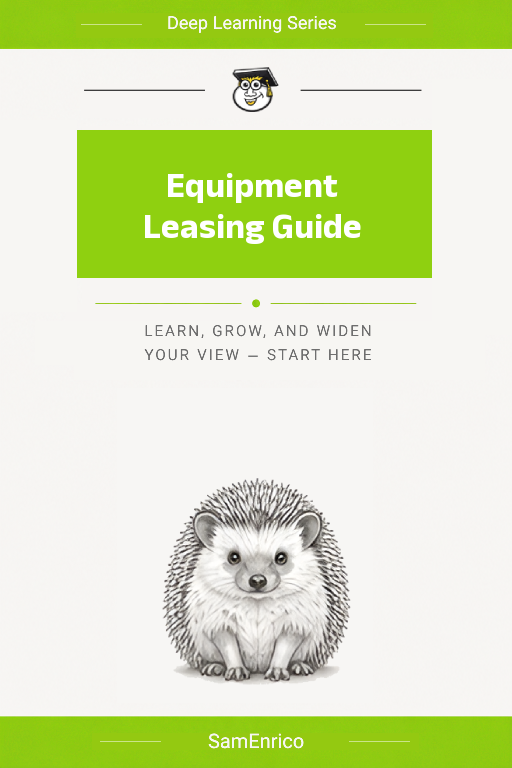
Non-FictionBusiness BriefLeasing
Equipment Leasing Guide eBook
Lease instead of buying equipment to preserve cash
Lease instead of buying equipment to preserve cash flow and upgrade technology easily.
Formats
Free sample
Chapter 1: The Ownership Trap--–- On a rainy Tuesday morning in 2011, I signed a five-year bank loan for 487,000topurchaseabrand−newoffsetprintingpress.Iremembertheweightofthepeninmyhand,theslickfeeloftheloandocuments,andtheproudsmileofmybanker.Iwasthirty−fouryearsold,hadbuiltacommercialprintingcompanyfromnothing,andbelieved Iwasdoingexactlywhatasuccessfulbusinessownerwassupposedtodo:ownthemeansofproduction.Thatbeliefcostme487,000 to purchase a brand-new offset printing press. I remember the weight of the pen in my hand, the slick feel of the loan documents, and the proud smile of my banker. I was thirty-four years old, had built a commercial printing company from nothing, and believed I was doing exactly what a successful business owner was supposed to do: own the means of production. That belief cost me 487,000topurchaseabrand−newoffsetprintingpress.Iremembertheweightofthepeninmyhand,theslickfeeloftheloandocuments,andtheproudsmileofmybanker.Iwasthirty−fouryearsold,hadbuiltacommercialprintingcompanyfromnothing,andbelieved Iwasdoingexactlywhatasuccessfulbusinessownerwassupposedtodo:ownthemeansofproduction.Thatbeliefcostme312,000 and nearly destroyed my marriage.Eighteen months later, a competitor three miles away installed the same model press. But they didn't buy it.
They leased it. When a digital printing revolution made offset presses obsolete two years after that, my competitor returned their press, leased a state-of-the-art digital model, and undercut my prices by 40 percent. I was stuck with a 487,000boatanchorthat Istillowed487,000 boat anchor that I still owed 487,000boatanchorthat Istillowed292,000 on. The press's actual market value: $47,000. I couldn't sell it.
I couldn't upgrade it. I couldn't even give it away without paying off the loan first.That experience taught me a brutal lesson that most business owners learn too late: the cult of ownership is the single most expensive belief in American commerce. We have been conditioned from childhood to equate ownership with success. Owning a home is the American Dream. Owning a business is the pinnacle of independence.
Owning equipment is considered an asset, a sign of stability, a badge of legitimacy. But in the modern economy, that badge often comes stapled to a death warrant.This book exists because I made that mistake so you don't have to. Over the next twelve chapters, I will show you exactly how to flip the script: how to stop tying up your cash in depreciating iron and start leasing everything that plugs in, rolls, or wears out. I will give you the scripts, the spreadsheets, the legal language, and the negotiation tactics I have learned over fifteen years of helping companies shift from ownership to access. But before we get into the mechanics, we need to burn down the most dangerous myth in business finance.The Myth of Ownership as Wealth Walk into any business networking event and listen to how owners describe their companies.
"I own three forklifts." "We have our own fleet of trucks." "We just bought a new CNC machine." The language of ownership is woven into the very fabric of how we measure success. But here is the truth that no one tells you: owned equipment is not an asset. It is a liability wearing an asset's clothing.Accounting textbooks define an asset as something that generates future economic benefit. But most equipment does the opposite. It consumes cash upfront (purchase price), consumes more cash for maintenance, consumes cash for storage and insurance, and then either sits idle or becomes obsolete.
Yes, it helps you produce revenue. But so does leased equipment. The difference is that leased equipment does not consume your borrowing capacity, does not trap your cash, and does not become your problem when it dies.Let me give you a simple test. Imagine two identical companies. Company A owns 2millionworthofequipmentfreeandclear.Company Bleasesthesameequipmentfor2 million worth of equipment free and clear.
Company B leases the same equipment for 2millionworthofequipmentfreeandclear.Company Bleasesthesameequipmentfor40,000 per month. A bank is considering lending each company $500,000 for an expansion. Which company gets the loan?Most people assume Company A looks stronger because they own assets. But banks do not want to lend against depreciating equipment. They want to lend against accounts receivable, inventory, and real estate.
Company A has 2milliontiedupinironthatthebankvaluesatmaybe2 million tied up in iron that the bank values at maybe 2milliontiedupinironthatthebankvaluesatmaybe800,000 on a good day. Company B has $2 million in cash that they never spent, sitting in their operating account. Company B gets the loan every single time. Because cash is king, not iron.The Four Hidden Costs of Ownership That No One Calculates When business owners compare buying versus leasing, they almost always make the same fatal mistake: they only compare the monthly payment. "Buying is cheaper in the long run," they say, because the total of lease payments over five years is higher than the purchase price.
This is the most expensive math error in business. Let me walk you through the four hidden costs that never appear on a purchase invoice.The first hidden cost is depreciation. The moment you drive a new truck off the dealer's lot, it loses 20 to 30 percent of its value. The moment you power up a new server, the same thing happens. This is not theoretical.
I have watched business owners proudly announce that they own a 150,000pieceofequipment,onlytodiscovereighteenmonthslaterthattheycouldnotsellitfor150,000 piece of equipment, only to discover eighteen months later that they could not sell it for 150,000pieceofequipment,onlytodiscovereighteenmonthslaterthattheycouldnotsellitfor40,000. Depreciation is not a tax fiction. It is real wealth destruction. And the IRS forces you to acknowledge it through depreciation schedules precisely because it is a real cost of doing business.The second hidden cost is technological obsolescence. This is depreciation on steroids.
In industries like information technology, medical devices, and manufacturing, new models arrive every twelve to twenty-four months. These new models are not just slightly better. They are often exponentially better. A three-year-old server is not worth 40 percent of its original price. It is worth zero because no one wants it.
The same is true for CNC machines with old control software, MRI machines with lower resolution than new models, and commercial kitchen equipment that fails new energy codes. When you buy technology, you are not buying an asset. You are buying a countdown clock to irrelevance.The third hidden cost is borrowing base consumption. Every dollar you spend on equipment is a dollar you cannot spend on payroll, marketing, research, or acquisitions. But the damage is worse than that.
Most businesses finance equipment purchases through their bank line of credit. That line of credit is typically tied to your borrowing base: a percentage of your accounts receivable plus inventory. When you draw on that line to buy equipment, you are reducing the capital available for working capital needs. This is how healthy businesses go bankrupt. They buy equipment, then cannot meet payroll when a customer pays late.
The equipment sits there, useless, while the business dies.The fourth hidden cost is strategic inflexibility. This is the cost that no spreadsheet can capture. When you own equipment, you are married to it. You cannot downsize easily. You cannot upgrade easily.
You cannot pivot to a new business model without dealing with the albatross of owned iron. I have watched owners turn down lucrative contracts because they would require different equipment than what they owned. I have watched owners stick with dying business models because they could not afford to write off their equipment investments. Ownership does not just cost you money. It costs you options.
And in a volatile economy, options are the only thing that matters.The Cap Ex-to-Op Ex Conversion Explained Now let me give you the financial framework that changed everything…
This is the end of the free sample. Get the eBook to keep going. Buy now
About this book
Details
- Author
- Wooldridge Halina
- Publisher
- SamEnrico
- Language
- English
- Genre
- Non-Fiction, Business Brief, Leasing
- Released
- 2026-06-01
- Pages (approx.)
- 148
- Available as
- eBook, Audiobook

Read better in the ZLOADR app
Your eBooks on your phone or tablet. Sign in with your SamEnrico account and start reading.
More by Wooldridge Halina
 TMS for Treatment Resistant MDDWooldridge Halina$11.99
 Creative Thinking for Operations ResearchWooldridge Halina$11.99
 Dog Loss Grief WorkbookWooldridge Halina$11.99
 Cholesterol Pregnancy GuideWooldridge Halina$11.99
 Retief Goosen Ice ManWooldridge Halina$11.99
 Chess Opening CardsWooldridge Halina$11.99
 Verbal Overshadowing Effect on IDWooldridge Halina$11.99
 Fear Of ThunderstormsWooldridge Halina$11.99
 Monte Cassino: The Mountain That Wouldn’t FallWooldridge Halina$11.99
 Iron Storm Over the Coral Sea: The Battle That Saved AustraliaWooldridge Halina$11.99
 Service Providers Guide to Propane Sales & ServicesWooldridge Halina$11.99
 How to Produce Household SundriesWooldridge Halina$11.99
You may also like
 Hong Kong Handover 1997Dunn Johnnie$11.99
 Zumba For Postnatal Recovery CourseNeal Christian$11.99
 Zumba for BeginnersLadner Nikia$11.99
 YouTube Comment Mining GuideHumes Pandora$12.99
 Worry Box MeditationCarlin Rudy$11.99
 Workplace Stress MeditationNguyen Lynn$11.99
 Workplace Stress and Sleep RepairHawley Ivory$11.99
 Workplace Perfectionism CureDelaney Jeffry$11.99
 Workplace Injustice Anger GuideWallen Isabelle$11.99
 Work Addiction and Burnout LinkGreenwood Ester$11.99
 Women in Yoga and WellnessBeattie Galina$11.99
 Women in Stand Up ComedyChun Evangeline$11.99