
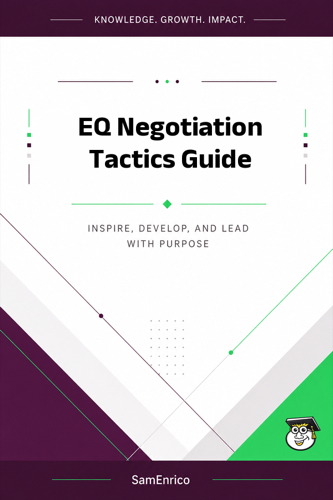
Non-FictionSelf-HelpNegotiation
EQ Negotiation Tactics Guide eBook
Read counterpart emotions and adjust negotiation s
Read counterpart emotions and adjust negotiation strategies for win win outcomes.
Formats
Free sample
Chapter 1: The Emotional Mirror--–- You are about to enter a negotiation. Your palms are slightly damp. Your mind is racing through possible objections, counteroffers, and fallback positions. You have reviewed the data, memorized your walkaway point, and rehearsed your opening statement three times. You are prepared.
And yet, something feels wrong. That something is not in the spreadsheet. It is not in your talking points. It is sitting in your chest, tightening, and you cannot name it.That something is your own unexamined emotion.Every negotiation book teaches you to read the other person. Few teach you to read yourself first.
This is the fatal flaw in most negotiation training. You can master every tactic, every calibrated question, every mirroring technique in existence, but if you walk into a negotiation with an unregulated amygdala, you will lose to someone who has done the internal work. The person who remains calm while you react owns the room. The person who sees their own emotional patterns before they see yours holds the real leverage.This chapter is about becoming a neutral instrument. It is about the uncomfortable, necessary work of looking inward before you ever look across the table.
Because the truth is brutal but liberating: you cannot accurately read a counterpart’s emotions if your own emotional state is hijacking your perception. Fear will make you see threats that do not exist. Anger will make you miss opportunities for collaboration. Exhaustion will make you agree to terms you will regret by morning.The Emotional Audit is your first and most essential tool. It is not a one-time exercise.
It is a discipline, a pre-game ritual, and a lifeline. Master this, and every tactic in the subsequent chapters will work. Skip this, and you will be the negotiator who knows exactly what to do but cannot do it when it matters most.The Myth of the Rational Negotiator There is a persistent fantasy in business culture that great negotiators are purely logical creatures. They weigh options, calculate probabilities, and make dispassionate decisions based on objective data. This fantasy is not only wrong; it is dangerous.Neuroscience has demolished the idea of the rational actor.
Antonio Damasio’s groundbreaking research with patients who had damage to the ventromedial prefrontal cortex revealed something astonishing: these patients could perform logical calculations perfectly, but they could not make decisions. They could list pros and cons endlessly, but without emotional input, they remained paralyzed. Damasio’s conclusion, now widely accepted, is that emotion is not the enemy of reason. Emotion is the substrate of reason. You cannot decide without feeling.This means that every negotiation is fundamentally an emotional event.
Even the driest contract negotiation, the most technical procurement discussion, the most number-crunching budget meeting is saturated with emotion. The emotion may be quiet. It may be disguised as professionalism or urgency or fatigue. But it is always there.The negotiator who pretends otherwise is not a rational actor. They are a person in denial, and denial is an emotional state.
It is the emotion of avoidance dressed in business casual.The first step toward emotional mastery is accepting that you are an emotional creature. Not sometimes. Not only when you are stressed. Always. Your brain evolved to feel before it thinks.
The amygdala processes threats in milliseconds. The prefrontal cortex, the so-called “rational brain,” takes hundreds of milliseconds longer. By the time you think, you have already felt.This is not a weakness. It is a design feature. But it is a feature you must learn to work with, not against.The 5 Core Concerns: Your Emotional Diagnostic Tool To audit your own emotional state, you need a framework.
Without a framework, you will simply feel “bad” or “stressed” or “anxious” without understanding why. Vague awareness is not useful. Precise diagnosis is.Drawing from the work of Roger Fisher and Daniel Shapiro, authors of Beyond Reason, this book uses the 5 Core Concerns as the foundational diagnostic tool for emotional intelligence in negotiation. These five concerns are universal human needs that, when met, produce positive emotions and collaborative behavior. When violated, they produce negative emotions and defensive or aggressive behavior.The 5 Core Concerns are:1.
Appreciation Appreciation is the need to feel heard, understood, and valued. It is not agreement. You can appreciate someone’s perspective without agreeing with their position. Appreciation says, “I see your effort. I understand your point.
Your presence here matters.”When appreciation is violated, you feel dismissed, ignored, or belittled. The emotional response is often frustration, resentment, or withdrawal. In a negotiation, an unappreciated counterpart will either fight for recognition or shut down entirely.2. Affiliation Affiliation is the need to feel connected, to be treated as a partner rather than an adversary. It is the sense of “we are in this together.” Affiliation transforms a transaction into a relationship.When affiliation is violated, you feel isolated, opposed, or treated as an enemy.
The emotional response is often defensiveness, suspicion, or hostility. A counterpart who feels no affiliation will view every concession as a loss and every proposal as a trap.3. Autonomy Autonomy is the need to feel in control of your own choices. It is the freedom to say yes or no without coercion. Autonomy does not mean getting everything you want.
It means having the space to decide for yourself.When autonomy is violated, you feel trapped, pressured, or manipulated. The emotional response is often resistance, rebellion, or passive aggression. An ultimatum is the most direct violation of autonomy. Even if the ultimatum offers a good deal, the instinct is to reject it simply to reclaim control.4. Status Status is the need to feel respected, competent, and worthy relative to others.
Status is not about ego in the negative sense. It is about fair recognition of one’s standing, expertise, or contribution.When status is violated, you feel diminished, humiliated, or overlooked. The emotional response is often shame, anger, or a desperate need to prove oneself. Status violations are among the most explosive in negotiation because they feel personal. An attack on your status feels like an attack on your identity.5.
Role Role is the need to have a meaningful and fulfilling function in the interaction. Role is about purpose. It answers the question, “What am I supposed to do here, and does it matter?”When role is violated, you feel useless, confused, or irrelevant. The emotional response is often apathy, disengagement, or frustration. A negotiator whose role is unclear will either over-function (trying to control everything) or under-function (checking out entirely).These five concerns are not abstract theories.
They are the levers of emotional experience. Every negative emotion you feel in a negotiation can be traced back to a violation of one or more of these concerns. Every positive emotion can be traced to one or more being met.The Late-Night Flight Test: Separating Substance from Emotion Here is a practical exercise to help you diagnose which of the 5 Core Concerns is driving your emotional state.Imagine you are on a late-night red-eye flight. You are exhausted. The flight has been delayed for three hours.
The gate has changed twice. You have no control over any of it. Now ask yourself: what is truly upsetting…
This is the end of the free sample. Get the eBook to keep going. Buy now
About this book
Details
- Author
- Carrington Mariam
- Publisher
- SamEnrico
- Language
- English
- Genre
- Non-Fiction, Self-Help, Negotiation
- Released
- 2026-06-08
- Pages (approx.)
- 155
- Available as
- eBook, Audiobook

Read better in the ZLOADR app
Your eBooks on your phone or tablet. Sign in with your SamEnrico account and start reading.
More by Carrington Mariam
 Historical Trauma AngerCarrington Mariam$11.99
 Green Beret Vietnam War StoryCarrington Mariam$11.99
 Random Input Creativity MethodCarrington Mariam$11.99
 The Last Voyage of the Belgica: Trapped in the Ice of the UnknownCarrington Mariam$11.99
 The Tower of Ten Thousand Shadows: The Yokai Architect's CurseCarrington Mariam$11.99
 Understanding Fuhrmann–rieger–de Sousa SyndromeCarrington Mariam$17.99
 How to Become a Director Of PhotographyCarrington Mariam$11.99
 Printed Catalog Launch HandbookCarrington Mariam$12.99
 Chinese Student EngagementCarrington Mariam$12.99
 Bike Rack Installation (Anchored)Carrington Mariam$11.99
You may also like
 Hong Kong Handover 1997Dunn Johnnie$11.99
 Zumba For Postnatal Recovery CourseNeal Christian$11.99
 Zumba for BeginnersLadner Nikia$11.99
 YouTube Comment Mining GuideHumes Pandora$12.99
 Worry Box MeditationCarlin Rudy$11.99
 Workplace Stress MeditationNguyen Lynn$11.99
 Workplace Stress and Sleep RepairHawley Ivory$11.99
 Workplace Perfectionism CureDelaney Jeffry$11.99
 Workplace Injustice Anger GuideWallen Isabelle$11.99
 Work Addiction and Burnout LinkGreenwood Ester$11.99
 Women in Yoga and WellnessBeattie Galina$11.99
 Women in Stand Up ComedyChun Evangeline$11.99