
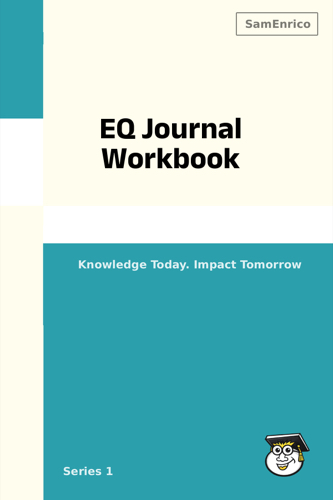
Free sample
Chapter 1: The Expensive Emotion--–- The email arrived at 10:37 AM on a Tuesday. Marcus, a senior project manager with an MBA from a top-tier university and a reputation for being the smartest person in every room, read the words "We need to discuss your team's performance" and felt his face go hot. By 10:38 AM, he had fired off a response—four paragraphs, fourteen exclamation points, and a passive-aggressive request for "clarity on why my department is being singled out again." By 10:42 AM, he had been copied on an HR thread. By 5:00 PM, he had been asked to take a week of "administrative leave" to "reflect on communication standards."Marcus had an IQ of 145. He could code in six languages.
He had turned around failing projects that smarter people said were impossible. And none of it mattered, because in four minutes, he had undone a year of reputation.This is not a story about a bad person. It is a story about a blind spot. And if you are reading this book, you almost certainly have the same blind spot.The Question That Changes Everything Let us ask a question that no performance review has ever asked you, no report card has ever measured, and no interview panel has ever probed: What is the most expensive emotion you have felt in the past thirty days?Not the strongest emotion. Not the most painful emotion.
The most expensive emotion—the one that cost you something measurable. A relationship. A promotion. A night of sleep. Three hours of rumination that could have been spent with your children.
The apology you had to issue. The email you regretted sending. The door you closed that you cannot reopen.Take a moment. Let the question land. If you are like most of the thousands of professionals, parents, and leaders who have tested the exercises in this book, you already have an answer forming.
It might be shame from a conversation you avoided. It might be anger that leaked out as sarcasm during a team meeting. It might be fear that kept you from speaking up in a negotiation, costing you twenty thousand dollars you will never know you lost.Here is the uncomfortable truth that the top ten bestselling books on emotional intelligence all agree upon, from Daniel Goleman's seminal Emotional Intelligence to the Harvard Business Review's 10 Must Reads on Emotional Intelligence: raw intelligence is not the primary driver of success. It never has been. A person with an average IQ but high emotional intelligence will consistently outperform a person with a genius-level IQ but low emotional intelligence in every metric that matters—leadership effectiveness, career advancement, relationship satisfaction, physical health, and even life expectancy.The data is staggering and, for many, infuriating.
Studies of workplace performance have repeatedly shown that EQ accounts for nearly 90% of what distinguishes top performers from average ones in leadership roles. Technical skills and IQ together account for the rest. In other words, you can be the best engineer in the company, but if you cannot regulate your reactions during a design review, you will never run the engineering department. You can be the most brilliant surgeon, but if you cannot deliver bad news to a family without shutting down or snapping, your patients will rate you poorly, your referrals will dry up, and your career will plateau.This chapter is not designed to make you feel bad about your IQ or your technical competence. You are clearly capable—you are reading a book about emotional intelligence, which already puts you ahead of the vast majority of people who will never examine their inner lives.
This chapter is designed to do something far more useful: to help you calculate the exact cost of your emotional blind spots, so that the rest of this workbook has a clear return on investment.The Anatomy of an Emotional Hijack Before we can understand why emotions become expensive, we need to understand what happens inside your brain in the seconds before you do something you regret. This is not abstract neuroscience for its own sake; this is practical knowledge that will save you thousands of hours of repair work.Deep within your brain, tucked behind your ears and shaped like two small almonds, sits the amygdala. Its only job is survival. The amygdala does not care about your career, your reputation, your relationships, or your five-year plan. It cares about one thing: keeping you alive in the next three seconds.
It was designed for a world of predators, not a world of passive-aggressive emails, critical feedback, and social rejection.Here is the problem. Your amygdala cannot tell the difference between a tiger and a text message. It cannot distinguish between a physical threat (a car running a red light) and a social threat (your boss saying "we need to talk"). The same chemical cascade—cortisol, adrenaline, norepinephrine—floods your system whether you are being chased by a predator or being ignored by a colleague.This is the amygdala hijack, a term first popularized by Daniel Goleman. When the amygdala perceives a threat, it seizes control of the brain's resources.
Blood flow redirects from the prefrontal cortex—the logical, planning, future-oriented part of your brain—to your limbs and reflexes. Your heart rate spikes. Your breathing becomes shallow. Your field of vision narrows. In approximately six seconds, a full hijack runs its course.During those six seconds, your IQ effectively drops by ten to fifteen points.
You lose access to nuance, long-term thinking, impulse control, and empathy. You become, neurologically speaking, a different person—a person who says things they do not mean, sends emails they cannot recall, and makes decisions they will spend days or weeks undoing.The critical insight, which we will return to throughout this workbook, is this: you cannot stop a hijack from starting. The amygdala is simply too fast. It detects a threat and initiates the cascade before your conscious brain even registers what is happening. What you can do—and what high-EQ people have learned to do—is shorten the hijack.
You can learn to recognize the physical signals of an incoming hijack, insert a six-second pause, and allow your prefrontal cortex to re-engage before you act.Most people never learn this skill. They live their entire lives at the mercy of a six-second chemical cascade that they mistake for their true self. They say "that's just how I am" or "I have a short temper" or "I tell it like it is" —all of which are rationalizations for a brain that has never been trained.The Success Audit: Measuring What Actually Works Let us move from neuroscience to something more personal. Open this workbook to the first journaling spread, or grab a notebook if you prefer to write elsewhere. You are going to conduct a Success Audit—a simple but ruthless inventory of your achievements, organized not by how impressive they sound but by what actually drove them.Draw a vertical line down the center of a two-page spread.
On the left side, title it IQ Wins. On the right side, title it EQ Wins.In the left column, list every significant achievement you can recall that was driven primarily…
This is the end of the free sample. Get the eBook to keep going. Buy now
About this book
Details
- Author
- Whitson Kaitlin
- Publisher
- SamEnrico
- Language
- English
- Genre
- Non-Fiction, Self-Help / Journal
- Released
- 2026-06-06
- Pages (approx.)
- 142
- Available as
- eBook, Audiobook

Read better in the ZLOADR app
Your eBooks on your phone or tablet. Sign in with your SamEnrico account and start reading.
More by Whitson Kaitlin
 Dumbbell HIIT CircuitWhitson Kaitlin$11.99
 The CPR Compression GuideWhitson Kaitlin$11.99
 Artist Morning RitualWhitson Kaitlin$11.99
 Relationship Comparison TrapWhitson Kaitlin$11.99
 Phone Call TriggersWhitson Kaitlin$11.99
 Influence For ManagersWhitson Kaitlin$11.99
 Grease Fire Burn ResponseWhitson Kaitlin$11.99
 The Phantom Thieves of Rio: Canada's Luxury Car Heist RingWhitson Kaitlin$11.99
 The Djinn of the Empty Quarter: A Sandstorm’s WhisperWhitson Kaitlin$11.99
 How to Produce Satellite and Cable TVWhitson Kaitlin$11.99
 How to Produce Fishing Snaps and SwivelsWhitson Kaitlin$11.99
 How to Become a Hassock MakerWhitson Kaitlin$11.99
You may also like
 Hong Kong Handover 1997Dunn Johnnie$11.99
 Zumba For Postnatal Recovery CourseNeal Christian$11.99
 Zumba for BeginnersLadner Nikia$11.99
 YouTube Comment Mining GuideHumes Pandora$12.99
 Worry Box MeditationCarlin Rudy$11.99
 Workplace Stress MeditationNguyen Lynn$11.99
 Workplace Stress and Sleep RepairHawley Ivory$11.99
 Workplace Perfectionism CureDelaney Jeffry$11.99
 Workplace Injustice Anger GuideWallen Isabelle$11.99
 Work Addiction and Burnout LinkGreenwood Ester$11.99
 Women in Yoga and WellnessBeattie Galina$11.99
 Women in Stand Up ComedyChun Evangeline$11.99