
Non-FictionSelf-HelpWriting Psychology
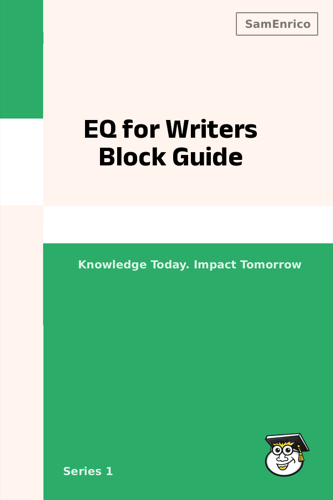
EQ for Writers Block Guide eBook
Overcomes creative paralysis using emotional aware
Overcomes creative paralysis using emotional awareness.
Formats
Free sample
Chapter 1: The Silence Before the Word...--You are sitting in front of a blank screen. The cursor blinks at you with the patience of a torturer. Your hands rest on the keyboard, but they might as well be made of stone. You know what you want to say—or at least, you know that you want to want to say something. But the words will not come.
Minutes pass. Then hours. You check your phone. You get a glass of water. You reorganize your desktop icons.
You read the same paragraph of research for the seventh time. You tell yourself that you will start tomorrow, when you are fresher, when the mood is right, when the stars align.But tomorrow comes, and the cursor is still blinking.If you are reading this book, you know this scene intimately. You have lived it dozens, perhaps hundreds, of times. And every time it happens, a smaller, quieter voice whispers in the back of your mind: What is wrong with me? Am I not disciplined enough?
Am I not talented enough? Am I not a real writer?That voice is wrong. And this chapter is going to prove it to you.The Shame That Deepens the Block Let us name the thing that hurts the most about writer's block. It is not the lost time, though that is frustrating. It is not the missed deadlines, though those are stressful.
It is not even the unfinished projects, though they haunt you. The deepest wound of writer's block is shame.You believe, on some level, that if you were a better person—more disciplined, more talented, more professional, more something—you would not be stuck. You look at writers who produce every day and assume they have something you lack. Willpower. Grit.
The mysterious X-factor called "talent." And because you cannot see their struggles, you assume they do not have any. You assume you are alone in your paralysis.You are not alone. You are not broken. And the shame you feel is not just an unpleasant side effect of being stuck—it is a primary cause of staying stuck.Here is the cruel irony that every blocked writer must understand: shame does not motivate you to write. It paralyzes you further.
When you feel ashamed of being blocked, your brain releases stress hormones. Those stress hormones activate the same freeze response that caused the block in the first place. You are layering shame on top of paralysis, which creates more paralysis, which creates more shame. It is a spiral. And the only way out is to stop believing the lie that writer's block is your fault.The Myth You Have Been Told Our culture has a story about writer's block.
You have heard it a thousand times. The story goes like this: Writer's block happens to amateur writers, to lazy writers, to undisciplined writers. Real writers—professionals, serious artists, people with talent—do not get blocked. They sit down and they write, regardless of how they feel. If you are blocked, the story says, it is because you are not trying hard enough.
You lack willpower. You lack character.This story is not just wrong. It is dangerously wrong.The myth of writer's block as a character flaw has destroyed more writing careers than lack of talent ever could. Because when you believe the myth, you respond to blockage with self-punishment. You stay up later.
You try harder. You berate yourself. You make grand resolutions to "just write" no matter what. And when those strategies fail—as they inevitably do—you conclude that the problem is even deeper than you thought. You must be fundamentally flawed.
You must not be a real writer after all.Let us be clear: Writer's block is not a moral failure. It is not a lack of willpower. It is not a sign that you are an imposter. It is a neurological and emotional signal. And once you learn to read that signal, you can do something about it.The Neuroscience of Creative Paralysis To understand why you get stuck, you need to understand a little bit about how your brain works.
Do not worry—this will not be a dry anatomy lesson. But there is one distinction that will change everything you think about writer's block.Your brain has two major systems that matter for writing. The first is the prefrontal cortex. This is the part of your brain located right behind your forehead. It is responsible for planning, language, sequencing, abstract thinking, creativity, and self-control.
It is the "executive" of your brain. When you are writing well, your prefrontal cortex is fully engaged, stringing words into sentences, sentences into paragraphs, paragraphs into meaning.The second system is the limbic system. This is an older, more primitive part of your brain. It includes a small, almond-shaped structure called the amygdala. The amygdala's job is to detect threats and activate your body's emergency response.
It does not distinguish between different kinds of threats. A tiger lunging at you and a blank page waiting for your words? The amygdala cannot tell the difference. Both register as danger.Here is what happens when you sit down to write and feel even a flicker of fear—fear of judgment, fear of failure, fear of vulnerability, fear of success, fear of wasting time, fear of being exposed as a fraud. Your amygdala sounds the alarm.
It triggers what psychologists call the fight/flight/freeze response. Your body releases stress hormones. Your heart rate increases. Your breathing becomes shallow. Blood flow diverts away from your prefrontal cortex (the thinking, writing part of your brain) and toward your muscles and limbs (so you can run from the tiger).The result?
The very part of your brain you need for writing goes offline. You stare at the blank page, and there is nothing there. The words will not come. Not because you lack talent, not because you are lazy, but because your brain has literally, physically, neurologically redirected its resources away from writing and toward survival.You are not broken. You are having a normal, predictable, physiological response to a perceived threat.
The only problem is that the threat is not real—it is a blank page.The Critical Question: Writing or Writer?Now that you understand the neuroscience, you need a practical way to apply it. Every time you feel stuck, you have a choice about where to place your attention. You can focus on the writing itself—the plot hole, the awkward sentence, the missing transition, the character who will not cooperate. Or you can focus on the writer—the fear, the shame, the perfectionism, the exhaustion, the overwhelm.Most blocked writers focus on the writing. They assume that if they could just fix the sentence, solve the plot problem, find the perfect opening line, the block would disappear.
So they stare harder at the page, trying to think their way out of the problem. But remember what happens when you are in a freeze response: your prefrontal cortex is already compromised. You cannot think your way out of a problem when the thinking part of your brain is offline. That is like trying…
This is the end of the free sample. Get the eBook to keep going. Buy now
About this book
Details
- Author
- Myrick Cassondra
- Publisher
- SamEnrico
- Language
- English
- Genre
- Non-Fiction, Self-Help, Writing Psychology
- Released
- 2026-06-09
- Pages (approx.)
- 155
- Available as
- eBook, Audiobook

Read better in the ZLOADR app
Your eBooks on your phone or tablet. Sign in with your SamEnrico account and start reading.
More by Myrick Cassondra
 TM For Essential Tremor WorkbookMyrick Cassondra$11.99
 Library as Living RoomMyrick Cassondra$11.99
 Gratitude for Difficult PeopleMyrick Cassondra$11.99
 Beginner Body Scan Meditation GuideMyrick Cassondra$11.99
 Silent Shadows of Dettingen: The Prussian Gambit That Saved an EmpireMyrick Cassondra$11.99
 Understanding Myhre–school SyndromeMyrick Cassondra$17.99
 Antibody Development and Immunohistochemistry TechnicianMyrick Cassondra$11.99
 Inventory Formula Study GuideMyrick Cassondra$12.99
 KLA Corporation SWOT GuideMyrick Cassondra$12.99
 How to Start a Mushroom Spawn Growing Business (Beginners Guide)Myrick Cassondra$11.99
You may also like
 Hong Kong Handover 1997Dunn Johnnie$11.99
 Zumba For Postnatal Recovery CourseNeal Christian$11.99
 Zumba for BeginnersLadner Nikia$11.99
 YouTube Comment Mining GuideHumes Pandora$12.99
 Worry Box MeditationCarlin Rudy$11.99
 Workplace Stress MeditationNguyen Lynn$11.99
 Workplace Stress and Sleep RepairHawley Ivory$11.99
 Workplace Perfectionism CureDelaney Jeffry$11.99
 Workplace Injustice Anger GuideWallen Isabelle$11.99
 Work Addiction and Burnout LinkGreenwood Ester$11.99
 Women in Yoga and WellnessBeattie Galina$11.99
 Women in Stand Up ComedyChun Evangeline$11.99