
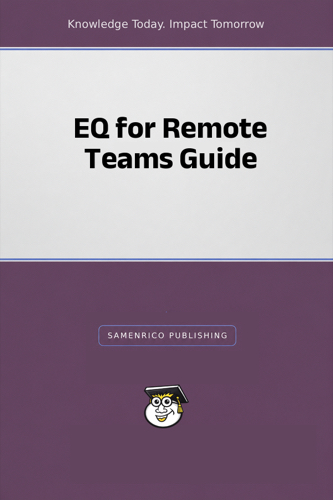
Non-FictionSelf-HelpRemote Work
EQ for Remote Teams Guide eBook
Builds emotional connection and conflict resolutio
by Burton Ricky
Builds emotional connection and conflict resolution across screens.
Formats
Free sample
Chapter 1: The Frozen Mirror--You have just finished a video call. Your back hurts. Your eyes are dry. Your brain feels like it has been running on a treadmill for three hours, except you have been sitting perfectly still. You check your calendar.
You were only on that call for forty-five minutes.This is not normal exhaustion. This is not a lack of coffee or a poor night’s sleep. This is a neurological event, and it has a name: Zoom fatigue. The term has entered the global vocabulary, but almost everyone has misdiagnosed the cause. Conventional wisdom blames screen time, or back-to-back meetings, or the sheer volume of digital communication.
All of those factors matter, but they are symptoms, not the disease.The real disease is this: your brain was not designed to process other humans through a screen.For three hundred thousand years, human beings have read each other through peripheral vision, body language, tone of voice, and the subtle micro-movements of a face seen in three dimensions. Every conversation your ancestors had was a full-body event. Your brain evolved to expect certain inputs—the slight tilt of a head, the rustle of clothing, the ambient awareness of someone standing to your left—and when those inputs disappear, your brain does not adapt gracefully. It panics.This chapter is about why your screen is lying to you. It is about the neuroscience of remote communication, the hidden costs of video calls, and the single most important shift you can make to protect your team’s cognitive bandwidth.
By the end of this chapter, you will understand why you are exhausted, why your team is irritable, and what to do about it. More importantly, you will learn that the solution is not more technology. The solution is less.The Cognitive Load Crisis Let us start with a simple experiment. Think about the last time you had a difficult conversation in person. You were probably standing or sitting across from someone.
You could see their hands. You could see their shoulders. You could see what was happening behind them. You could hear the ambient sounds of the room—a fan, footsteps, the shuffle of papers. All of that information was processed subconsciously, which means your conscious brain was free to focus on the actual content of the conversation.Now think about the last time you had that same conversation on a video call.
You were staring at a grid of faces. You could see only from the collarbone up. You were watching your own face in a small window, which is something no human being has ever done in the history of evolution until the last five years. You were trying to interpret emotions from a pixelated image that froze every few minutes. You were aware that others could see your face, your background, your lighting, and your expression.
You were doing all of this while also trying to listen, think, and respond.That is the difference. In-person communication is low-load. Video communication is high-load. The technical term for this is Non-Verbal Overload, and it is the primary driver of remote exhaustion.Non-Verbal Overload means that your brain is working three times harder to extract the same amount of social information from a digital interaction as it would from an in-person interaction. Why three times?
Because on a screen, almost all of the usual cues are missing or degraded.Consider the following. In person, you process facial expressions through binocular vision, which gives you depth and nuance. On a screen, you are looking at a two-dimensional representation of a face, often compressed and delayed. In person, you see the whole body, which provides context for the face. A clenched jaw means something different when accompanied by crossed arms.
On a screen, you see only the face, which means you are constantly guessing. In person, you have peripheral awareness of the room, which helps you understand the environment. On a screen, you have no periphery, only the grid.Your brain tries to compensate for these missing cues by working harder. It fills in gaps. It makes assumptions.
It amplifies small signals into large ones. And all of that work is exhausting, even if you do not notice it happening.The Frozen Screen Effect Now let us add another layer. Video calls freeze. Connections lag. Audio drops out.
These are not minor annoyances. They are neurological triggers.When a screen freezes in the middle of a facial expression, your brain does not know what to do. In the physical world, faces do not freeze. They move continuously. When a face freezes, your brain registers something wrong, and because it cannot immediately identify the source of the wrongness, it defaults to a threat response.
Specifically, the brain interprets a frozen face as social rejection or social threat.This is called the Frozen Screen Effect, and it is measurable. When researchers monitor cortisol levels before and after video calls with frequent freezes, they find spikes comparable to mild social stress. Your body is literally producing stress hormones because your colleague’s face froze for two seconds.The same effect occurs with audio lag. In normal conversation, the gap between one person finishing a sentence and the next person beginning is about two hundred milliseconds. On a video call, that gap is often four hundred milliseconds or more.
Your brain detects the delay. It interprets the delay as hesitation, disinterest, or hostility. Suddenly, a perfectly neutral statement like “I will review the document” sounds like “I will review the document… if I have to.”None of this is happening at a conscious level. You are not thinking, “Ah, the two-hundred-millisecond delay is causing me to misinterpret my colleague.” You are simply feeling irritated, or anxious, or inexplicably annoyed. The feeling is real.
The cause is invisible.The Cognitive Load Formula Let us put all of this together into a single equation. The Cognitive Load Formula describes the total mental effort required for a remote interaction:Cognitive Load = Facial Scanning + Timing Latency + Self-Consciousness Each of these components is a tax on your brain. Let us break them down.Facial scanning is the effort required to extract emotional information from a two-dimensional, often pixelated face. In person, facial scanning is almost automatic. On a screen, it is deliberate and draining.
You are constantly checking for micro-expressions that may or may not be visible, and you are doing this while also maintaining eye contact with a camera lens, which is not the same as eye contact with a person.Timing latency is the cognitive cost of the delay between speaking and hearing. Your brain has to hold onto your thought longer than it should, waiting for the other person to respond. This creates a backlog of unprocessed information, which increases mental fatigue.Self-consciousness is the cost of watching your own face. For the entire duration of a video call, you are seeing yourself as others see you. This triggers the same neural pathways as public speaking.
Even if you are just listening, part of your brain is monitoring your own expression, your own background, your own appearance. That monitoring is work.Add these three together, and you get exhaustion. Not…
This is the end of the free sample. Get the eBook to keep going. Buy now
About this book
Details
- Author
- Burton Ricky
- Publisher
- SamEnrico
- Language
- English
- Genre
- Non-Fiction, Self-Help, Remote Work
- Released
- 2026-06-10
- Pages (approx.)
- 128
- Available as
- eBook, Audiobook

Read better in the ZLOADR app
Your eBooks on your phone or tablet. Sign in with your SamEnrico account and start reading.
More by Burton Ricky
 The Success FearBurton Ricky$11.99
 Software Developer Interruption GuideBurton Ricky$11.99
 Reflective Listening Technique GuideBurton Ricky$11.99
 Parent Death and Cultural RitualsBurton Ricky$11.99
 The Quit Smoking Lung HealingBurton Ricky$11.99
 Study Video GuideBurton Ricky$11.99
 Airtable Reminder BaseBurton Ricky$11.99
 Reuniting the Orphan Train RidersBurton Ricky$11.99
 The Pharaoh's Bat and Ball: Egypt's Forgotten Ancient Game of SkillBurton Ricky$11.99
 The Vanishing Billionaire: The Mysterious Disappearance of Harold SmithBurton Ricky$11.99
 The Golden Calculators of Timbuktu: Mathematics That Shaped the WorldBurton Ricky$11.99
 The Mineral Guide to KinoiteBurton Ricky$11.99
You may also like
 Hong Kong Handover 1997Dunn Johnnie$11.99
 Zumba For Postnatal Recovery CourseNeal Christian$11.99
 Zumba for BeginnersLadner Nikia$11.99
 YouTube Comment Mining GuideHumes Pandora$12.99
 Worry Box MeditationCarlin Rudy$11.99
 Workplace Stress MeditationNguyen Lynn$11.99
 Workplace Stress and Sleep RepairHawley Ivory$11.99
 Workplace Perfectionism CureDelaney Jeffry$11.99
 Workplace Injustice Anger GuideWallen Isabelle$11.99
 Work Addiction and Burnout LinkGreenwood Ester$11.99
 Women in Yoga and WellnessBeattie Galina$11.99
 Women in Stand Up ComedyChun Evangeline$11.99