
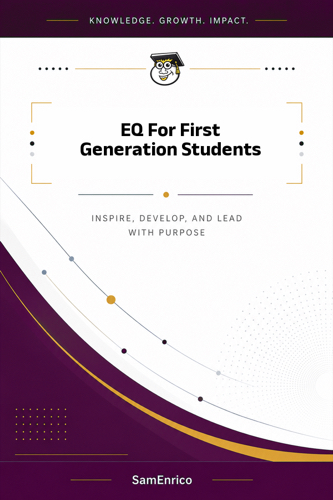
EQ For First Generation Students eBook
Navigates family expectations and imposter syndrom
by Cruz Taylor
Navigates family expectations and imposter syndrome.
Formats
Free sample
Chapter 1: The Cultural Chasm--The first time you felt it, you probably didn’t have a name for it. Maybe it was Thanksgiving of your freshman year, when your aunt asked what you were learning, and you started to explain your interest in post-colonial theory or microeconomics, and you watched her eyes glaze over while your uncle muttered something about “ivory tower nonsense.” Maybe it was the study abroad meeting where everyone else seemed to already know that “spring break in Costa Rica” meant a faculty-led research trip, not a party, and you sat there calculating how many shifts at the dining hall it would take to afford the flight. Maybe it was the moment your mother called, worried because you hadn’t texted back in six hours, and you couldn’t explain that you had been in back-to-back classes, then a lab, then a group project meeting, and that “busy” meant something different now than it did in high school.Or maybe it was quieter than that. Maybe it was just the feeling of being in two places at once, belonging fully to neither, translating yourself constantly between languages that were supposed to be the same but weren’t.This is the cultural chasm. And if you are reading this book, you have been standing at its edge for longer than you realize.The Geography of the In-Between Let us name what you have been living.
The cultural chasm is the gap between the world you came from—the values, expectations, rhythms, and sacrifices of your family and home community—and the world you are moving into, the world of higher education and, eventually, professional life. These two worlds are not better or worse than each other. They are simply different. But their differences are not small. They are tectonic.In your family’s world, success is often communal.
You succeed for the family, not just for yourself. Your achievements reflect on everyone, and everyone’s struggles are your struggles. Money is for survival, not for investment. Time is flexible because life is unpredictable. Love is shown through presence, through showing up, through answering the phone at 11 PM even when you are exhausted.
Loyalty is measured in availability.In your academic and professional world, success is individual. You earn grades alone, you build a resume alone, you network for your own career. Money is for growth—tuition, unpaid internships, delayed gratification. Time is a resource to be optimized, scheduled, protected. Love is shown through support from a distance, through “I believe in you” texts, through understanding that you cannot always come home.
Loyalty is measured in follow-through, not availability.Neither of these value systems is wrong. But they collide inside you every single day.The anthropologist might call this biculturalism. The sociologist might call it code-switching. But you, the person living it, might call it exhaustion. Because the cultural chasm is not just an intellectual puzzle.
It is an emotional fault line. Every time you cross from one side to the other, you have to translate yourself. You have to decide which version of you shows up. You have to perform belonging in a space where you are never fully native.And that performance has a cost.The Exhaustion You Didn't Know You Could Name Let me ask you something honest. How tired are you?
Not physically tired, though probably that too. But emotionally tired. The kind of tired that lives in your bones, that makes you want to cry at a kind email from a professor or snap at a well-meaning question from a parent. The kind of tired that makes you wonder if everyone else got a manual you missed.This is not regular stress. Regular stress has a beginning and an end: a deadline passes, a test is over, a project is submitted.
What you are experiencing is chronic, low-grade, cumulative exhaustion from navigating two worlds that speak different emotional languages. And because you have been doing it for years—maybe since middle school, when you first realized your family’s dinner conversations sounded different from your friends’—you might not even recognize it as exhaustion anymore. You might just think this is what growing up feels like.It isn’t.What you are feeling has a name, and naming it is the first act of reclaiming your energy. Researchers who study first-generation students have documented this phenomenon across every type of institution, from community colleges to Ivy League universities. They call it the “bicultural stress” or the “dual identity burden,” but you can call it what it is: the cost of building a bridge while you are still standing on it.Think of your emotional energy as a bank account.
Every time you code-switch—every time you suppress one part of yourself to highlight another, every time you explain a term your family doesn’t know, every time you sit silently in a seminar while others debate because you aren’t sure of the “right” way to disagree—you make a withdrawal. And unlike a bank account, you don’t get automatic deposits. Rest doesn’t fully restore you if you spend the entire rest period worrying about the next switch.This is why you can sleep ten hours and still feel drained. This is why a fifteen-minute phone call with your mom can leave you more exhausted than a three-hour lecture. This is why you have started avoiding certain conversations, certain people, certain spaces.
Not because you don’t love your family or don’t want to succeed. But because the translation is just so much.The Trigger Mapping Exercise Before we go any further, I want you to do something specific. Take out a notebook, open a new note on your phone, or grab a sticky note. You are going to create what I call a Trigger Map.Draw a line down the middle of the page. On the left side, write “Home World.” On the right side, write “School/Work World.” Now, without overthinking, write down at least three specific moments from the past month that made you feel anxious, ashamed, frustrated, or exhausted in each world.Be specific.
Not “family dinners are hard,” but “last Tuesday, when my dad asked why I couldn’t just come home for the weekend, and I had to explain that studying is work, and he laughed.” Not “I feel out of place in class,” but “yesterday in sociology, when the professor asked everyone to share their spring break plans, and I lied about having plans because mine was just working extra shifts.”Do not judge yourself for these moments. Do not tell yourself you are overreacting or that you should be more grateful or that other people have it worse. Just write them down.Now, look at your list. For each moment, ask yourself one question: What was the rule I was trying to follow?When your dad laughed, maybe the rule was “family comes before everything else.” When you lied about spring break, maybe the rule was “you should be able to afford what everyone else can.” These rules are not written down anywhere. No one handed you a manual.
But you learned them anyway—from the silences, from the raised eyebrows, from the way people looked at you when you…
This is the end of the free sample. Get the eBook to keep going. Buy now
About this book
Details
- Author
- Cruz Taylor
- Publisher
- SamEnrico
- Language
- English
- Genre
- Non-Fiction, Self-Help, First Gen
- Released
- 2026-06-09
- Pages (approx.)
- 139
- Available as
- eBook, Audiobook

Read better in the ZLOADR app
Your eBooks on your phone or tablet. Sign in with your SamEnrico account and start reading.
More by Cruz Taylor
 The Cold Call AnxietyCruz Taylor$11.99
 Midnight Waking RescueCruz Taylor$11.99
 Mindfulness Meditation for Panic AttacksCruz Taylor$11.99
 One Page Business Plan GuideCruz Taylor$12.99
 Switzerland Remote Tax GuideCruz Taylor$11.99
 Peg System for TaxonomyCruz Taylor$11.99
 Neuropathic Pain ExerciseCruz Taylor$11.99
 Loci for Medical TerminologyCruz Taylor$11.99
 Bipolar Eating Disorder ConnectionCruz Taylor$11.99
 The Deep Unknown: The Titanic’s Last Secrets RevealedCruz Taylor$11.99
 Orpheus: The Lyre That Moved GodsCruz Taylor$11.99
 Black Box: The Vanished Flight of the PhantomCruz Taylor$11.99
You may also like
 Hong Kong Handover 1997Dunn Johnnie$11.99
 Zumba For Postnatal Recovery CourseNeal Christian$11.99
 Zumba for BeginnersLadner Nikia$11.99
 YouTube Comment Mining GuideHumes Pandora$12.99
 Worry Box MeditationCarlin Rudy$11.99
 Workplace Stress MeditationNguyen Lynn$11.99
 Workplace Stress and Sleep RepairHawley Ivory$11.99
 Workplace Perfectionism CureDelaney Jeffry$11.99
 Workplace Injustice Anger GuideWallen Isabelle$11.99
 Work Addiction and Burnout LinkGreenwood Ester$11.99
 Women in Yoga and WellnessBeattie Galina$11.99
 Women in Stand Up ComedyChun Evangeline$11.99