
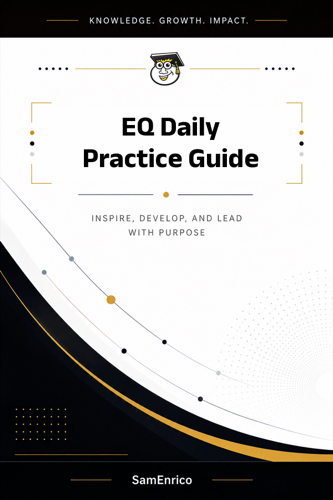
EQ Daily Practice Guide eBook
Build emotional intelligence through small daily e
Build emotional intelligence through small daily exercises.
Formats
Free sample
Chapter 1: The Observer Awakening--–- You are about to snap. Your jaw is clenched. Your chest feels tight. Your fingers are hovering over a keyboard, ready to type something you will regret in eleven seconds. Or maybe you are standing in your kitchen, staring at a mess that isn't yours, feeling a hot wave rise from your stomach to your throat.
Perhaps you are in a meeting, and someone has just used a phrase you have heard a hundred times before – “per my last email” – and something inside you breaks.In that moment, you have a choice. But here is the problem: you do not know you have a choice. The choice exists inside a window of time so small that most people never see it. That window is approximately six to ten seconds long. In this book, we will train for ten seconds – a nice round number that gives you room to breathe.
Within those ten seconds, your body has already registered everything it needs to know about your emotional state. Your conscious mind, however, is still catching up. The gap between what your body knows and what your mind understands is where every emotional hijack lives. Close that gap, and you close the door on a lifetime of regretful emails, snapped responses, and nights spent replaying conversations you wish you could redo.This chapter is about opening that window.The Six-Second Gap Let us start with a story. A few years ago, a senior vice president at a major technology firm walked into a negotiation he had been preparing for six months.
He knew the numbers cold. He had rehearsed every objection. His team had briefed him on the other side's likely tactics. Five minutes into the meeting, the lead negotiator across the table said something dismissive about the VP's proposal – not even particularly harsh, just condescending. The VP felt a flash of heat.
His face flushed. Without thinking, he shot back a sarcastic remark. The room went quiet. The deal fell apart two hours later. When his team debriefed, no one could understand what had happened.
The VP himself could not explain it. "I just lost it," he said. "It was like watching myself from outside my body."That VP is not unusual. He is not weak, unprofessional, or emotionally immature. He is human.
And what happened to him happens to every single person reading this page, probably multiple times per week. The neuroscience is remarkably consistent: from the moment a trigger occurs, your amygdala – an ancient part of your brain designed to keep you alive from predators – begins to sound an alarm. In approximately six to ten seconds, that alarm will hijack your prefrontal cortex, the part of your brain responsible for reasoning, planning, and impulse control. After those seconds pass, you are no longer making decisions. Your reptile brain is making them for you.Here is what most people get wrong about that process.
They think the emotion appears suddenly, like a thunderclap from a clear sky. But the emotion does not appear suddenly. The physical sensation appears first – the tight chest, the clenched jaw, the shallow breath, the heat in your face, the sinking in your stomach. Those sensations appear within milliseconds of the trigger. Your conscious mind, however, takes another six to ten seconds to catch up and say, "Oh, I'm angry." Or "Oh, I'm scared." Or "Oh, I'm humiliated."In those six to ten seconds, you have a superpower that most people never learn to use.
You can notice the physical sensation before it becomes an emotion. You can observe your body's alarm system without pulling the fire alarm yourself. You can say, "My heart is racing," instead of, "I'm having a heart attack because my boss hates me." That distinction – between physical sensation and narrative story – is the difference between reaction and response. It is the difference between sending the angry email and closing the laptop to take a walk. It is the difference between snapping at your child and kneeling down to ask what is really going on.This entire book exists to teach you how to live inside that six-to-ten-second window.
We call this skill The Observer Stance.What Is The Observer Stance?Imagine you are a meteorologist. You do not control the weather. You cannot make the storm stop or the sun shine. But you can observe the weather with extraordinary precision. You can measure temperature, humidity, wind speed, and barometric pressure.
You can name what is happening without being destroyed by it. A meteorologist does not panic when a hurricane forms – they track it. They do not despair when a drought arrives – they document it. They are separate from the weather even as they describe it in exacting detail.The Observer Stance is exactly this relationship to your own inner state. You learn to watch your emotions the way a meteorologist watches a storm system.
You notice the physical sensations first: There is tightness in my chest. There is heat in my face. My breathing has become shallow. Then you notice the thoughts that follow: My mind is telling me that I have been disrespected. My mind is telling me that this always happens to me.
My mind is telling me that I need to fight back right now. And then – and this is the crucial step – you do nothing. You simply observe. You do not suppress the feeling. You do not act on the feeling.
You do not argue with the feeling. You just watch it, the way you would watch a train pass through a station while you stand safely on the platform.Most people, when they feel a strong emotion, do one of two things. They either react – they lash out, send the email, say the thing – or they suppress – they swallow the feeling, tell themselves to get over it, numb it with food or alcohol or scrolling. Both strategies fail. Reaction creates consequences you will clean up later.
Suppression creates a pressure cooker that will eventually explode. The Observer Stance offers a third path: acknowledgment without action. You feel the feeling fully. You name it precisely. And then you choose, from a place of calm awareness, what to do next.This is not easy.
It is not natural. Your brain has spent your entire life building shortcuts between trigger and response. Those shortcuts are called habits, and they run faster than your conscious thought. Rewiring them requires practice – not intellectual understanding, not good intentions, but actual, repetitive, daily practice. That is what this book provides.The 60-Second Body-to-Brain Scan Let us be very clear about what The Scan is and is not.
The Scan is a low-to-moderate arousal practice. You use it when you are feeling irritation, worry, mild frustration, boredom, or vague unease. You do NOT use The Scan when you are in high arousal – panic, rage, terror, or the kind of explosive anger that makes you want to throw your phone across the room. For high arousal, you will use The Reset (Chapter 5). For impulse control before responding, you will use The Pause (Chapter 6).
The Scan is for the times when you have a few seconds to actually think, not for the moments when…
This is the end of the free sample. Get the eBook to keep going. Buy now
About this book
Details
- Author
- Cassidy Reuben
- Publisher
- SamEnrico
- Language
- English
- Genre
- Non-Fiction, Self-Help, Habit
- Released
- 2026-06-09
- Pages (approx.)
- 135
- Available as
- eBook, Audiobook

Read better in the ZLOADR app
Your eBooks on your phone or tablet. Sign in with your SamEnrico account and start reading.
More by Cassidy Reuben
 LBO Value Creation DashboardCassidy Reuben$11.99
 Circadian Rhythm Sleep WakeCassidy Reuben$11.99
 Financial Services M&A MultiplesCassidy Reuben$11.99
 Emotional Validation for AdopteesCassidy Reuben$11.99
 Senior Dating ConfidenceCassidy Reuben$11.99
 Self Hypnosis for Chronic Pain SleepCassidy Reuben$11.99
 Forensic Odontology TrainingCassidy Reuben$11.99
 The Illuminated Scrolls: How Medieval Monks Laid the Foundation for AnimationCassidy Reuben$11.99
 Madness on Trial: The Birth of the Insanity Defense in Victorian EnglandCassidy Reuben$11.99
 How to Produce a DeckCassidy Reuben$11.99
 How to Produce PET Training PadsCassidy Reuben$11.99
 How to Become a Salvager IiCassidy Reuben$11.99
You may also like
 Hong Kong Handover 1997Dunn Johnnie$11.99
 Zumba For Postnatal Recovery CourseNeal Christian$11.99
 Zumba for BeginnersLadner Nikia$11.99
 YouTube Comment Mining GuideHumes Pandora$12.99
 Worry Box MeditationCarlin Rudy$11.99
 Workplace Stress MeditationNguyen Lynn$11.99
 Workplace Stress and Sleep RepairHawley Ivory$11.99
 Workplace Perfectionism CureDelaney Jeffry$11.99
 Workplace Injustice Anger GuideWallen Isabelle$11.99
 Work Addiction and Burnout LinkGreenwood Ester$11.99
 Women in Yoga and WellnessBeattie Galina$11.99
 Women in Stand Up ComedyChun Evangeline$11.99