
Non-FictionSelf-HelpWorkplace EQ
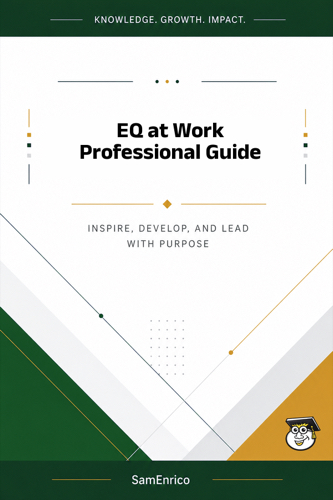
EQ at Work Professional Guide eBook
Applies emotional intelligence to office politics,
by Hitt Otha
Applies emotional intelligence to office politics, leadership, and teamwork.
Formats
Free sample
Chapter 1: The Political Animal--–- Every organization has two maps. The first is printed in the employee handbook, a tidy hierarchy of boxes and reporting lines that suggests clarity, order, and rational decision-making. The second map exists only in the minds of the people who work there. It has no boxes, only currents. No reporting lines, only alliances.
No job titles, only influence. If you cannot read the second map, the first map will get you fired.This is not cynicism. This is neurobiology. Human beings evolved in tribes of no more than 150 people, where survival depended not on who had the official rank but on who had the trust, the information, and the ability to mobilize others. Your office is a tribe with Wi-Fi.
And like every tribe throughout history, it runs on invisible power dynamics that no org chart will ever capture.The most politically intelligent people in your organization are not the ones with the fanciest titles. They are the ones who walk into a room and know, within sixty seconds, who defers to whom, whose silence means disagreement, and whose casual question is actually a command. They are not necessarily more ethical or more ambitious than you. They have simply learned to see what you have been trained to ignore.This chapter will teach you to see. You will learn the four political personas that shape every workplace, the single most powerful tool for mapping informal influence, and the uncomfortable truth about why nice people often finish last while politically aware people finish first—without becoming the people you despise.The Cost of Political Blindness Let us begin with a story.
Maria was a senior product manager at a mid-sized tech company. She had impeccable technical credentials, consistently hit her deliverables, and received glowing performance reviews from her direct manager. When a director position opened on her team, Maria was certain she was the logical choice. Instead, the role went to James, a peer with weaker technical skills, a habit of missing deadlines, and a reputation for taking credit for others' work.Maria was devastated. She requested a meeting with her manager, who gave her feedback that felt both vague and damning: "You don't have the same level of organizational awareness as James.
You need to work on your stakeholder management."What Maria heard: "You aren't political enough."What her manager actually meant: "James understood who needed to be convinced, when to speak privately versus publicly, and how to build bridges before he needed them. You stayed in your lane and expected the work to speak for itself. The work never speaks for itself."Maria had fallen victim to the most common and costly error in professional life: she assumed that merit alone would carry her. She treated the org chart as if it were a meritocracy and the conference room as if it were a classroom where the best answer always wins. Neither is true.Research from the Center for Creative Leadership found that nearly 80 percent of senior-level executives who fail within their first eighteen months do so not because of technical incompetence but because of political incompetence—an inability to read the room, build coalitions, or navigate unspoken power structures.
A separate study of 1,500 managers across twenty organizations found that political skill was a stronger predictor of career success than intelligence, conscientiousness, or emotional stability combined.Let that land. Political skill is not a nice-to-have. It is not a dirty word. It is the single largest differentiator between those who plateau at mid-level and those who ascend to leadership.The Four Political Personas Not everyone sees the invisible map. And of those who do see it, not everyone knows what to do with the information.
After reviewing decades of organizational behavior research and observing hundreds of professionals across industries, we can identify four distinct political personas. You will recognize yourself in at least one of them. Most people oscillate between two, depending on stress and context.Persona One: The Observer The Observer sees the political map but refuses to act on it. They watch coalitions form, notice who defers to whom, and accurately predict the outcome of meetings before they begin. But when it comes time to influence, advocate, or position themselves, the Observer steps back.
Often this hesitation comes from a moral conviction—a belief that acting politically is somehow dirty. Sometimes it comes from fear—a concern that any visible move will make them a target. Occasionally it comes from exhaustion—the Observer has seen too many cycles of betrayal and has simply checked out.The tragedy of the Observer is that their awareness without action generates no return. They have done the hard work of seeing clearly, and then they have stopped. In Chapter 12, you will learn why temporary observation is a strategy but permanent observation is paralysis.
For now, recognize that the Observer typically ends their career wondering why people with less insight advanced further. The answer is painful: insight without influence is just spectatorship.Persona Two: The Naïve The Naïve denies that politics exist at all. They believe the org chart is the real map, that hard work is always rewarded, and that the best idea in the room always wins. When they encounter evidence to the contrary—a colleague who takes credit for their work, a decision made behind closed doors, a promotion that ignores merit—the Naïve experiences cognitive dissonance and typically resolves it by blaming themselves. "I must not have worked hard enough." "I must not have communicated clearly." "Maybe I'm just not as good as I thought."The Naïve is not stupid.
The Naïve is often brilliant. But their brilliance is married to a dangerous innocence that leaves them perpetually surprised and perpetually under-resourced. They are the easiest target for toxic personalities (see Chapter 6) because they do not see the knife until it is already in their back. The Naïve's career trajectory is a flat line: they enter at one level, they work hard, and they exit at roughly the same level, having never understood why.Persona Three: The Cynic The Cynic also sees the political map—perhaps even more clearly than the Observer. But where the Observer hesitates from fear or morality, the Cynic sees only corruption.
To the Cynic, every alliance is a conspiracy, every act of influence is manipulation, every promotion is undeserved. The Cynic mistakes awareness of darkness for wisdom, believing that seeing the worst in everyone makes them sophisticated.The Cynic's fatal flaw is that they become the very thing they despise. Because they assume everyone is acting from bad faith, they preemptively sabotage, withhold trust, and alienate potential allies. Their cynicism becomes a self-fulfilling prophecy: people eventually avoid them, exclude them, and talk about them behind their backs. The Cynic interprets this as proof that everyone is corrupt, never recognizing that they manufactured the evidence.
The Cynic's career ends in isolation—technically competent, politically astute, and completely unemployable in any role requiring collaboration.Persona Four: The Strategist The Strategist sees the political map clearly and acts on it ethically. They understand that influence is neither good nor evil—it is a tool. They build coalitions without…
This is the end of the free sample. Get the eBook to keep going. Buy now
About this book
Details
- Author
- Hitt Otha
- Publisher
- SamEnrico
- Language
- English
- Genre
- Non-Fiction, Self-Help, Workplace EQ
- Released
- 2026-06-11
- Pages (approx.)
- 144
- Available as
- eBook, Audiobook

Read better in the ZLOADR app
Your eBooks on your phone or tablet. Sign in with your SamEnrico account and start reading.
More by Hitt Otha
 Campfire RelaxationHitt Otha$11.99
 Indoor Fitness PreferrersHitt Otha$11.99
 MMR Vaccine Facts HandbookHitt Otha$11.99
 John Wayne Gacy Media Sensation StudyHitt Otha$11.99
 The Long White Cloud: New Zealand's Scientific and Cultural RenaissanceHitt Otha$11.99
 Understanding Mulibrey NanismHitt Otha$17.99
 Quality Assurance RepresentativeHitt Otha$11.99
 Nestle Supply GuideHitt Otha$12.99
 AI Video Production ROI GuideHitt Otha$12.99
 A Beginners Guide to Cross-country skiing (Volume 1)Hitt Otha$11.99
You may also like
 Hong Kong Handover 1997Dunn Johnnie$11.99
 Zumba For Postnatal Recovery CourseNeal Christian$11.99
 Zumba for BeginnersLadner Nikia$11.99
 YouTube Comment Mining GuideHumes Pandora$12.99
 Worry Box MeditationCarlin Rudy$11.99
 Workplace Stress MeditationNguyen Lynn$11.99
 Workplace Stress and Sleep RepairHawley Ivory$11.99
 Workplace Perfectionism CureDelaney Jeffry$11.99
 Workplace Injustice Anger GuideWallen Isabelle$11.99
 Work Addiction and Burnout LinkGreenwood Ester$11.99
 Women in Yoga and WellnessBeattie Galina$11.99
 Women in Stand Up ComedyChun Evangeline$11.99