
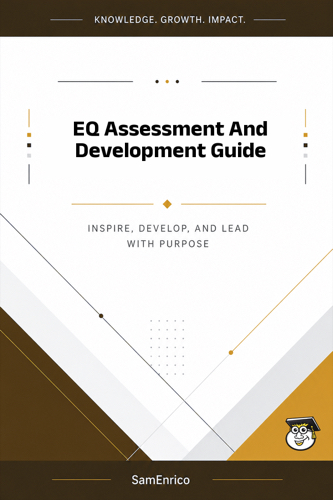
Non-FictionSelf-HelpAssessment
EQ Assessment And Development Guide eBook
Helps readers measure their emotional intelligence
Helps readers measure their emotional intelligence across four domains with targeted improvement plans.
Formats
Free sample
Chapter 1: Beyond the IQ Myth--–- Marcus had an IQ of 142. He graduated summa cum laude from a top engineering program, could recite pi to fifty digits, and regularly solved New York Times crossword puzzles in under ten minutes. He was, by any conventional measure, brilliant. And yet, at age thirty-four, Marcus had been fired from three jobs in seven years, his marriage was hanging by a thread, and his teenage daughter had stopped speaking to him after he screamed at her for getting a B on a chemistry quiz. His colleagues described him as “explosive.” His wife used the word “unreachable.” His own performance reviews cited a recurring pattern: brilliant analysis, catastrophic delivery.Across town, a community college graduate named Elena worked as a floor nurse in a busy emergency room.
Her IQ had never been formally tested, but she would be the first to tell you she was no prodigy. She struggled with standardized tests, took twice as long as her peers to learn new software, and had a drawer full of half-finished books. Yet Elena was the nurse that doctors requested by name, the one that panicking families clung to, the one who could de-escalate a violent patient with three calm sentences. She had been promoted to charge nurse, led the unit’s morale committee, and had not missed a single day of work in six years. When the hospital conducted a 360-degree feedback review, Elena ranked in the top one percent for “ability to inspire trust.”Marcus and Elena are not real people.
But they represent a pattern that organizational psychologists have documented for decades: cognitive intelligence (IQ) predicts academic success and technical proficiency, but it is a remarkably poor predictor of life satisfaction, leadership effectiveness, and relationship health. Something else is at work. Something that allows a moderately intelligent nurse to thrive while a certified genius implodes.That something is emotional intelligence.This book is not about making you feel bad about your IQ. It is not about dismissing cognitive ability as irrelevant. And it is certainly not about turning you into a soft, smiling, positivity-spouting person who never experiences anger.
Quite the opposite. This book is about giving you a precise, measurable, and improvable set of skills that will determine whether your intelligence serves you or sabotages you. It is about moving from knowing what emotional intelligence is—a concept that has become diluted through overuse—to assessing your specific profile across four proven domains and executing a targeted development plan that actually sticks.Let us begin with a hard truth: the traditional education system lied to you. Not maliciously, but incompletely. From kindergarten through graduate school, you were rewarded for one thing: correct answers delivered on time.
You were graded on your ability to recall facts, solve logic problems, and conform to rules. Rarely—almost never—were you graded on your ability to recognize that you were about to cry during a meeting, or to calm a coworker who was spiraling, or to repair a relationship after you said something cruel. Those skills were considered “soft,” electives at best, distractions at worst.Meanwhile, a mountain of peer-reviewed research has accumulated, and the conclusion is startlingly clear: emotional intelligence accounts for between 58 and 80 percent of the difference between average and outstanding performers in leadership roles. In sales, the top quartile of EQ performers outsell the bottom quartile by a factor of three to one. In nursing, higher EQ scores correlate with a 63 percent reduction in burnout risk.
In executive leadership, every one-point increase on a validated EQ assessment (on a 100-point scale) correlates with an additional $1,300 in annual income, after controlling for IQ, education, and years of experience.These are not feel-good statistics. These are the hard numbers that have persuaded Fortune 500 companies to invest millions in EQ training. But most of that training fails. Not because the science is wrong, but because the delivery is wrong. Most programs give you a one-day workshop, a laminated card with “ten tips,” and a vague sense that you should “be more empathetic.” Then you return to your desk, your inbox has 147 new messages, and within forty-eight hours, you have forgotten everything except the free sandwiches.This book is the opposite of that.Over the next twelve chapters, you will complete a comprehensive assessment of your current EQ across four domains: Self-Awareness, Self-Management, Social Awareness, and Relationship Management.
You will learn exactly where you are strong and exactly where you have blind spots. Then, domain by domain, you will be given targeted, five-to-ten-minute exercises that have been validated in clinical and organizational settings. You will not be asked to change your personality. You will be asked to change specific behaviors. And because the brain remains plastic—capable of rewiring itself—throughout your entire life, these changes will, with consistent practice, become automatic.
The person who loses their temper in meetings can become the person who pauses. The person who cannot read a room can become the person who senses tension before it erupts. The person who avoids difficult conversations can become the person who navigates them with grace.But first, we must answer a more fundamental question: what exactly is emotional intelligence, and why does it matter more than IQ for the things that actually make life worth living?The Premise: Why EQ Trumps IQ in the Real World Imagine two identical twins, raised in the same household, with nearly identical IQs. One becomes a successful project manager with a stable marriage and a rich social life. The other becomes a brilliant but isolated data analyst who cannot keep friends and has been divorced twice.
What explains the difference? Not cognitive ability. Not luck. Not even parenting style. What explains the difference is emotional intelligence: the set of skills that allows a person to perceive, understand, regulate, and express emotions effectively.The term “emotional intelligence” was popularized by psychologist and journalist Daniel Goleman in his 1995 bestseller Emotional Intelligence: Why It Can Matter More Than IQ.
But the scientific foundations were laid earlier by researchers like Peter Salovey and John Mayer, who defined EQ as “the ability to monitor one’s own and others’ feelings and emotions, to discriminate among them, and to use this information to guide one’s thinking and action.” That definition is dense, so let us unpack it.First, emotional intelligence requires monitoring—paying attention to emotional data. Most people do not do this. They experience anger, sadness, or fear and are immediately swept away by the feeling. They do not observe it; they become it. Second, EQ requires discrimination—telling the difference between, say, irritation and rage, or between disappointment and shame.
These are different emotions with different solutions. Third, EQ requires using that information to guide action. Knowing you are anxious is useless if you still cancel the presentation. The value is in the behavior change.IQ, by contrast, is the ability to solve abstract problems, recognize patterns, and manipulate symbols. It is extraordinarily useful for tasks like calculus, chess, and computer programming.
It is remarkably useless for tasks like calming a crying child, negotiating a raise, or knowing when to apologize. There is a reason that no marriage has ever failed…
This is the end of the free sample. Get the eBook to keep going. Buy now
About this book
Details
- Author
- Olivarez Louie
- Publisher
- SamEnrico
- Language
- English
- Genre
- Non-Fiction, Self-Help, Assessment
- Released
- 2026-06-08
- Pages (approx.)
- 142
- Available as
- eBook, Audiobook

Read better in the ZLOADR app
Your eBooks on your phone or tablet. Sign in with your SamEnrico account and start reading.
More by Olivarez Louie
 Boundary Setting After Childhood Neglect WorkbookOlivarez Louie$11.99
 Anger After Partner's Ex ContactOlivarez Louie$11.99
 The Self Worth Body Connection GuideOlivarez Louie$11.99
 Postpartum Body Acceptance GuideOlivarez Louie$11.99
 The Last Pharaoh's Gambit: Cleopatra's Secret ExodusOlivarez Louie$11.99
 Understanding Macular Corneal DystrophyOlivarez Louie$17.99
 LightGBM OperatorOlivarez Louie$11.99
 Data Presentation For ClientsOlivarez Louie$12.99
 Africa Long Term Opportunities GuideOlivarez Louie$12.99
 How to Become a Coil ShaperOlivarez Louie$11.99
You may also like
 Hong Kong Handover 1997Dunn Johnnie$11.99
 Zumba For Postnatal Recovery CourseNeal Christian$11.99
 Zumba for BeginnersLadner Nikia$11.99
 YouTube Comment Mining GuideHumes Pandora$12.99
 Worry Box MeditationCarlin Rudy$11.99
 Workplace Stress MeditationNguyen Lynn$11.99
 Workplace Stress and Sleep RepairHawley Ivory$11.99
 Workplace Perfectionism CureDelaney Jeffry$11.99
 Workplace Injustice Anger GuideWallen Isabelle$11.99
 Work Addiction and Burnout LinkGreenwood Ester$11.99
 Women in Yoga and WellnessBeattie Galina$11.99
 Women in Stand Up ComedyChun Evangeline$11.99