
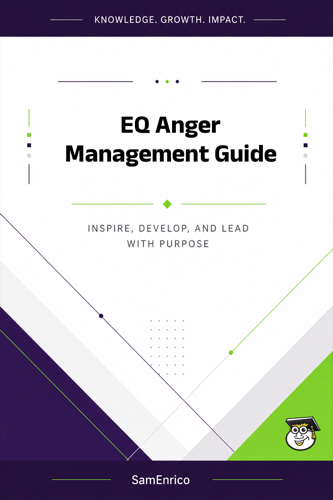
Non-FictionSelf-HelpAnger Management
EQ Anger Management Guide eBook
Understand and transform angry feelings using emot
Understand and transform angry feelings using emotionally intelligent strategies.
Formats
Free sample
Chapter 1: The Anger Lie--–- Marcus sat in his car for eleven minutes before walking into the house. His knuckles were white on the steering wheel. His jaw ached from clenching. He had just been cut off in traffic—not once, but three times—and then the person behind him had laid on the horn as if Marcus were the problem. His chest felt like it was filled with hot coals.
Every rational thought had been replaced by a looping, venomous narrative about how stupid, selfish, and incompetent everyone else on the road was.When he finally walked through the front door, his partner asked, "How was your day?""Fine," he said.But it wasn't fine. It wouldn't be fine for hours. He would be short with the kids. He would scroll through his phone in angry silence. He would go to bed still replaying the traffic incident, still rehearsing the witty, cutting things he should have said, still simmering with a fury that had no place to go.
And somewhere in the back of his mind, he would wonder: What is wrong with me?Nothing was wrong with Marcus. He had simply been taught a lie.The lie is this: Anger is a bad emotion. Good people don't get angry. And if you do get angry, you should suppress it, ignore it, or apologize for it immediately.This lie is repeated everywhere—in childhood homes where yelling was punished, in workplaces where professionalism is confused with emotional flatness, in religious communities where anger is listed alongside greed and lust as something to root out, and in self-help culture that tells you to "just let it go" without telling you how.But here is the truth this entire book is built upon: Anger is not the enemy. Unmanaged anger is.This chapter will dismantle the lie, introduce a new way of seeing anger, and give you the first practical tool for distinguishing between the anger that destroys and the anger that heals.The Difference Between a Volcano and a Signal Most people think of anger as a volcanic eruption—something that builds pressure underground until it explodes, damaging everything in its path.
This metaphor is powerful because it matches the felt experience of rage. The heat, the pressure, the loss of control, the aftermath of destruction.But the volcano metaphor is also deeply misleading.It suggests that anger is a force of nature that cannot be redirected, only endured or detonated. It suggests that the only two options are suppression (capping the volcano) or explosion (letting it blow). And it suggests that anger itself is the problem, rather than what you do with it.A more accurate metaphor is this: Anger is a signal light on your emotional dashboard.When the oil light comes on in your car, you don't smash the dashboard. You don't pretend the light isn't there.
You don't curse the light for being inconvenient. You recognize that the light is providing information—something is wrong under the hood, and if you ignore it, the engine will seize.Anger works exactly the same way.Anger signals that one of three things has happened:A boundary has been violated. Someone has crossed a line you didn't even know you had, or a line you knew about but failed to defend.A need has gone unmet. You have a legitimate requirement for safety, respect, autonomy, or fairness that is not being satisfied.An injustice has occurred. Something is unfair, and your nervous system is mobilizing energy to address that unfairness.Notice what is not on this list.
Anger is not a sign that you are weak, sinful, broken, or immature. Anger is not a character flaw. Anger is not something to eliminate.Anger is information.The question is not how do I stop feeling angry? The question is what is my anger telling me, and how do I respond to that information in a way that aligns with my values?The Secondary Gain of Anger (Why You Hold Onto It)Before we go further, we need to address an uncomfortable truth. Even though anger causes problems in your life, you may also be getting something out of it.
Psychologists call this a "secondary gain"—a hidden benefit that keeps a behavior going even when it hurts you.What does anger give you?Anger gives you power when you feel powerless. Vulnerability is terrifying. Hurt is embarrassing. Shame makes you want to disappear. But anger?
Anger feels strong. Anger feels right. When you're angry, you're not the victim anymore—you're the avenger. Many people unconsciously choose anger over hurt because anger is less painful in the moment.Anger gives you a sense of control. When things fall apart, anger creates the illusion that you are doing something.
It's better than helplessness. Rage feels active; grief feels passive.Anger protects you from deeper pain. Below most anger is fear. Below most anger is shame. Below most anger is a childhood wound that never healed.
Anger acts as a firewall, keeping you from feeling the more vulnerable emotions that would actually require you to change something fundamental about yourself or your situation.Anger can be effective. Let's be honest: sometimes anger works. People back down when you yell. Problems get solved when you raise your voice. Boundaries get respected when you become threatening.
The problem is that what works in the short term often destroys in the long term. You can win a battle with anger and lose the relationship.None of this means you are bad for having anger. It means you are human. But it does mean that you need to look honestly at what your anger is doing for you before you can learn to manage it differently.Destructive Anger vs. Healthy Anger: A Unified Definition Many anger management books define destructive anger as "any anger at all" and healthy anger as "no anger" or "calm communication." This is not only unrealistic—it's harmful.
It sets up an impossible standard and guarantees that you will feel like a failure every time you feel a normal human emotion.This book uses a different definition—one that will remain consistent from this chapter through Chapter 12.Destructive anger is any expression of anger that does one or more of the following:Damages a relationship you value. You yell at your partner, and now they pull away. You snap at your child, and now they cry. You send an angry email at work, and now your reputation suffers. The anger may be justified, but the expression was destructive because it harmed something important to you.Violates your own values.
You believe in treating people with respect, but in a moment of rage, you called someone a name. Afterward, you feel ashamed—not because you were angry, but because you acted against who you want to be.Escalates a situation unnecessarily. A minor disagreement becomes a screaming match. A small mistake becomes a character assassination. A solvable problem becomes a war because your anger added fuel instead of light.Healthy anger is any expression of anger that:Communicates a boundary without attacking.
You say "I need you to stop" instead of "You're a terrible person."Mobilizes energy for constructive action. You use the…
This is the end of the free sample. Get the eBook to keep going. Buy now
About this book
Details
- Author
- Winston Gilda
- Publisher
- SamEnrico
- Language
- English
- Genre
- Non-Fiction, Self-Help, Anger Management
- Released
- 2026-06-09
- Pages (approx.)
- 153
- Available as
- eBook, Audiobook

Read better in the ZLOADR app
Your eBooks on your phone or tablet. Sign in with your SamEnrico account and start reading.
More by Winston Gilda
 Thunberg Family Climate Activism GuideWinston Gilda$11.99
 Cognitive Restructuring for FailureWinston Gilda$11.99
 The Caregiver Wandering Prevention GuideWinston Gilda$11.99
 MIND Diet Cognitive Protection PlanWinston Gilda$11.99
 Last Dance in the ColosseumWinston Gilda$11.99
 The Last Broadcast: The RMS Titanic's Forgotten Wireless OperatorsWinston Gilda$11.99
 Training and Development ROIWinston Gilda$12.99
 Prompt Engineering for Risk AnalystsWinston Gilda$12.99
 Understanding Focal Agyria PachygyriaWinston Gilda$17.99
 How to Start a Printing and Writing Paper Ready for Use Business (Beginners Guide)Winston Gilda$11.99
 Touch-up Paint ApplicationWinston Gilda$11.99
You may also like
 Hong Kong Handover 1997Dunn Johnnie$11.99
 Zumba For Postnatal Recovery CourseNeal Christian$11.99
 Zumba for BeginnersLadner Nikia$11.99
 YouTube Comment Mining GuideHumes Pandora$12.99
 Worry Box MeditationCarlin Rudy$11.99
 Workplace Stress MeditationNguyen Lynn$11.99
 Workplace Stress and Sleep RepairHawley Ivory$11.99
 Workplace Perfectionism CureDelaney Jeffry$11.99
 Workplace Injustice Anger GuideWallen Isabelle$11.99
 Work Addiction and Burnout LinkGreenwood Ester$11.99
 Women in Yoga and WellnessBeattie Galina$11.99
 Women in Stand Up ComedyChun Evangeline$11.99