
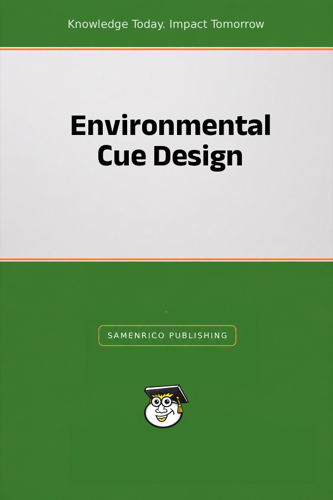
Non-FictionSelf-HelpEnvironmental Psychology
Environmental Cue Design eBook
Sets physical triggers for focus mode.
Sets physical triggers for focus mode.
Formats
Free sample
Chapter 1: The Spoon Paradox--–- You are about to make a mistake. It is not the mistake you think. You believe your phone is the problem. You believe your lack of willpower is the problem. You believe that if you could simply try harder, focus more, or care enough, you would finally get your important work done.
All of these beliefs are wrong.The mistake is not in your effort. The mistake is in your diagnosis. For years, productivity advice has pointed inward: build better habits, strengthen your discipline, wake up at 5 AM, meditate, use a pomodoro timer, delete social media, install a website blocker, buy a planner, write a to-do list, feel guilty when you fail, then try again. This is the cycle of self-blame. And it does not work.What if distraction is not a character flaw?
What if it is a structural consequence of living in environments that were never designed for the human brain? What if the spoon is not to blame for making you fat—and your phone is not to blame for stealing your attention?This book offers a different path. Not self-discipline. Not moral effort. Not guilt.
Instead: Environmental Cue Design. The systematic arrangement of physical, sensory, and behavioral triggers that make focus the path of least resistance. By the time you finish this chapter, you will never blame yourself for distraction again. You will blame your environment. And then you will fix it.The Anatomy of a Distraction Let us begin with a simple experiment.
Right now, look around the space where you are reading this. Do not move your body. Just move your eyes. What do you see?Perhaps a phone face-down on the desk. Perhaps a second browser tab open to email.
Perhaps a cluttered countertop, a pile of mail, a blinking notification light on a router, a television remote, a stack of dishes, an open laptop from yesterday's unfinished task. Each of these objects is not merely present. Each one is calling to you.That is not a metaphor. It is neuroscience.Every object in your visual field sends a micro-signal to your brain. These signals are processed in approximately 200 milliseconds—far faster than your conscious mind can intervene.
By the time you think "I should focus," your brain has already registered the phone, the email tab, the clutter, and begun preparing a response. That response is not a decision. It is a reflex.This is the Stimulus-Trigger-Response (STR) loop, the fundamental unit of environmental psychology. A stimulus (a blinking light, a buzzing phone, an open laptop) enters your sensory field. Your brain, without asking permission, interprets that stimulus as a trigger.
And that trigger initiates a behavioral response—often before you have even named what is happening.Here is the terrifying part: most of your daily behavior is not chosen. It is triggered. You do not decide to check your phone. Your phone decides for you, by buzzing. You do not decide to open a new tab.
The open tab from yesterday decides for you, by remaining on the screen. You do not decide to feel distracted. Your cluttered environment decides for you, by presenting twelve competing stimuli at once.The STR loop explains why "just trying harder" almost always fails. Willpower is a conscious process. The STR loop is subconscious.
By the time your prefrontal cortex (the rational, decision-making part of your brain) engages, the trigger has already fired and the response has already begun. You are not fighting a habit. You are fighting an architecture.The Great Misdiagnosis For the past two decades, the self-help and productivity industries have sold you a story. The story goes like this: you are distracted because you lack discipline. You scroll social media because you are weak.
You procrastinate because you are lazy. The solution is to build better habits, to strengthen your willpower muscle, to wake up earlier, to meditate longer, to try harder.This story is not merely unhelpful. It is actively harmful.When you believe distraction is a moral failure, you respond with shame. Shame does not motivate lasting change. Shame motivates hiding, rationalization, and eventually, resignation.
"I guess I am just not a focused person," you tell yourself. And then you stop trying.The research tells a different story. In a landmark study published in the Journal of Experimental Psychology, researchers found that participants placed in a clean, organized room performed consistently better on attention-based tasks than participants placed in a cluttered, disorganized room—even when both groups had identical instructions, identical breaks, and identical motivation. The environment alone accounted for a 34% difference in performance.Think about that. Thirty-four percent.
Not effort. Not intelligence. Not discipline. The arrangement of objects in a room.Another study tracked office workers for six months. Half were given standard desks.
Half were given desks with built-in drawers and cabinets to hide clutter. The group with hiding spaces reported 27% lower cognitive fatigue at the end of each day—despite performing the same tasks, for the same hours, under the same management. The only difference was whether distraction was visible or concealed.These findings point to an uncomfortable truth: you are not lazy. Your environment is currently designed for distraction.Every object placement, notification setting, lighting choice, and digital default has been optimized—by technology companies, by entropy, by the inertia of your own past decisions—to pull attention away from deep work. Your phone is engineered to interrupt you.
Your email client is designed to keep you checking. Your social media feeds are built on variable rewards that exploit the same neural pathways as slot machines.You are not losing a battle of will. You are losing a battle of architecture.Two Kinds of Silence, Two Kinds of Distraction Before we go further, we must make a critical distinction. Not all silence is the same. Not all distraction is the same.
This distinction will shape every chapter that follows.Consider two experiences.First: You walk into a library reading room. The floors are carpeted. The lights are soft. The air smells of old paper. Around you, strangers sit quietly, reading.
You find a chair. You open your book. Without anyone saying a word, you lower your voice. You slow your movements. Your attention settles.
Why?Second: You wake up at 3 AM in a house that is usually noisy—the refrigerator hums, the furnace clicks, the traffic outside rumbles. But tonight, the power is out. The silence is absolute. You lie in bed, heart beating, listening. Every tiny creak of the house sounds like a footstep.
You cannot sleep. Why?Both are silence. But they are opposite experiences.The library provides familiar silence. It is predictable, expected, and consistent. Your brain has learned, through repeated exposure, that this silence means safety, focus, and the absence of threat.
Familiar silence is restorative. It lowers cortisol. It allows directed attention to recover.The blackout provides novel silence. It is unexpected, unfamiliar, and breaks a predictable pattern. Your brain, evolutionarily wired to detect threats, interprets novel silence as a potential danger signal.
Why has the refrigerator stopped? Why is there no traffic? Something must be wrong. Novel silence triggers hyper-vigilance. It raises cortisol.
It fragments attention.This distinction explains the apparent contradiction in how silence affects focus. Some people swear by complete quiet. Others…
This is the end of the free sample. Get the eBook to keep going. Buy now
About this book
Details
- Author
- Schulz Deanne
- Publisher
- SamEnrico
- Language
- English
- Genre
- Non-Fiction, Self-Help, Environmental Psychology
- Released
- 2026-06-06
- Pages (approx.)
- 144
- Available as
- eBook, Audiobook

Read better in the ZLOADR app
Your eBooks on your phone or tablet. Sign in with your SamEnrico account and start reading.
More by Schulz Deanne
 Swiss Alps Refuge ScriptSchulz Deanne$11.99
 Pregnancy Meal PlanningSchulz Deanne$11.99
 EA 6B ProwlerSchulz Deanne$11.99
 The Immigrant Subscription KingSchulz Deanne$11.99
 High Achiever Morning GuideSchulz Deanne$11.99
 Resilience After TraumaSchulz Deanne$11.99
 Accountability for Apathy GuideSchulz Deanne$11.99
 The Moscow Spy Swap: The Cold War's Last Stand (2010)Schulz Deanne$11.99
 The Iron Walls of Osaka: The Last Stand of the TokugawaSchulz Deanne$11.99
 How to Produce a Versatile Multilayer DiscSchulz Deanne$11.99
 Stripe API First Kanban GuideSchulz Deanne$12.99
 How to Produce Laser LevelsSchulz Deanne$11.99
You may also like
 Hong Kong Handover 1997Dunn Johnnie$11.99
 Zumba For Postnatal Recovery CourseNeal Christian$11.99
 Zumba for BeginnersLadner Nikia$11.99
 YouTube Comment Mining GuideHumes Pandora$12.99
 Worry Box MeditationCarlin Rudy$11.99
 Workplace Stress MeditationNguyen Lynn$11.99
 Workplace Stress and Sleep RepairHawley Ivory$11.99
 Workplace Perfectionism CureDelaney Jeffry$11.99
 Workplace Injustice Anger GuideWallen Isabelle$11.99
 Work Addiction and Burnout LinkGreenwood Ester$11.99
 Women in Yoga and WellnessBeattie Galina$11.99
 Women in Stand Up ComedyChun Evangeline$11.99