
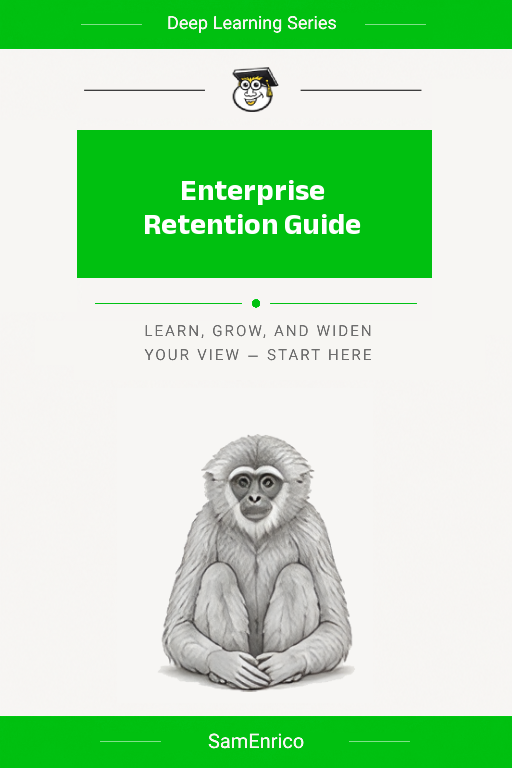
Non-FictionStrategic AtlasEnterprise
Enterprise Retention Guide eBook
Reveals how top performers retain large enterprise
Reveals how top performers retain large enterprise customers through dedicated account teams and governance models.
Formats
Free sample
Chapter 1: The $10M Email--It arrived at 6:47 AM on a Tuesday.The subject line was innocuous: “Strategic partnership review.” No exclamation marks. No “URGENT.” Just four words that made Sarah’s stomach drop before she even opened it. She had been VP of Customer Success at Fin Serve Dynamics for eighteen months. In that time, she had built a team, launched a health scoring system, and personally overseen the company’s three largest accounts. She thought she knew where every body was buried.She was wrong.The email was from Jennifer, the Chief Procurement Officer at Horizon Financial, a $10 million annual recurring revenue (ARR) account that represented nearly 15% of Fin Serve’s entire business.
Horizon had been a customer for seven years. They had expanded from one product line to five. Their chief technology officer had given a keynote speech at Fin Serve’s user conference. By every external measure, Horizon was a “reference account” – the kind of customer you feature in investor decks and sales collateral.The email was two paragraphs long. The first paragraph thanked Sarah’s team for their “professionalism and dedication.” The second paragraph contained the words that would keep her awake for the next seventy-two hours:“After a comprehensive review of our technology portfolio, Horizon Financial has decided not to renew our enterprise agreement when it expires in 90 days.
We have accepted a proposal from Compete Soft. We would be happy to schedule a transition call at your convenience.”No warning. No negotiation. No “we have concerns” emails that went unanswered. Just a termination notice, delivered with the same emotional weight as a restaurant reservation cancellation.Sarah called her CEO within thirty seconds.
His response was measured, professional, and terrifying: “Figure out what happened, and figure out if there’s anything we can do. Then come see me.”What Sarah discovered over the next two weeks would become the foundation of this book. The Horizon account had not been neglected. It had not suffered catastrophic outages. Its support tickets were answered faster than the company average.
By every metric Fin Serve tracked, Horizon was a healthy, happy customer.But metrics lie. And the traditional “handoff” model of enterprise sales – where sales sells, implementation implements, support supports, and no one truly owns the customer – had created an invisible chasm that swallowed $10 million without a sound.The Day the Music Died: Why Traditional Retention Fails The Horizon story is not an outlier. It is the rule.Every year, enterprise software companies lose between 15% and 25% of their recurring revenue to churn. But those numbers tell only half the story. The real damage is in the accounts that do not churn but should have – the ones that renew grudgingly, cut scope, refuse to expand, or quietly shift strategic spending to competitors.
These “near-miss” accounts are like termites in the foundation of a subscription business. They do not bring down the house overnight. They eat away at it until one day, without warning, the floor collapses.Why does this happen? The answer lies in a fundamental structural flaw that most enterprise vendors refuse to acknowledge.The Handoff That Kills In the old software era – the era of perpetual licenses and on-premise deployment – the handoff model worked reasonably well. A salesperson sold a software license.
An implementation team installed it. A support team answered tickets. If the customer had a problem, they called support. If the customer wanted to buy more, they called sales. The relationship was transactional, but it was also simple.
Switching costs were enormous. Migrating off an on-premise system could take years and cost millions. Customers were not happy. But they were trapped.The cloud and subscription models changed everything – except the handoff.Most enterprise software companies still operate a linear, fragmented customer journey. Sales signs the contract and disappears, often compensated only on new logo acquisition.
Implementation deploys the product and declares victory. Support inherits the day-to-day relationship, but support is measured on ticket closure time, not customer outcomes. And somewhere in the middle, lost in the gaps between these functions, the customer’s strategic needs, emotional state, and competitive vulnerability go unmonitored.This is not a failure of individual effort. It is a failure of design.Consider the incentives. Sales is paid to acquire customers, not to keep them.
Implementation is paid to go live, not to drive adoption. Support is paid to close tickets, not to understand business outcomes. No single function is accountable for the customer’s success over time. And no single function has the authority to marshal resources across the organization to prevent churn.The result is what Sarah discovered at Horizon: a customer that looked healthy on every dashboard but had been quietly courted by a competitor for nine months, gradually losing confidence in Fin Serve’s strategic value, with no one assigned to notice or intervene.The Math That Boardrooms Ignore Before we go further, we need to talk about numbers. Because if you take nothing else from this chapter, take this: retention math is the most powerful lever in any subscription business, and most executives do not understand it.The standard formula is simple but devastating.
For a software-as-a-service (Saa S) business with gross margins of 70% to 85%, increasing customer retention by just 5% increases profits by 25% to 95%, depending on the industry and margin structure. This is not a hypothetical. It is the result of decades of research from Bain & Company, Harvard Business School, and the subscription economy’s leading practitioners.Let me give you a concrete example.Imagine a company with 100millioninannualrecurringrevenue,a10100 million in annual recurring revenue, a 10% annual churn rate, and a 75% gross margin. That company loses 100millioninannualrecurringrevenue,a1010 million in revenue every year to churn. To grow, it must acquire $10 million in new revenue just to stand still – plus whatever additional revenue it wants to add.Now imagine that same company reduces churn from 10% to 5%.
It loses only 5milliontochurn.The5 million to churn. The 5milliontochurn.The5 million it saves is not just revenue; it is high-margin, fully burdened revenue. Acquiring 5millioninnewrevenuewouldrequiremarketingspend,salescommissions,implementationcosts,andtimetoramp.Saving5 million in new revenue would require marketing spend, sales commissions, implementation costs, and time to ramp. Saving 5millioninnewrevenuewouldrequiremarketingspend,salescommissions,implementationcosts,andtimetoramp.Saving5 million in existing revenue requires none of those things.The math compounds over time. A company with 90% annual retention keeps its customers for an average of ten years.
A company with 95% retention keeps them for twenty years. The difference between ten years and twenty years, for a 10millionaccount,is10 million account, is 10millionaccount,is100 million in lifetime value.Yet most companies invest the vast majority of their customer-facing resources – sales, marketing, product development – on acquisition. Retention is treated as a cost center, not a profit multiplier. Support teams are underfunded. Customer success is often an afterthought.
And governance – the structured, proactive management of enterprise relationships – is virtually nonexistent.This is not a minor oversight. It is a strategic error of the first order.Reactive vs. Proactive: The Two Worlds of Retention To understand what went wrong at Horizon – and what goes wrong in thousands of accounts every year – we need to distinguish between two fundamentally different approaches to customer retention.Reactive Retention: The Ambulance at the Bottom of the Cliff…
This is the end of the free sample. Get the eBook to keep going. Buy now
About this book
Details
- Author
- Sierra Darcel
- Publisher
- SamEnrico
- Language
- English
- Genre
- Non-Fiction, Strategic Atlas, Enterprise
- Released
- 2026-05-30
- Pages (approx.)
- 146
- Available as
- eBook, Audiobook

Read better in the ZLOADR app
Your eBooks on your phone or tablet. Sign in with your SamEnrico account and start reading.
More by Sierra Darcel
 HIIT And Strength Combo GuideSierra Darcel$11.99
 Empathetic Reflecting SkillsSierra Darcel$11.99
 The Project Based Pricing GuideSierra Darcel$11.99
 The Toddler Parent Anger GuideSierra Darcel$11.99
 Marijuana Anonymous Step GuideSierra Darcel$11.99
 Rumble in the Desert: The Birth of the Tank at Cambrai (1917)Sierra Darcel$11.99
 Guest Posting for PRSierra Darcel$12.99
 The Breeder's Guide to Malay ChickensSierra Darcel$11.99
 Kitchen Cabinet CraftSierra Darcel$11.99
 How to Start a Blueberry Growing Business (Beginners Guide)Sierra Darcel$11.99
You may also like
 Hong Kong Handover 1997Dunn Johnnie$11.99
 Zumba For Postnatal Recovery CourseNeal Christian$11.99
 Zumba for BeginnersLadner Nikia$11.99
 YouTube Comment Mining GuideHumes Pandora$12.99
 Worry Box MeditationCarlin Rudy$11.99
 Workplace Stress MeditationNguyen Lynn$11.99
 Workplace Stress and Sleep RepairHawley Ivory$11.99
 Workplace Perfectionism CureDelaney Jeffry$11.99
 Workplace Injustice Anger GuideWallen Isabelle$11.99
 Work Addiction and Burnout LinkGreenwood Ester$11.99
 Women in Yoga and WellnessBeattie Galina$11.99
 Women in Stand Up ComedyChun Evangeline$11.99