

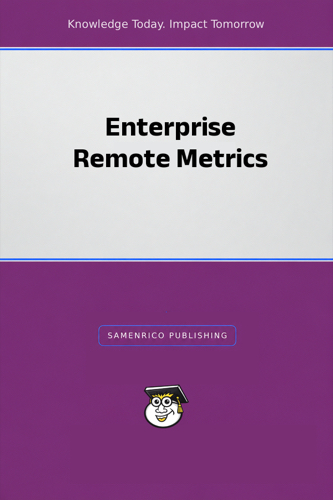
Non-FictionBusiness BriefEnterprise
Enterprise Remote Metrics eBook
Scale productivity measurement for large distribut
Scale productivity measurement for large distributed orgs.
Formats
Free sample
Chapter 1: The Visibility Trap--The CEO leaned back in her chair, the glow of three monitors reflecting off her glasses. On screen, a rainbow of dashboard widgets displayed the lifeblood of her 4,000-person distributed enterprise: green dots for active Slack users, bar charts for tickets closed per hour, heat maps of webcam-on time during meetings, and a single alarming red alert indicating that 12 percent of her workforce had been “idle” for more than fifteen minutes in the past day.She turned to her VP of Engineering. “Twelve percent idle,” she said, tapping the screen. “That’s almost five hundred people. What are they doing?”The VP hesitated.
“Working?”“The dashboard says idle.”“The dashboard measures whether their mouse moved, not whether they were thinking.”The CEO did not like this answer. She had spent two million dollars on the “productivity intelligence platform” that powered these dashboards. It had been sold to her as a solution to the great anxiety of remote leadership: the feeling of blindness, the terror that without a physical office, no one was actually working. Now, six months later, she had more data than she knew what to do with and less confidence than ever.This chapter is for that CEO. It is for every leader who has ever stared at a dashboard and felt not empowered, but confused.
It is for the manager who suspects that the employee with the most tickets closed is not actually the most valuable, and for the executive who wonders why productivity metrics seem to correlate so poorly with business results. And it is for the thousands of employees who have learned, through painful experience, that when a company starts measuring something, the smartest thing to do is to game it.The Visibility Trap is the foundational problem of remote management. It is the instinct—rational, understandable, and catastrophically wrong—to demand dashboards that show presence instead of progress. This chapter will dismantle that instinct, introduce the vocabulary you need to escape it, and provide the first concrete tool for evaluating whether any metric is worth collecting at all.The Birth of a Bad Idea In the before times—the pre-2020 era of offices and commutes—managers had an unfair advantage. They could walk the floor.
They could see who was at their desk, who was in the conference room, who was laughing over coffee. This visual availability was not actually a measure of productivity, but it felt like one. The human brain is wired to trust what it sees. An empty chair triggers an anxiety that no spreadsheet can soothe.When the pandemic forced everyone home, that visual reassurance vanished overnight. Managers who had spent decades relying on “management by walking around” suddenly had nothing but screens.
The response was predictable and, in hindsight, tragic. A new industry emerged overnight: workplace surveillance. Vendors promised to restore visibility. They sold cameras, keystroke loggers, idle-time trackers, and AI that could tell you whether an employee looked “focused” during video calls.The pitch was seductive. “You wouldn’t run a factory with a blindfold on,” one vendor’s website read.
“Don’t run your remote team that way either.”The flaw in this logic is subtle but devastating. A factory is not a metaphor for knowledge work. In a factory, seeing a worker at a machine is a reasonable proxy for output because the machine produces a physical object at a predictable rate. In knowledge work, seeing someone type does not tell you whether they are solving a difficult problem, composing a thoughtful email, or rewriting a sentence for the fourth time because they are anxious about being watched.The bad idea—that visibility equals productivity—spread like a virus through corporate America. By 2022, according to one study cited in Harvard Business Review, more than sixty percent of large employers had deployed some form of electronic surveillance on their remote workers.
And almost all of them regretted it.What Is the Visibility Trap?The Visibility Trap has three components, each more insidious than the last.First, the trap replaces trust with verification. A manager who cannot see their team feels anxious. Instead of addressing the anxiety directly—by hiring people they trust, setting clear expectations, and accepting reasonable uncertainty—they demand data. The data gives the illusion of control. But control without trust is not management; it is hostage-taking.
The employee knows they are not trusted. The manager knows they are not trusted. The data becomes a weapon in a cold war that no one wins.Second, the trap mistakes activity for value. A green Slack dot means someone is online. It does not mean they are working.
A closed ticket means something was marked complete. It does not mean something valuable was delivered. An email sent means words were typed. It does not mean a decision was advanced. The trap convinces managers that more activity is better activity.
This is not true in any knowledge work context. The best software developer on your team might stare out a window for forty-five minutes, solve a problem that has been blocking the project for two weeks, and write three lines of code. The worst developer might produce two thousand lines of buggy, unnecessary code that will cost the company months of maintenance. The dashboard will call the second developer “productive.” The first will be flagged as “idle.”Third, the trap is self-reinforcing. Once you deploy visibility metrics, behavior changes.
Employees learn to optimize for the metric, not for the outcome. This is not because employees are lazy or dishonest. It is because they are rational. If your bonus depends on keeping your Slack status green, you will never set yourself to “away,” even when you need to focus. If your performance review cites your ticket count, you will break one legitimate task into five tickets.
If your job security depends on appearing active, you will send emails at 10 PM even if they could have waited until morning. The organization gets exactly what it measures—but what it measures is not what it wants.Productivity Theater: The Unavoidable Consequence There is a name for what happens when employees optimize for bad metrics. It is Productivity Theater—the measurable increase in low-value activity that occurs when people believe they are being watched.The term is not metaphorical. Productivity Theater has been observed and measured across dozens of organizations, from small startups to Fortune 100 giants. The pattern is always the same.
A company deploys a visibility metric. Within weeks, that metric rises. Leadership celebrates. Six months later, business outcomes have not improved. If anything, they have worsened.
What happened?Consider a marketing agency that installed keystroke loggers on all remote employee laptops. The CEO wanted to ensure that no one was “wasting time.” Within a month, keystrokes per employee per day had increased by forty percent. The CEO was delighted. He published the numbers in an all-hands email. He praised the team for their “productivity surge.”What he did not know was that his best copywriter had started writing draft emails, deleting them, and rewriting them—not to improve the emails, but to generate keystrokes.
His best designer had begun clicking randomly between Photoshop layers for minutes at a time. His best strategist, the one…
This is the end of the free sample. Get the eBook to keep going. Buy now
About this book
Details
- Author
- Ridenour Adelina
- Publisher
- SamEnrico
- Language
- English
- Genre
- Non-Fiction, Business Brief, Enterprise
- Released
- 2026-06-09
- Pages (approx.)
- 159
- Available as
- eBook, Audiobook

Read better in the ZLOADR app
Your eBooks on your phone or tablet. Sign in with your SamEnrico account and start reading.
More by Ridenour Adelina
 Parent Death Anniversary GuideRidenour Adelina$11.99
 The Nap Smartphone App GuideRidenour Adelina$11.99
 Assertiveness Journal PromptsRidenour Adelina$11.99
 Neck Pain MeditationRidenour Adelina$11.99
 Amazon Private Label GuideRidenour Adelina$11.99
 The Long Walk Home MemoirRidenour Adelina$11.99
 The Smoke Free Pregnancy PlanRidenour Adelina$11.99
 Child Loss Grief JournalRidenour Adelina$11.99
 The Ballot and the Beast: A Byzantine Election NightRidenour Adelina$11.99
 Rum & Rebellion: The Pirate Who Outsmarted the British NavyRidenour Adelina$11.99
 Belisarius: The Last Roman's Final StandRidenour Adelina$11.99
 Growing GomphrenaRidenour Adelina$11.99
You may also like
 Hong Kong Handover 1997Dunn Johnnie$11.99
 Zumba For Postnatal Recovery CourseNeal Christian$11.99
 Zumba for BeginnersLadner Nikia$11.99
 YouTube Comment Mining GuideHumes Pandora$12.99
 Worry Box MeditationCarlin Rudy$11.99
 Workplace Stress MeditationNguyen Lynn$11.99
 Workplace Stress and Sleep RepairHawley Ivory$11.99
 Workplace Perfectionism CureDelaney Jeffry$11.99
 Workplace Injustice Anger GuideWallen Isabelle$11.99
 Work Addiction and Burnout LinkGreenwood Ester$11.99
 Women in Yoga and WellnessBeattie Galina$11.99
 Women in Stand Up ComedyChun Evangeline$11.99