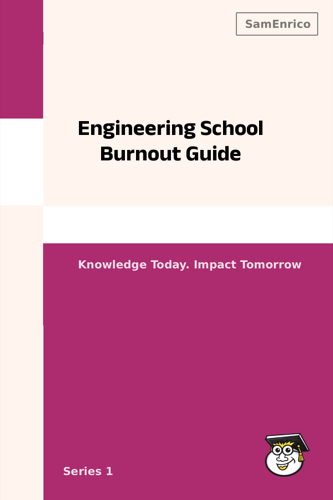
Engineering School Burnout Guide eBook
Manage heavy workload, lab reports, and problem se
Manage heavy workload, lab reports, and problem set marathons with strategic breaks.
Formats
Free sample
Chapter 1: The Caring Paradox--–- The first sign that something was wrong wasn't exhaustion. It wasn't the 3 a.m. crying session over a Laplace transform that refused to cooperate, or the morning you realized you'd eaten the same stale granola bar for breakfast, lunch, and dinner. The first sign was much quieter. It was the moment you stopped being excited about the thing you used to love.You probably felt it sometime between your sophomore and junior year.
Remember that feeling from freshman orientation? The one where you stood in front of a scale model of a bridge or a wind turbine or a circuit board that someone had soldered with the precision of a surgeon, and you thought: I'm going to build things that matter. That feeling had a specific texture—a blend of curiosity, ambition, and the secret thrill of knowing you were smart enough to be here. Now ask yourself honestly: when was the last time you felt that?If you're like most engineering students reading this book, the answer is somewhere between "I don't remember" and "What's that got to do with passing Thermo?" That loss—the quiet erosion of passion—is not a character flaw. It is not evidence that you chose the wrong major or that you're not cut out for this.
It is, quite simply, the predictable outcome of a system that rewards suffering and punishes rest. This book exists because that system is broken, and because you deserve a better way through it.Let's start with a confession. This is not a book about how to work harder. If you picked this up hoping for a secret schedule that will let you cram 80 hours of work into a 50-hour week, put it down now. That book doesn't work.
I know because I tried to write it first. The outline looked great: Superhuman Productivity for Engineers. It promised to optimize every minute, eliminate wasted motion, and turn you into a studying machine. Then I interviewed thirty engineering students who had actually tried that approach. Every single one of them was either already burned out or within six weeks of it.
The ones who claimed it was working? They were lying to themselves. I checked in six months later. All but two had either changed majors, taken a medical leave, or were white-knuckling through with GPAs that would make their advisors wince.What those students taught me is that engineering burnout is not a time management problem. It's not a discipline problem.
It's not even a stress problem, exactly, because stress can be motivating in the right doses. Burnout is something else entirely: it's the progressive disconnection between the effort you're putting in and the meaning you're getting out. You can manage your time perfectly, execute every Pomodoro with military precision, and still burn out because you've lost the thread of why any of this matters.So let's rename this book for what it actually is. It's not a productivity guide. It's a survival guide.
And survival, in the context of engineering school, means learning to work less on the things that don't matter so you have energy left for the things that do. It means building strategic rest into your schedule not as an afterthought but as the central pillar of your academic strategy. It means rejecting the myth of the Hero Engineer—that suffering is noble, that sleep is for the weak, that burnout is just the price of admission to a profession that changes the world.This chapter will do three things. First, it will name the enemy: the Caring Paradox, which explains why the students who care the most about engineering are the ones most likely to crash. Second, it will show you the math behind your exhaustion—not to scare you, but to validate that you're not crazy for feeling overwhelmed.
Third, it will introduce the foundational framework of this entire book: the difference between a System Restore and a Distraction. By the end of this chapter, you will have a completely different way of understanding what's happening to you. And you will have the first tool you need to fight back.Let's begin.The Caring Paradox: Why Passion Is a Liability Here is a truth that no one tells you during orientation week: caring too much is dangerous.I don't mean caring in the abstract, philosophical sense. I mean the specific, visceral caring that comes from looking at a crumbling bridge, an inefficient solar panel, or a medical device that fails half the time and thinking: I could fix that. That kind of caring is why you became an engineer.
It's also, paradoxically, the primary risk factor for burnout.Consider two students. Student A chose engineering because her parents said it was a stable career. She doesn't particularly love circuits or coding, but she's competent enough to get B's. When she fails an exam, she shrugs and moves on. Student B chose engineering because he genuinely believes that better battery technology could save the planet.
He stays up late reading about solid-state electrolytes. When he fails an exam, he spirals—because the failure doesn't just mean a bad grade. It means he's not good enough to save the planet.Who do you think burns out first?The research is unequivocal. Across multiple studies of medical students, law students, and engineers, the strongest predictor of burnout is not academic ability or hours studied. It's what psychologists call over-identification with the role.
When your identity is wrapped up in being a "good engineer," every setback feels like an existential threat. You don't just fail a test; you fail as a person. You don't just struggle with a concept; you prove that you don't belong here. This is the Caring Paradox in action: the very passion that made you choose engineering becomes the engine that drives you toward exhaustion.I've seen this pattern play out hundreds of times. The students who come into office hours asking the deepest questions, who stay after class to debate the finer points of thermodynamics, who light up when you mention research opportunities—those are the ones who, eighteen months later, are sitting in their advisors' offices with hollow eyes, saying they don't know if they can finish.
Meanwhile, the student who treats engineering as a job—eight hours a day, then goes home and doesn't think about it—is often the one who graduates with a solid GPA and a healthy social life.This is not an argument for caring less. You can't just decide to care less about something that matters to you. But you can understand the mechanism so you can protect yourself against it. The Caring Paradox operates through three specific pathways:Pathway One: All-or-Nothing Thinking. When your identity is tied to performance, you lose the ability to tolerate mediocrity.
A B-minus feels like an F. A problem set where you got 80% feels like failure. This all-or-nothing thinking drives perfectionism, which drives procrastination (if I can't do it perfectly, I won't do it at all), which drives last-minute cramming, which drives exhaustion. The cycle is self-reinforcing.Pathway Two: Loss of Perspective. Caring engineers often lose the ability to see their work in…
This is the end of the free sample. Get the eBook to keep going. Buy now
About this book
Details
- Author
- Yeager Cathie
- Publisher
- SamEnrico
- Language
- English
- Genre
- Non-Fiction, Self-Help, STEM Education
- Released
- 2026-06-11
- Pages (approx.)
- 159
- Available as
- eBook, Audiobook

Read better in the ZLOADR app
Your eBooks on your phone or tablet. Sign in with your SamEnrico account and start reading.
More by Yeager Cathie
 Postdoc Talent MovementYeager Cathie$11.99
 Research Proposal for Soros FellowshipYeager Cathie$11.99
 Versioning Strategy GuideYeager Cathie$11.99
 Theodore Roosevelt BadlandsYeager Cathie$11.99
 Evolutionary Phobia OriginsYeager Cathie$11.99
 Self Esteem for Aging MusiciansYeager Cathie$11.99
 Archery Stillness HypnosisYeager Cathie$11.99
 The Storm of Lepanto: Christian and Muslim Navies Collide (1571)Yeager Cathie$11.99
 The Silk Road’s Forgotten Queen: How a 7th-Century Empress Reshaped Global TradeYeager Cathie$11.99
 How to Start a Computer Games Design Business (Beginners Guide)Yeager Cathie$11.99
 Growing DisanthusYeager Cathie$11.99
 Cooperative Loan Guarantee FundsYeager Cathie$12.99