
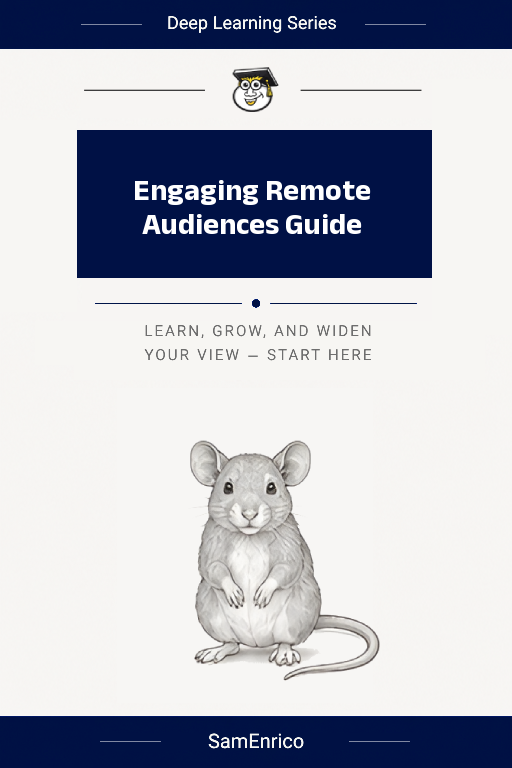
Engaging Remote Audiences Guide eBook
Keep remote attendees engaged with polls, Q&A, cha
by Mallen Theda
Keep remote attendees engaged with polls, Q&A, chat, and interactive elements during presentations.
Formats
Free sample
Chapter 1: The Attention Economy--–- The first time I lost a room virtually, I didn’t even notice. I was thirty-eight slides into a sixty-slide deck—because of course I was—and I was on fire. Or so I thought. I had jokes. I had data.
I had the kind of confident rhythm that usually gets me nodding heads and knowing smiles in a physical conference room. But on this day, on this Zoom call, something was wrong. I couldn’t feel it yet. I would only discover it later, in the recording, when I forced myself to watch what I had refused to see in real time.The recording told a different story than my memory. In my memory, I was commanding.
In the recording, I was alone. At minute twelve, the CFO—the one person I needed to impress—opened a second window. I could see it in the reflection of his glasses. It looked like email. By minute seventeen, the marketing director had her camera on but her eyes were scrolling.
Not my slides. Something else. By minute twenty-two, someone was actively folding laundry. I am not making this up. A pastel-colored sweater was being folded, on camera, during my explanation of Q3 forecasting methodology.
And I kept talking. I talked through the laundry. I talked through the email. I talked through the scrolling eyes. I talked until the end, when I said “Any questions?” and received the answer I deserved: silence.That night, I did what any reasonable professional would do.
I blamed the audience. They were distracted. They were rude. They didn’t respect my time. That story felt good for about twenty minutes.
Then the shame set in, because I knew the truth: they weren't the problem. I was. I had treated attention as if it were a renewable resource that I was entitled to. I had assumed that because I was speaking, they were listening. I had confused access with attention, attendance with engagement, my presence on their screen with my presence in their mind.
Those are not the same thing. They have never been the same thing. But the virtual environment makes the difference brutally visible.This book exists because that night happened to me, and because I suspect it has happened to you. You have stood on the virtual stage—whether Zoom, Teams, Webex, or something else—and watched the light leave your audience’s eyes. You have asked a question and received the hollow silence of fifty people who have checked out but haven't bothered to leave.
You have finished a presentation that you worked hours on and felt, in your gut, that almost nothing landed. And you have wondered: what am I doing wrong?The answer is not that you are a bad presenter. The answer is that you are using an in-person playbook in a virtual world. And that playbook does not work here. It never did.
We just couldn't see the failure as clearly before.The Great Unmasking The pandemic forced millions of professionals onto video conferencing platforms virtually overnight. Overnight is the wrong word. It was not overnight. It was a Tuesday. You remember the Tuesday.
The Tuesday when “we’ll try this Zoom thing for a few weeks” became the new reality, and a few weeks became a few months, and a few months became years, and now here we are, still on camera, still presenting, still wondering why it feels so much harder than it used to.But here is what we have learned in those years, collectively, through trial and error and burnout and bad recordings: virtual presenting is not in-person presenting with a screen in the middle. It is a different medium entirely. It has different rules, different physics, different cognitive demands. A joke that kills in a ballroom dies on a laptop. A story that holds a room of fifty people in silence loses thirty percent of its audience by the second sentence online.
A slide deck that worked beautifully in a conference room becomes a weapon of mass distraction on a shared screen.This is not hyperbole. This is cognitive science.The human brain did not evolve to process faces in two dimensions while simultaneously reading text, ignoring our own reflection, monitoring our facial expression, and filtering out the sound of our own voice echoing back to us from someone else’s laggy microphone. That is not a natural act. It is a profoundly unnatural act. And yet we ask our audiences to perform it for an hour, or two hours, or—God help us—an entire day.
Then we wonder why they check out.The Signal-to-Noise Ratio Let me introduce you to a concept that will appear in every chapter of this book. It is the single most important idea in virtual engagement, and once you understand it, you will never look at a presentation the same way again. It is called the Signal-to-Noise Ratio.Signal is anything that moves your audience toward the outcome you want. Signal is clarity, purpose, emotion, direction, connection. Signal is a well-framed camera.
Signal is a crisp microphone that captures your voice without distortion. Signal is a slide that adds understanding rather than confusion. Signal is a pause that lets an idea land. Signal is a question that invites genuine participation. Signal is the feeling of being seen and heard.Noise is anything that moves your audience away from the outcome you want.
Noise is distraction, confusion, friction, cognitive load. Noise is a dark camera with a window behind you. Noise is an echo or a tinny microphone. Noise is a slide with too many words. Noise is a tangent that goes nowhere.
Noise is dead air that signals “nothing important is happening.” Noise is the feeling of being talked at rather than talked with.Here is the terrible truth: in a physical room, the environment provides a tremendous amount of signal for free. Your physical presence, the temperature of the room, the eye contact you can make with individuals, the spatial awareness of who is sitting where, the subtle sounds of affirmation or confusion—all of that signal is built into the medium. You don’t have to create it. You just have to not destroy it.In a virtual room, that free signal is gone. Stripped away.
Zero. You start from zero signal and must build every single unit of it yourself. Meanwhile, the environment provides noise for free: notifications, bad lighting, family members walking behind you, the constant temptation of a second monitor, the exhaustion of staring at your own face for an hour. The starting position of a virtual presentation is not neutral. It is negative.
You begin in a hole, and every piece of noise digs the hole deeper.This changes everything. It means that your job as a virtual presenter is not to add engagement. Your job is to first stop subtracting it. Every decision you make—every word, every slide, every poll, every second of silence—either adds signal or adds noise. There is no neutral.
There is no “fine.” There is only better or worse, signal or noise, earning attention or losing it.The 60-Second Attention…
This is the end of the free sample. Get the eBook to keep going. Buy now
About this book
Details
- Author
- Mallen Theda
- Publisher
- SamEnrico
- Language
- English
- Genre
- Non-Fiction, Professional's Cheat Sheet, Virtual Communication
- Released
- 2026-05-30
- Pages (approx.)
- 144
- Available as
- eBook, Audiobook

Read better in the ZLOADR app
Your eBooks on your phone or tablet. Sign in with your SamEnrico account and start reading.
More by Mallen Theda
 Zero Cost Validation MethodsMallen Theda$11.99
 Stress Boundary Setting GuideMallen Theda$11.99
 Door in Face MethodMallen Theda$11.99
 EMDR for Sexual Addiction TraumaMallen Theda$11.99
 The Scorched Earth Gambit: Saddam's Last Stand at Khafji (1991)Mallen Theda$11.99
 Major Account Sales ManagerMallen Theda$11.99
 Learn to Play the HuqinMallen Theda$11.99
 Ultimate Handbook Guide to Deir El-zor : (Syria) Travel GuideMallen Theda$11.99
You may also like
 Remote Public Speaking GuideBelk Valene$12.99
 Remote Presentation Tech ChecklistGist Hunter$12.99
 Remote Presentation Setup GuideSwart Jannette$12.99
 Remote Presentation Nervousness GuideKang Cheri$12.99
 Remote Presentation Eye ContactBriggs Clint$12.99
 Remote Presentation Vocal TipsBedard Zelda$12.99
 Remote Presentation Slide DesignSwain Tory$12.99
 Remote Presentation Q&A GuideHoover Elidia$12.99
 Remote Presentation Body LanguageHowell Rosemarie$12.99