
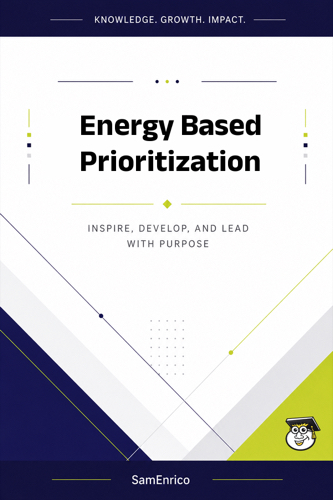
Energy Based Prioritization eBook
Match ABC tasks to peak energy hours during the da
Match ABC tasks to peak energy hours during the day.
Formats
Free sample
Chapter 1: The 3:00 PM Graveyard--You are reading this book for one of three reasons.First, you might be the person who starts each morning with a fistful of ambition and a beautifully curated to-do list, only to find yourself at 3:00 PM staring at a blinking cursor, incapable of forming a complete sentence. You have done seven things today, none of which were the one thing that actually mattered. Your brain feels like wet cement. Your inbox has been tamed, but your soul is empty.Second, you might be the person who has tried every productivity system ever written. You have color-coded your calendar.
You have tried the Pomodoro Technique. You have attempted time blocking, task batching, and the sacred ritual of waking up at 5:00 AM to conquer the world before breakfast. And yet, here you are, still feeling behind, still exhausted, still wondering why the successful people on Linked In seem to have twenty-five-hour days while you cannot even find the energy to fold the laundry.Third, you might be the skeptic. The one who does not believe a book about "prioritization" could possibly offer anything new. You have read the bestsellers.
You know about the frogs and the rocks and the jars. You have heard the parables about putting the big rocks in first, and you have nodded along, and then you went back to your life and discovered that your jar was somehow still full of sand and also on fire.Whoever you are, I need you to understand something immediately. This book is not another productivity system. It is not a collection of hacks or tricks or lifehacks designed to help you cram more into your already overflowing day. This book is an argument against everything you have been taught about how to get things done.The most important sentence you will read in this entire book is this: time management is a lie.Not because time is not valuable.
It is. Not because schedules do not matter. They do. But because the entire premise of time management assumes that all hours are created equal. That an hour at 8:00 AM is the same as an hour at 3:00 PM, which is the same as an hour at 8:00 PM.
That productivity is simply a matter of slotting tasks into empty boxes on a calendar, like Tetris pieces falling into place.This assumption is wrong. It is catastrophically, foundationally, burn-out-inducingly wrong. And it is the reason you have tried every system and still feel like a failure.The Industrial Revolution Stole Your Biology To understand why time management fails, you need to understand where it came from. The modern conception of the workday was not designed by biologists or neuroscientists or even particularly wise philosophers. It was designed by factory owners during the Industrial Revolution.In the late eighteenth and early nineteenth centuries, factories needed bodies.
Machines could run continuously, so humans were expected to do the same. The factory whistle blew at 6:00 AM. Workers filed in. They stood at their stations for ten, twelve, sometimes fourteen hours. They took scheduled breaks because the machines needed maintenance, not because the humans needed rest.
The goal was uniformity, predictability, and the relentless conversion of human hours into output.That model worked reasonably well for repetitive physical labor. Turning a crank, pulling a lever, sorting widgets—these tasks require a certain baseline of alertness, but they do not require creative insight, strategic thinking, complex problem-solving, or emotional intelligence. You can turn a crank at 8:00 AM. You can turn the same crank at 4:00 PM. The quality of the crank-turning is largely unaffected by the time of day.But here is the problem.
Most of you reading this book are not turning cranks. You are knowledge workers. You are writers, designers, engineers, managers, therapists, teachers, entrepreneurs, and professionals whose work requires something far more demanding than physical repetition. Your work requires cognitive horsepower. It requires creativity, judgment, pattern recognition, emotional regulation, and the ability to hold multiple abstract variables in your mind simultaneously.And your brain is not a factory machine.Your brain is a living organ with its own rhythms, its own cycles, its own periods of peak performance and inevitable troughs.
These rhythms are not optional. They are not suggestions. They are as fundamental to your biology as your heartbeat or your need for sleep. And when you try to override them—when you schedule your most important cognitive work for 3:00 PM because your calendar had an empty slot—you are not being disciplined. You are being foolish.
You are setting yourself up for failure, and then blaming yourself for failing.The Science You Cannot Argue With Let me introduce you to a concept that will change how you think about every single day for the rest of your life: chronotypes.Every human being has a genetically hardwired sleep-wake cycle. This is not a preference or a habit or a matter of willpower. It is biology. Some people are genetically predisposed to wake early and feel sharpest in the morning. Others cannot fully wake up until mid-morning and hit their stride in the afternoon.
Still others do not feel truly alert until the evening or even late at night.You have probably heard these described as "morning people" and "night owls," but the reality is more nuanced. Sleep researchers have identified four distinct chronotypes, each with its own peak energy window and natural rhythm. You will find a complete reference table in the appendix, but here is the essential framework:Lions are the early risers. They wake naturally between 5:00 and 6:00 AM, feel sharpest between 8:00 and 11:00 AM, and begin to fade by early afternoon. Approximately 15 to 20 percent of the population are Lions.Bears follow the solar cycle.
They wake with the sun, feel productive through the mid-morning and early afternoon, and experience a significant dip after lunch before a second wind in the late afternoon. This is the most common chronotype, representing roughly 50 to 55 percent of people. The standard 9-to-5 workday was essentially designed for Bears, which is why everyone else struggles.Wolves are the night owls. They struggle to wake before 9:00 AM, feel foggy through the morning, and do not reach peak alertness until the afternoon or evening. Wolves often do their best work between 6:00 PM and midnight.
Approximately 15 to 20 percent of the population are Wolves.Dolphins are the insomniacs. They have irregular sleep patterns, often waking multiple times during the night, and never feel fully rested. Their energy is unpredictable, with brief windows of focus scattered throughout the day. Approximately 10 percent of the population are Dolphins, though many people misidentify as Dolphins when they are actually sleep-deprived Wolves or Bears.Here is what you need to understand about these categories. They are not personality types.
They are not lifestyle choices. They are as inherent as your height or your eye color. You can no more decide to become a morning person than you can decide to grow six inches taller. You can train yourself to wake earlier, yes. You can drink coffee and force yourself through morning meetings.
But you cannot change the underlying rhythm of your cognitive performance. You cannot make your brain produce peak levels of alertness on demand. You…
This is the end of the free sample. Get the eBook to keep going. Buy now
About this book
Details
- Author
- Cotton Arminda
- Publisher
- SamEnrico
- Language
- English
- Genre
- Non-Fiction, Self-Help, Energy
- Released
- 2026-06-10
- Pages (approx.)
- 143
- Available as
- eBook, Audiobook

Read better in the ZLOADR app
Your eBooks on your phone or tablet. Sign in with your SamEnrico account and start reading.
More by Cotton Arminda
 Senior Financial Self EsteemCotton Arminda$11.99
 Group Decision MakingCotton Arminda$11.99
 The Step Reading CompanionCotton Arminda$11.99
 Whole Grain BenefitsCotton Arminda$11.99
 Shift Work Exercise GuideCotton Arminda$11.99
 NVC for Coaching GuideCotton Arminda$11.99
 Financial Incentives for QuittingCotton Arminda$11.99
 Empress Wu's Silent Revolution: The Woman Who Ruled China in the ShadowsCotton Arminda$11.99
 The Battle of Salsu: Korea's Last Stand Against the Tang (675 AD)Cotton Arminda$11.99
 UK Russell Group vs US Ivy LeagueCotton Arminda$12.99
 Bank Verification ProcessCotton Arminda$12.99
 Service Providers Guide to General SurgeryCotton Arminda$11.99
You may also like
 Hong Kong Handover 1997Dunn Johnnie$11.99
 Zumba For Postnatal Recovery CourseNeal Christian$11.99
 Zumba for BeginnersLadner Nikia$11.99
 YouTube Comment Mining GuideHumes Pandora$12.99
 Worry Box MeditationCarlin Rudy$11.99
 Workplace Stress MeditationNguyen Lynn$11.99
 Workplace Stress and Sleep RepairHawley Ivory$11.99
 Workplace Perfectionism CureDelaney Jeffry$11.99
 Workplace Injustice Anger GuideWallen Isabelle$11.99
 Work Addiction and Burnout LinkGreenwood Ester$11.99
 Women in Yoga and WellnessBeattie Galina$11.99
 Women in Stand Up ComedyChun Evangeline$11.99