
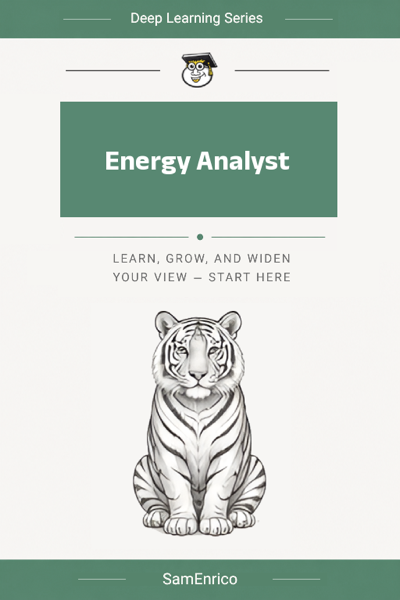
Non-FictionInformativeEducational
Energy Analyst Audiobook
A Coursebook on Energy Analyst
A Coursebook on Energy Analyst
Formats
Free sample
Chapter 1: The Invisible Addiction--Before you calculate your first net present value, before you model your first duck curve, before you even open a spreadsheet – you must understand one uncomfortable truth: you are addicted to energy. Not metaphorically. Literally. Every cell in your body, every breath you take, every screen you stare at, every bite of food that reaches your table exists because somewhere, somehow, energy was transformed from one state to another. The average person in a wealthy nation commands the energy equivalent of several hundred human laborers working around the clock – not because they are wealthy, but because they have tapped into a vein of ancient sunlight (coal, oil, natural gas) or the immediate output of a nuclear reaction or a solar panel.
Turn off that flow, and within hours, hospitals run on backup generators. Within days, water treatment plants fail. Within weeks, modern civilization as you know it would be a memory preserved only in the emergency broadcasts that no longer have power to transmit.This is not hyperbole. This is the starting point of the energy analyst's mindset. You are not studying a commodity.
You are studying the lifeblood of everything.The Pre-Industrial Baseline: Human Power and Its Limits To understand where we are, you must first understand where we were – and how agonizingly constrained human existence was before the fossil fuel revolution. For most of human history, the only available energy sources were biomass (wood, dung, crop residues), wind (sails, windmills), flowing water (waterwheels), and the metabolic labor of humans and draft animals. That was it. That was the entire menu.Let us quantify this. A healthy adult human performing sustained physical labor can sustain about 75 watts of mechanical power output over an eight-hour shift.
That is less power than a single incandescent light bulb. A horse can sustain about 750 watts – roughly ten humans. A yoke of oxen, about 1,000 watts. These were the prime movers of every pre-industrial economy. Every furrow plowed, every stone lifted, every grain of wheat ground into flour – all of it came from the solar energy captured by plants (which fed humans and animals) or the kinetic energy of wind and water.The implications were brutal.
Per-capita energy consumption in pre-industrial Europe is estimated at roughly 20-30 gigajoules per person per year (GJ/capita/year). That sounds abstract until you convert it: about 5,500 to 8,300 kilowatt-hours per person per year. That is roughly…
This is the end of the free sample. Get the Audiobook to keep going. Buy now
About this book
Details
- Author
- Garrison Chante
- Publisher
- SamEnrico
- Language
- English
- Genre
- Non-Fiction, Informative, Educational
- Released
- 2026-06-03
- Pages (approx.)
- 141
- Available as
- eBook, Audiobook

Listen in the VoxFlicks app
Audiobooks and audio dramas wherever you go. Sign in with your SamEnrico account and press play.
More by Garrison Chante
 Bridge Loan StructuresGarrison Chante$11.99
 Parental Addiction and ParentingGarrison Chante$11.99
 Podcast Overconsumption WorkbookGarrison Chante$11.99
 Sleeve Gastrectomy Long Term SuccessGarrison Chante$11.99
 Gluten Free Baking Basics CourseGarrison Chante$11.99
 The Billionaire's Gamble: Inside the 2018 Tesla Short SqueezeGarrison Chante$11.99
 Echoes of the Last Broadcast: The Mysterious Final Transmission of the RMS TitanicGarrison Chante$11.99
 Understanding Cat Eye SyndromeGarrison Chante$17.99
 Speaking Exam Proctoring GuideGarrison Chante$12.99
 Business Credit for Non ProfitsGarrison Chante$12.99
 How to Start a Pottery Making Machinery Business (Beginners Guide)Garrison Chante$11.99
You may also like
 Hong Kong Handover 1997Dunn Johnnie$11.99
 Zumba For Postnatal Recovery CourseNeal Christian$11.99
 Zumba for BeginnersLadner Nikia$11.99
 YouTube Comment Mining GuideHumes Pandora$12.99
 Worry Box MeditationCarlin Rudy$11.99
 Workplace Stress MeditationNguyen Lynn$11.99
 Workplace Stress and Sleep RepairHawley Ivory$11.99
 Workplace Perfectionism CureDelaney Jeffry$11.99
 Workplace Injustice Anger GuideWallen Isabelle$11.99
 Work Addiction and Burnout LinkGreenwood Ester$11.99
 Women in Yoga and WellnessBeattie Galina$11.99
 Women in Stand Up ComedyChun Evangeline$11.99