
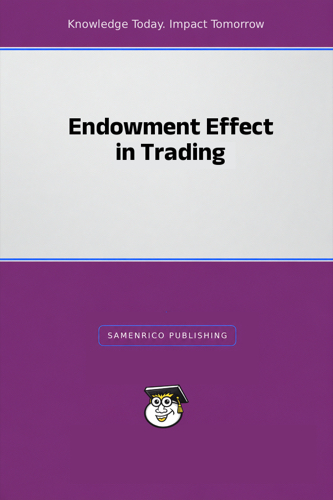
tradingBusiness BriefEndowment
Endowment Effect in Trading eBook
Overvalue assets you already own due to ownership
by Whyte Tana
Overvalue assets you already own due to ownership bias.
Formats
Free sample
Chapter 1: The Mug That Ruined Portfolios--–- It was a completely ordinary coffee mug. White ceramic, university logo, the kind of promotional giveaway that fills office cabinets and collects dust in basements. In 1990, two psychologists named Daniel Kahneman and Amos Tversky, along with economist Richard Thaler, handed this mug to half the students in a Cornell University classroom. They told those students, “This mug is now yours.” To the other half, they said, “You can buy this mug if you want.” Then they asked a deceptively simple question: How much money would it take for you to sell that mug if you owned it? And how much would you be willing to pay to buy it if you didn’t?What happened next changed our understanding of human decision-making forever and exposed a flaw that has quietly drained trillions of dollars from investor accounts across the globe.
The students who did not own the mug offered to buy it for an average of $3. The students who owned the mug refused to sell it for anything less than $7. That is not a typo. The exact same mug, purchased from the exact same university bookstore, with no sentimental value, no scarcity, and no functional difference between the two groups, was valued at more than twice the price simply because of one variable: ownership.This is the Endowment Effect. And if you have ever held a stock that was dropping, telling yourself “it’s not a loss until I sell,” or watched a winning position turn into a loser because you “didn’t want to take profits too early,” you have been mugged by your own psychology.
This chapter introduces the core discovery that launched behavioral economics, translates the coffee mug experiment to the trading desk, and reveals why buying and selling are not symmetrical decisions in your brain. By the end of this chapter, you will understand why your portfolio is likely worth less today than it should be—not because you lack intelligence, but because you own it.The Experiment That Broke Economics For decades, classical economics rested on a beautiful, elegant assumption: human beings are rational actors who make decisions based on objective value. If a coffee mug is worth $6 in the store, then any rational buyer would pay up to $6 and any rational seller would accept no less than $6. The price should be the same regardless of who holds the mug. This assumption, known as the Coase Theorem, suggested that the allocation of property rights does not matter because people will trade until goods end up in the hands of those who value them most, at an equilibrium price.Kahneman, Tversky, and Thaler shattered this assumption with a simple demonstration.
In their seminal experiment, published in 1990 in the Journal of Political Economy, they ran several variations. In one version, they gave half the participants a mug and then gave them a choice: trade the mug for a large chocolate bar or keep the mug. An equal number of participants chose the mug and the chocolate bar when given a direct choice, indicating that the two items were roughly equal in value. But when they introduced a market—allowing mug owners to set a selling price and non-owners to set a buying price—a strange gap emerged. Sellers demanded roughly $7.
Buyers offered roughly $3. The gap persisted across multiple rounds, multiple items, and even when real money was at stake.This was not a fluke. It was not a measurement error. It was not a failure of the participants to understand the instructions. It was a fundamental property of human psychology: ownership instantly and irrationally increases perceived value.Thaler, who would later win the Nobel Prize for this work, coined the term “endowment effect” to describe the gap between willingness to accept (WTA) and willingness to pay (WTP).
In a rational world, WTA and WTP should be nearly identical. In the real world, WTA is consistently two to ten times higher than WTP. The mere act of endowing someone with a good changes their valuation of it.From Coffee Mugs to Stock Certificates Now let us perform a thought experiment. Imagine you are a trader. You do not own shares of Apple.
You check the price and see it trading at $150. You think to yourself, “That seems reasonable. I might buy at $148 or $149, but $150 is fair.” You do not buy. You have a willingness to pay of roughly $148.Now imagine the opposite scenario. You already own 100 shares of Apple that you purchased six months ago at $140.
The price is now $150. A friend asks you, “Would you sell today for $150?” You hesitate. “No,” you say. “I think it’s worth more. Maybe $155 or $160.” You have a willingness to accept of roughly $155.The asset is identical.
The market price is identical. But as a non-owner, you value the stock at $148. As an owner, you value the same stock at $155. You have just experienced the Endowment Effect in real time, and you have done something economically irrational: you have created two different prices for the same thing based solely on your ownership status.This is not a minor quirk. This is a systematic distortion that affects every trading decision you make.
When you own a stock, you immediately begin overvaluing it relative to the market. You demand a higher price to sell than you would be willing to pay to buy. And because the market does not care about your subjective valuation, you end up holding positions too long, missing exit points, and turning paper gains into real losses.The mug experiment and the Apple thought experiment reveal the same underlying mechanism: loss aversion. Losing something you own hurts approximately twice as much as gaining something you do not own feels good. Kahneman and Tversky’s Prospect Theory, which predated the mug experiments, demonstrated this mathematically.
The value function for losses is steeper than the value function for gains. In plain English: the pain of losing $100 is about twice the pleasure of gaining $100. When you own a stock, selling it feels like a loss—even if you sell at a profit—because you are giving up something that was “yours.” Your brain processes the transaction as a departure from the status quo, and the status quo is defined by ownership.The Neural Circuits of Buying and Selling One of the most remarkable discoveries in the decades since the mug experiments is that buying and selling are not symmetrical operations in the human brain. They activate different neural circuits, involve different emotional responses, and produce different physiological reactions. Understanding this asymmetry is essential for any trader who wants to escape the endowment trap.When you consider buying a stock, your brain activates regions associated with reward anticipation, primarily the nucleus accumbens and the ventral striatum.
You imagine the upside. You feel excitement. You focus on the potential gains. Your pupils may dilate slightly, but the dominant emotion is positive expectation. The question your brain asks is: “What could I gain from this purchase?”When you consider selling a stock you already own, your brain activates a completely different set of regions: the insula and the amygdala.
These are the fear centers. You imagine the downside. You feel anxiety. You focus on the potential for regret. The…
This is the end of the free sample. Get the eBook to keep going. Buy now
About this book
Details
- Author
- Whyte Tana
- Publisher
- SamEnrico
- Language
- English
- Genre
- trading, Business Brief, Endowment
- Released
- 2026-06-06
- Pages (approx.)
- 157
- Available as
- eBook, Audiobook

Read better in the ZLOADR app
Your eBooks on your phone or tablet. Sign in with your SamEnrico account and start reading.
More by Whyte Tana
 The COPD Prevention Through Quitting GuideWhyte Tana$11.99
 Mental Illness ResentmentWhyte Tana$11.99
 Caregiver Stress and Guilt ReleaseWhyte Tana$11.99
 Jingwei’s Flight: The Phoenix Who Tamed the SeaWhyte Tana$11.99
 Media SupervisorWhyte Tana$11.99
 How to Become a Glass DecoratorWhyte Tana$11.99
 UNHCR Field Staff HandbookWhyte Tana$12.99
 How to Produce AxesWhyte Tana$11.99
You may also like
 Shift Work Shift Trading GuideDuff Cathrine$11.99
 Insider Trading SentimentWurtz Shawnda$11.99
 Gambler's Fallacy TradingGaydos Shu$11.99
 Cryptocurrency Trading AddictionGeorge Kathleen$11.99
 Brokerage Account Margin TradingSegura Hermila$11.99
 Gambling Addiction and Day TradingClanton Hyacinth$11.99
 Beginner Mindfulness for Stock TradersFultz Mary$11.99
 Dividend Capture Strategy GuideWallace Antoinette$11.99
 Unauthorized Trading CasesQuintanilla Ima$11.99
 Insider Trading Heist TheoryTripp Luvenia$11.99
 Trader Distraction Control GuideSummers Gina$11.99
 Loss Aversion Trading GuideBoucher Ellamae$11.99