
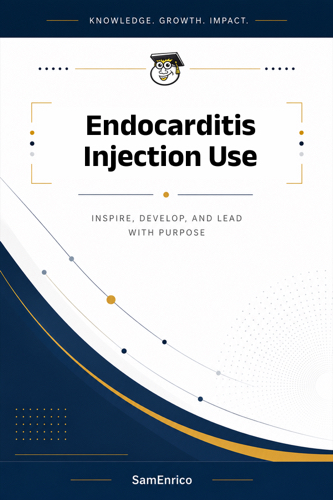
Endocarditis Injection Use eBook
Treat heart valve infection from IV drug bacteria.
Treat heart valve infection from IV drug bacteria.
Formats
Free sample
Chapter 1: The Hidden Epidemic--–- On a cold February morning in 2018, a 27-year-old woman named Jessica walked into the emergency room of a rural Kentucky hospital. She was sweating despite the freezing temperatures outside, her teeth chattering not from cold but from fever. She told the triage nurse she had the flu – body aches, nausea, a cough that wouldn't quit, and a fever of 103 that had persisted for nine days. She did not mention the track marks on her inner arms, hidden beneath long sleeves. She did not mention that she had been injecting heroin, and more recently fentanyl, for the past six years.
The emergency department team treated her for presumed pneumonia, gave her a prescription for antibiotics, and sent her home. Twelve days later, she was back – this time unable to breathe, her lips blue, her blood pressure in free fall. A bedside echocardiogram revealed a massive vegetation on her mitral valve, already perforated and flailing. She was airlifted to a tertiary cardiac center, but the delay in diagnosis had cost her more than a valve. She suffered a catastrophic embolic stroke during transport and died three days later, at 27, leaving behind a four-year-old daughter.This story is not an outlier.
It is not a rare tragedy that makes for dramatic case reports. It is, terrifyingly, the new normal.The Unseen Crisis Over the past two decades, a shadow epidemic has been quietly unfolding alongside the well-publicized opioid overdose crisis. While overdose deaths have rightfully captured headlines and policy attention – exceeding 100,000 annual deaths in the United States by 2023 – a slower, more insidious killer has been claiming a different demographic. This killer does not act in minutes or hours like a fentanyl overdose. It takes weeks, sometimes months, burrowing into the heart, destroying valves one vegetation at a time, seeding the brain, kidneys, and lungs with infected clots.
It is infective endocarditis (IE) associated with injection drug use, and it has transformed a once-rare complication of intravenous drug use into a leading cause of hospitalization, cardiac surgery, and death among young adults across North America and Europe.Infective endocarditis is, at its simplest, an infection of the inner lining of the heart – the endocardium – and most critically, the heart valves. In the era before antibiotics and modern cardiac surgery, IE was a death sentence, with mortality rates exceeding 90%. Even today, despite powerful intravenous antibiotics and sophisticated surgical techniques, the one-year mortality for injection-drug-use-associated IE hovers between 25% and 35%, a figure that has barely budged in two decades. This is not because the medicine has failed. It is because the patients keep returning, and the system keeps failing them.This chapter lays the foundation for everything that follows.
It will trace the epidemiological arc of the crisis, from the introduction of Oxy Contin in the late 1990s to the fentanyl and xylazine era of today. It will define who is at risk, where the hotspots are, and how the profile of IE has shifted from a disease of elderly patients with degenerative valves to a disease of young, often marginalized, people who inject drugs. It will quantify the staggering economic burden – not just in dollars, but in lives cut short, in families shattered, in operating rooms filled with twenty-five-year-olds receiving their second or third valve replacement. And it will establish the central paradox that this book exists to resolve: we know how to treat the infection, but we have failed to treat the person.From Elderly to Young: The Demographic Shift To understand the current crisis, one must first understand what IE looked like before the opioid epidemic. Historically, infective endocarditis was a disease of two populations.
The first were elderly patients with degenerative calcific aortic stenosis or mitral regurgitation from age-related myxomatous degeneration – people in their seventies and eighties whose worn-out valves became susceptible to seeding from urinary tract infections, dental procedures, or routine bacteremias from colonoscopy. The second were patients with prosthetic heart valves or congenital heart disease, whose artificial or abnormal surfaces provided fertile ground for bacterial adherence. In these populations, the typical pathogen was Streptococcus viridans from the oral cavity or Enterococcus faecalis from the gastrointestinal or urinary tract. Right-sided IE (tricuspid valve) was rare, seen almost exclusively in the context of indwelling central venous catheters or pacemaker leads.The opioid epidemic changed everything.Beginning in the late 1990s, as prescription opioids flooded rural and suburban America, infectious disease specialists began noticing a troubling trend. Young adults – people in their twenties and thirties – were presenting with fevers, positive blood cultures, and echocardiograms showing vegetations on valves that had been perfectly healthy six months earlier.
Unlike the elderly IE patients, these young adults almost invariably grew Staphylococcus aureus from their blood, and they had a predilection for the tricuspid valve, a pattern nearly pathognomonic for injection drug use.By 2010, the demographic shift was undeniable. A landmark study from the Nationwide Inpatient Sample, analyzing over 40 million hospital discharges, found that the rate of IE hospitalizations among young adults aged 18–44 had increased by more than 300% between 2000 and 2010, driven entirely by injection-drug-use-associated cases. The median age of IE patients had dropped from 71 to 39 in a single decade. In some regions, particularly West Virginia, Kentucky, Ohio, Indiana, and rural New England, the increase was even steeper – 600% or more.Today, the typical IE patient in many urban and rural hospitals is no longer an octogenarian with a degenerative valve. She is a 32-year-old woman who started with prescription opioids after a back injury, transitioned to heroin when her prescription ran out, and now injects fentanyl multiple times daily.
He is a 28-year-old man who has been in and out of the criminal justice system, who has hepatitis C from shared needles, who has already survived one overdose reversed by naloxone, and who is now facing his first episode of tricuspid valve endocarditis. These patients are young enough to be the children of the elderly patients who used to fill the IE beds. They are often parents themselves. And they are dying at rates that would provoke a national emergency if any other disease were responsible.Geographic Hotspots: Mapping the Crisis The opioid epidemic has not been uniform across geography, and neither has the IE crisis. Three distinct regional patterns have emerged.First, Appalachia – particularly West Virginia, eastern Kentucky, southwestern Virginia, and southeastern Ohio – has been the epicenter of injection-drug-use-associated IE in the United States.
This region was ground zero for the Oxy Contin epidemic, with per capita oxycodone prescribing rates that exceeded the national average by a factor of five or more during the 2000s. When prescription opioids were reformulated and restricted in the early 2010s, the transition to heroin and later fentanyl was rapid and almost complete. The region's limited healthcare infrastructure, with many rural hospitals lacking on-site cardiology or cardiothoracic surgery, means that patients often require long-distance transfers to tertiary centers, delaying diagnosis and treatment. A 2021 study from West Virginia University found that IE hospitalization rates in the state were 4.7 times the national average, with injection drug use implicated in over 60% of cases.Second, the Rust Belt – including Indiana, Michigan, Illinois, and Wisconsin – has seen a more heterogeneous pattern, with urban centers like Indianapolis, Detroit, Chicago, and…
This is the end of the free sample. Get the eBook to keep going. Buy now
About this book
Details
- Author
- Mckenna Shenita
- Publisher
- SamEnrico
- Language
- English
- Genre
- Non-Fiction, Self-Help, Cardiology
- Released
- 2026-06-07
- Pages (approx.)
- 153
- Available as
- eBook, Audiobook

Read better in the ZLOADR app
Your eBooks on your phone or tablet. Sign in with your SamEnrico account and start reading.
More by Mckenna Shenita
 Pre Speech Anxiety WorkbookMckenna Shenita$11.99
 Nonverbal Cues at WorkMckenna Shenita$11.99
 Blood Flow Restriction TrainingMckenna Shenita$11.99
 The Crown of the Ocean: Portugal’s Golden Age of DiscoveryMckenna Shenita$11.99
 How to Start a Millstone and Grindstone Cutting Business (Beginners Guide)Mckenna Shenita$11.99
 Keno RunnerMckenna Shenita$11.99
 How to Produce Canned and Prepared BeansMckenna Shenita$11.99
 Competitive Pricing Intelligence HandbookMckenna Shenita$12.99
You may also like
 Trance for High Blood PressureMetzger Kasi$11.99
 Stress and Heart DiseaseWiley Aurea$11.99
 MBSR For Heart DiseaseSwann Franklyn$11.99
 Cocaine Heart Attack PreventionBritt Timika$11.99
 Cocaine Heart RecoveryStanley Winifred$11.99
 The MBSR for Heart DiseaseLaughlin Santina$11.99
 Alcohol and Heart Health RecoveryDodd Monika$11.99
 Stress Cardiovascular Repair GuideLozano Muoi$11.99
 Workaholic Cardiovascular RiskKeller Tomas$11.99
 Stress Induced Hypertension GuideRounds Naoma$11.99
 Stress Heart Disease LinkMedlin Brandee$11.99
 Emotional Regulation For Heart DiseaseMalkin Lory$11.99