
Non-FictionSelf-HelpRelationship Endings
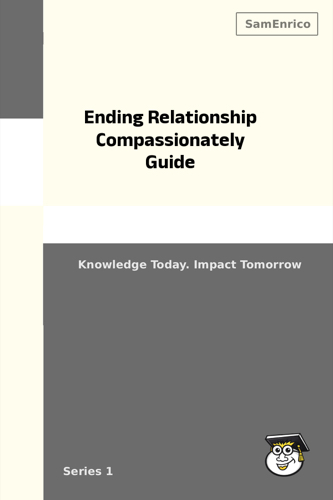
Ending Relationship Compassionately Guide eBook
Breaks up or fires someone with kindness and clari
by Poe Brook
Breaks up or fires someone with kindness and clarity.
Formats
Free sample
Chapter 1: The Relationship Autopsy--–- Most people wait until after a breakup to examine what went wrong. They sit in the wreckage, picking through the debris, trying to piece together a story that makes sense of the pain. But by then, the damage is done, the conversation has been botched, and both people are left with wounds that could have been avoided. This chapter asks you to do something harder and more valuable: examine your relationship while you are still in it. Before you say a word.
Before you pack a bag or draft a resignation letter or change your Facebook status. This is the diagnostic chapter, and it exists because the single greatest predictor of a compassionate ending is knowing, with absolute clarity, that ending is the right choice.The question is not whether you are unhappy. The question is whether your unhappiness can be fixed within this relationship, or whether the relationship itself is the problem. Most people who delay compassionate endings do so because they cannot answer this question. They swing between hope and despair, convinced one day that everything is fixable and convinced the next that nothing has ever worked.
That oscillation is not a sign of indecision. It is a sign of missing information. This chapter provides that information.Why Clarity Before Compassion Matters The first principle of this book is that clarity is kindness. But clarity does not begin with the words you speak to another person. It begins with the truth you tell yourself.
If you end a relationship while still uncertain, you will leak that uncertainty into the conversation. You will use softening language. You will leave doors cracked open. You will say things like "maybe" and "for now" and "I just need space." That is not kindness. That is cruelty dressed in nice clothes.Every best-selling book on breakups and relationship loss agrees on one point: the most damaging endings are not the angry ones.
They are the ambiguous ones. Research cited in This Is How Your Marriage Ends and Getting Past Your Breakup shows that people who are left with uncertainty—who do not know whether the relationship is truly over, whether their partner meant what they said, whether there is still hope—take significantly longer to heal than people who receive a clear, definitive ending. Ambiguity is traumatic because it keeps the brain in a state of prediction and anticipation, constantly scanning for cues that the situation might reverse. A compassionate ending, by contrast, delivers the gift of certainty. But you cannot deliver certainty to someone else until you have achieved it yourself.This chapter, therefore, is not about deciding whether to leave.
It is about becoming the kind of person who can decide with integrity. That process requires three things: accurate information about your relationship, a reliable framework for distinguishing fixable problems from fatal flaws, and the emotional courage to accept what the data tells you.The Attachment Theory Foundation Before we examine your specific relationship, it is worth understanding why this decision is so difficult in the first place. As introduced in the book's opening chapters, attachment theory provides the underlying framework for everything that follows. Developed by psychologist John Bowlby and expanded by Mary Ainsworth, attachment theory describes how humans are biologically wired to form strong emotional bonds with specific others. These bonds are not merely psychological preferences; they are survival mechanisms, encoded in our nervous systems over millions of years of evolution.When you are in a significant relationship, your brain literally merges your sense of self with the other person.
This is not poetry; it is neuroscience. The same neural circuits that process your own physical pain activate when you anticipate the loss of an attachment figure. This is why the thought of leaving—even a relationship that makes you unhappy—can feel physically unbearable. Your brain is not being dramatic. It is being evolutionary.Understanding this does not make the decision easier, but it does make it make sense.
The resistance you feel to ending the relationship is not evidence that you should stay. It is evidence that you are human. The goal of this chapter is not to override that resistance. The goal is to give you enough information and structure that you can make a decision despite the resistance.Distinguishing Fixable Problems from Fatal Flaws The central framework of this chapter comes from synthesizing the decision-making models in Should I Stay or Should I Go? and This Is How Your Marriage Ends.
Both books argue that the key question is not whether the relationship has problems—all relationships have problems—but whether those problems are fixable given the resources, willingness, and compatibility of the two people involved.Fixable problems share four characteristics. First, they are situational rather than characterological. A fixable problem might be poor communication during stress, mismatched schedules, financial pressure, or the normal deterioration of intimacy that occurs when life gets busy. These problems are not about who someone fundamentally is. They are about circumstances and skills.
Second, fixable problems respond to effort. When both people are willing to learn new skills, adjust their behavior, or change their circumstances, the problem diminishes or resolves. Third, fixable problems do not violate core values. A disagreement about how to spend money is fixable. A fundamental difference about whether to have children, how to define honesty, or what constitutes respect is not.
Fourth, fixable problems do not involve abuse, addiction, or contempt. These are not problems to be solved within the relationship; they are conditions that require professional intervention, often best pursued outside the relationship.Fatal flaws, by contrast, share a different set of characteristics. First, they are rooted in who someone fundamentally is. You cannot negotiate someone into sharing your core values any more than they can negotiate you out of yours. Second, fatal flaws do not respond to effort, because the effort would require one person to become someone they are not.
Third, fatal flaws have been present for the entire relationship, even if you did not see them clearly at the start. The red flags you dismissed during the honeymoon period were not warnings about fixable problems. They were glimpses of fatal flaws.The following decision tree will help you categorize your specific situation. Take out a journal or open a document. Answer each question honestly.The 5-Factor Relationship Assessment This assessment has been renamed from "Relationship Inventory" to distinguish it from the Post-Breakup Inventory in Chapter 12, and you will return to these scores later to compare your perspective before and after the breakup.
Score each question from 1 (strongly disagree) to 5 (strongly agree).Factor One: Emotional Safety Emotional safety is the foundation of every healthy relationship. Without it, nothing else matters.I can tell my partner anything without fearing they will use it against me later.When I express a need or concern, my partner listens without becoming defensive or punitive.I do not walk on eggshells in this relationship.My partner respects my boundaries, even when those boundaries are inconvenient for them.I feel physically and emotionally safe in this relationship.Factor Two: Mutual Respect Respect is not the same as love. Love without respect is sentimentality at best and control at worst.My…
This is the end of the free sample. Get the eBook to keep going. Buy now
About this book
Details
- Author
- Poe Brook
- Publisher
- SamEnrico
- Language
- English
- Genre
- Non-Fiction, Self-Help, Relationship Endings
- Released
- 2026-06-11
- Pages (approx.)
- 149
- Available as
- eBook, Audiobook

Read better in the ZLOADR app
Your eBooks on your phone or tablet. Sign in with your SamEnrico account and start reading.
More by Poe Brook
 Pattern Recognition for GamesPoe Brook$11.99
 CRE Property Condition ReportPoe Brook$11.99
 Forgiveness for Educational FailurePoe Brook$11.99
 Nonviolent Anger ExpressionPoe Brook$11.99
 Benzo Taper Support For Families ManualPoe Brook$11.99
 Resume For Postdocs IndustryPoe Brook$11.99
 Self Esteem After DivorcePoe Brook$11.99
 Gaslit Childhood Truth Seeker PrimerPoe Brook$11.99
 Vanishing Act: The Mysterious Disappearance of George SmithPoe Brook$11.99
 The Fire Below: Ancient Seafarers and the Mystery of Atlantic RadiationPoe Brook$11.99
 The Iron Genius of the Kongo: The Forgotten Metallurgists of Central AfricaPoe Brook$11.99
 Gamification and Engagement DesignPoe Brook$11.99
You may also like
 Hong Kong Handover 1997Dunn Johnnie$11.99
 Zumba For Postnatal Recovery CourseNeal Christian$11.99
 Zumba for BeginnersLadner Nikia$11.99
 YouTube Comment Mining GuideHumes Pandora$12.99
 Worry Box MeditationCarlin Rudy$11.99
 Workplace Stress MeditationNguyen Lynn$11.99
 Workplace Stress and Sleep RepairHawley Ivory$11.99
 Workplace Perfectionism CureDelaney Jeffry$11.99
 Workplace Injustice Anger GuideWallen Isabelle$11.99
 Work Addiction and Burnout LinkGreenwood Ester$11.99
 Women in Yoga and WellnessBeattie Galina$11.99
 Women in Stand Up ComedyChun Evangeline$11.99