
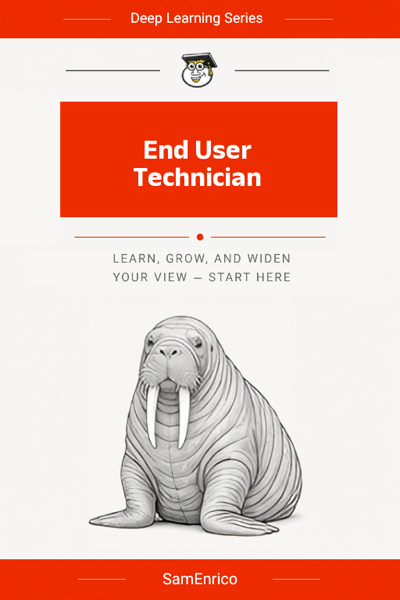
Non-FictionInformativeEducational
End User Technician eBook
A Coursebook on End User Technician
by Pence Tomoko
A Coursebook on End User Technician
Formats
Free sample
Chapter 1: The Empathy Deficit--Every help desk manager has a secret. They do not put it in job postings. They do not mention it during interviews. But within the first thirty days of hiring a new technician, they already know whether that person will last six months or six years. And the secret has nothing to do with how fast the technician can rebuild a kernel, diagnose a RAM failure, or recite the seven layers of the OSI model from memory.The secret is this: technical skills get you hired.
Communication skills keep you employed. And empathy? Empathy is the difference between a technician who survives the help desk and one who thrives there.Let me prove it to you with a story.The Forty-Seven Second Revelation A few years ago, a major hospital system in the Midwest tracked every help desk ticket across its fifteen locations for an entire year. They wanted to know why some technicians resolved tickets faster than others. They expected the answer to be technical certifications, years of experience, or specialized training in specific software applications.What they found shocked them.The fastest ticket resolvers were not the most technically certified.
They were not the ones with the most advanced degrees or the longest resumes. The fastest ticket resolvers were the technicians who spent an average of forty-seven seconds longer on the phone with each user. Forty-seven seconds. That was the difference.Those forty-seven seconds were not spent typing commands, clicking through menus, or running diagnostic tools. They were spent listening.
They were spent saying things like, “I understand why that is frustrating” and “Let me make sure I understand the problem correctly” and “Here is what I am going to do, and here is when you will hear back from me.”The hospital system calculated the cost savings of those forty-seven seconds. By reducing callbacks (users who hung up and called again because they did not feel heard), by reducing escalations (tickets that got passed to higher-level technicians because the first technician could not communicate the problem clearly), and by reducing user frustration (angry emails to management that required hours of damage control), those forty-seven seconds saved the hospital system over two hundred thousand dollars per year.Forty-seven seconds. Two hundred thousand dollars.That is the power of the End User Technician mindset. And that is what this chapter is about.The Myth of the Lone Genius Before we go any further, we need to kill a dangerous myth. You have seen it in movies.
You have read it in tech forums. It is the myth of the lone genius – the hoodie-wearing programmer who communicates in grunts, hates talking to users, and somehow saves the company through sheer technical brilliance while everyone else stands around uselessly.That person does not exist in end user support. And if they did exist, they would be fired within a week.End user support is not about being the smartest person in the room. It is about being the most useful person in the room. And you cannot be useful if you cannot communicate.
A technician who knows exactly how to fix a problem but cannot explain that fix to the user has not solved anything. A technician who diagnoses the issue in thirty seconds but spends the next ten minutes fighting with an angry user who does not trust them has wasted everyone’s time.The most technically brilliant person I ever worked with – let us call him David – was fired after four months. David could rebuild a corrupt Active Directory database from memory. He could write Power Shell scripts that made senior architects weep with envy. He once fixed a network outage by identifying a misconfigured spanning tree protocol setting that three other technicians had missed entirely.David was also impossible to work with.
When a user called with a problem, David would sigh – audibly – as soon as he answered the phone. He would interrupt users mid-sentence to tell them they were wrong about their own symptoms. He would fix the problem without telling the user what he was doing, then hang up without confirming that the issue was actually resolved. Users complained about him constantly. His tickets were unreadable – three words and a period, if you were lucky.
When his manager asked him to document his fixes for the knowledge base, David said, and I quote, “That is why they pay you.”David was fired not because he lacked technical skill but because he lacked the basic human skill of treating other people with respect. His replacement was a woman named Maria who had half of David’s technical knowledge but twice his emotional intelligence. Maria spent an extra minute on every call explaining what she was doing and why. Users loved her. Her tickets were masterpieces of clarity.
Within six months, Maria was promoted to team lead. David, as far as I know, is still looking for a job where he never has to talk to anyone.The Three Pillars of Help Desk Communication Great communication on the help desk rests on three pillars. Master these three skills, and you will resolve more tickets, receive better user evaluations, and advance faster than technicians who focus exclusively on technical certifications.Pillar One: Active Listening Active listening is not the same as hearing. Hearing is passive. It is the background noise of your auditory system processing sound waves.
Active listening is deliberate. It is the conscious effort to understand not just the words a user is saying but the meaning behind those words.Here is the most important lesson of this chapter, so pay close attention.Users do not know technical terminology. They do not know the difference between a router and a modem. They do not know what DNS stands for or why it matters. They do not know the difference between a software crash and a hardware failure.
And that is fine. That is why you have a job.When a user says, “The internet is down,” they rarely mean that their TCP/IP stack has failed or that their default gateway is unreachable. What they mean is, “The thing I was doing on my computer stopped working, and I am frustrated, and I need you to fix it.” It might be Outlook. It might be a web browser. It might be a line-of-business application that uses the internet but is not actually the internet.
Your job is not to correct their terminology. Your job is to translate their frustration into a technical diagnosis.The best tool for active listening is called reflective questioning. Here is how it works:User says: “My computer is frozen.”Bad response: “It is not frozen, the application just crashed. You need to use Task Manager.”Good response: “I hear that the computer is not responding. Let me ask a few questions to understand better.
When you move your mouse, does the cursor move on the screen?”Reflective questioning does three things. First, it shows the user that you are listening – you repeated their concern back to them in your own words. Second, it narrows the problem from a vague complaint to a specific symptom. Third, it builds trust because…
This is the end of the free sample. Get the eBook to keep going. Buy now
About this book
Details
- Author
- Pence Tomoko
- Publisher
- SamEnrico
- Language
- English
- Genre
- Non-Fiction, Informative, Educational
- Released
- 2026-05-09
- Pages (approx.)
- 152
- Available as
- eBook, Audiobook

Read better in the ZLOADR app
Your eBooks on your phone or tablet. Sign in with your SamEnrico account and start reading.
More by Pence Tomoko
 Breath Awareness For MigrainesPence Tomoko$11.99
 The Macaulay Culkin StoryPence Tomoko$11.99
 PNE for Chemo Induced PainPence Tomoko$11.99
 Job Loss and Relationship Strain RecoveryPence Tomoko$11.99
 Bill Gates Open Letter to HobbyistsPence Tomoko$11.99
 The Phantom of Bogotá: Colombia’s Vanishing BillionairePence Tomoko$11.99
 SEA Cold Storage InvestmentPence Tomoko$12.99
 Payment Terms Dictionary For ExportersPence Tomoko$12.99
 Understanding LipomucopolysaccharidosisPence Tomoko$17.99
 How to Start a Business (Beginners Guide) Systems Consultant Business (Beginners Guide)Pence Tomoko$11.99
You may also like
 Hong Kong Handover 1997Dunn Johnnie$11.99
 Zumba For Postnatal Recovery CourseNeal Christian$11.99
 Zumba for BeginnersLadner Nikia$11.99
 YouTube Comment Mining GuideHumes Pandora$12.99
 Worry Box MeditationCarlin Rudy$11.99
 Workplace Stress MeditationNguyen Lynn$11.99
 Workplace Stress and Sleep RepairHawley Ivory$11.99
 Workplace Perfectionism CureDelaney Jeffry$11.99
 Workplace Injustice Anger GuideWallen Isabelle$11.99
 Work Addiction and Burnout LinkGreenwood Ester$11.99
 Women in Yoga and WellnessBeattie Galina$11.99
 Women in Stand Up ComedyChun Evangeline$11.99