
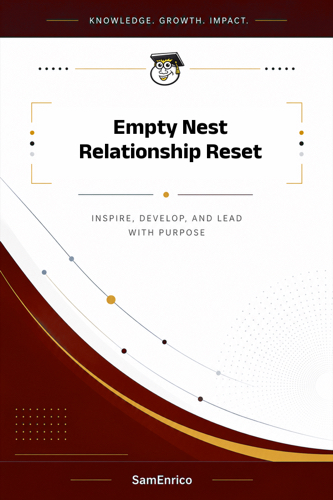
Empty Nest Relationship Reset eBook
Rediscover each other after children leave home an
by Moore Beulah
Rediscover each other after children leave home and redefine your partnership.
Formats
Free sample
Chapter 1: What No One Warned You--The goodbye was supposed to be the hard part. You stood in the driveway, hugged your youngest child a little too long, watched them drive away, and waited for the tears to come. But the tears didn't come. Instead, you felt something you immediately felt guilty for feeling. You felt relief.This is the secret that no one warns you about.
The empty nest is rarely the emotional bomb the movies promised. Most couples do not collapse into sobbing piles on their child's stripped bed. They stand in the sudden quiet, look at each other across the kitchen island, and realize they have nothing to say. Not because they are angry. Not because they are sad.
Because for the last two decades, nearly every meaningful conversation they have had began with the words "the kids," "school," "practice," or "schedules." And now those words have no urgency.The silence is not empty. It is full of everything you have been too busy to notice, too exhausted to address, and too distracted to feel. That silence is the real beginning of the empty nest. And what you do with it will determine whether your marriage enters its richest chapter or becomes a casualty of the gray divorce epidemic.The Cultural Lie You Have Been Sold Let us name the lie directly. The lie is that the empty nest is primarily a parenting transition.
It is not. It is a marital transition disguised as a parenting transition. Every article, every sympathy card, every concerned friend who asks "How are you handling the quiet?" frames the empty nest as an event that happens to you as a parent. But you have been parenting for eighteen years. That skill set is deeply ingrained.
What you have not been doing for eighteen years is being married without a buffer.Children are the ultimate buffer. They fill silences. They provide shared topics of conversation. They create a common enemy—homework, bedtime, teenage rebellion—that unites parents against a shared foe. They make constant togetherness unnecessary because you are both too busy running in different directions to notice that you have stopped running toward each other.
When the buffer disappears, the marriage that remains is the marriage you actually built, not the one you assumed you had.This is why the gray divorce rate—divorce among couples over fifty—has doubled since 1990 while overall divorce rates have fallen. Couples are not suddenly deciding they hate each other. They are discovering, in the quiet of the empty nest, that they have been roommates for years. And once the kids are gone, there is no reason to stay roommates.Loss Grief Versus Opportunity Anxiety Here is a distinction that will save you years of confusion. There are two completely different experiences that feel almost identical in your body.
The first is loss grief. The second is opportunity anxiety. You need to know which one you are feeling, because they require opposite responses.Loss grief is what the movies show you. It is the active missing of your children's presence. You miss the sound of the front door slamming.
You miss the chaos of dinner table arguments. You miss being needed in a tangible, urgent way. Loss grief is real, and it deserves acknowledgment. But loss grief is not the dominant experience for most empty nest couples. The dominant experience is opportunity anxiety.Opportunity anxiety is the uncomfortable freedom of having no urgent demands.
It is the feeling of standing in an open field with no path and realizing you have forgotten how to choose a direction. Opportunity anxiety does not feel like sadness. It feels like restlessness, boredom, irritability, or a vague sense that you are failing at something you cannot name. You might pick fights with your partner over a dish left in the sink. You might scroll your phone for an hour because the alternative is sitting in silence with someone you have not really talked to in years.
You might find yourself volunteering for extra work or suddenly obsessed with a hobby because any activity is better than the terrifying openness of an unscheduled evening.Loss grief needs acknowledgment. You need to say, "I miss the kids," and have someone nod. Opportunity anxiety needs action. You cannot acknowledge your way out of it. You cannot wait for the feeling to pass.
The feeling will not pass because it is not a wound that heals. It is a muscle that has atrophied. The muscle is being a couple without children as the central organizing principle.The Data That Changes Everything Let us look at what the research actually says about empty nest marriages. Studies on marital satisfaction across the lifespan show a consistent pattern. Satisfaction declines after the birth of the first child.
It stays relatively low during the active parenting years. Then, for a significant subset of couples, it rises again after the last child leaves.The key phrase is "for a significant subset." Not all couples experience this rise. The ones who do have one thing in common. They actively re-engage with each other. They do not passively wait for happiness to return.
They treat the empty nest not as a problem to survive but as a project to design.The couples who passively wait—who assume that time alone will heal the drift, who assume that living in the same house is enough, who assume that the love they once felt will automatically rekindle—report the steepest declines in marital satisfaction. They are the couples who end up in divorce court five years after the last child leaves, telling their friends, "We just grew apart." They did not grow apart. They stopped growing together.This chapter is not written for those couples. Or rather, it is written for them, but they will not read it. This chapter is written for the couples who feel the drift and want to do something about it before the drift becomes a chasm.The Reset Checklist Before you can reset, you need a diagnosis.
Not a psychological diagnosis—you are not broken—but a situational diagnosis. The following questions are not a test. There is no passing or failing. They are a flashlight in a dark room. Answer them honestly, alone first, then share your answers with your partner.
The goal is not to agree. The goal is to see.One. In the last month, have you had a conversation with your partner that lasted over thirty minutes and did not mention the children, the grandchildren, or any logistics related to either? This includes texting and phone calls. If the answer is no, you are not unusual.
You are also not having a marriage. You are having a co-parenting arrangement that has outlived its usefulness.Two. Do you know your partner's current top three non-parenting worries? Not their worries about the kids. Their worries about themselves.
Their health, their career, their friendships, their sense of purpose, their body, their fears about aging. If you cannot answer this, you have stopped being curious about your partner. Curiosity is not automatic. Curiosity is a muscle. Muscles atrophy without use.Three.
When you and your partner are alone together—really alone, no phones, no television, no tasks—do you feel awkward, bored, or…
This is the end of the free sample. Get the eBook to keep going. Buy now
About this book
Details
- Author
- Moore Beulah
- Publisher
- SamEnrico
- Language
- English
- Genre
- Non-Fiction, Self-Help
- Released
- 2026-06-08
- Pages (approx.)
- 99
- Available as
- eBook, Audiobook

Read better in the ZLOADR app
Your eBooks on your phone or tablet. Sign in with your SamEnrico account and start reading.
More by Moore Beulah
 Stress and Neuropathy GuideMoore Beulah$11.99
 Heart Disease Risk PreventionMoore Beulah$11.99
 Affirmation Science GuideMoore Beulah$11.99
 Abandoned Cart Recovery FlowMoore Beulah$11.99
 Nociception ExplainedMoore Beulah$11.99
 Jupiter Storm WatchingMoore Beulah$11.99
 ABCDE for Fitness CoachesMoore Beulah$11.99
 The Silent Assassins: Swimming's Secret War for GoldMoore Beulah$11.99
 Ramses II: The Lion of Egypt - Battle of Kadesh and the Age of EmpireMoore Beulah$11.99
 How to Produce a Disc HarrowMoore Beulah$11.99
 How to Start a Hobby in CosplayingMoore Beulah$11.99
 A Collector's Handbook to the Wolseley WaspMoore Beulah$11.99
You may also like
 Hong Kong Handover 1997Dunn Johnnie$11.99
 Zumba For Postnatal Recovery CourseNeal Christian$11.99
 Zumba for BeginnersLadner Nikia$11.99
 YouTube Comment Mining GuideHumes Pandora$12.99
 Worry Box MeditationCarlin Rudy$11.99
 Workplace Stress MeditationNguyen Lynn$11.99
 Workplace Stress and Sleep RepairHawley Ivory$11.99
 Workplace Perfectionism CureDelaney Jeffry$11.99
 Workplace Injustice Anger GuideWallen Isabelle$11.99
 Work Addiction and Burnout LinkGreenwood Ester$11.99
 Women in Yoga and WellnessBeattie Galina$11.99
 Women in Stand Up ComedyChun Evangeline$11.99