
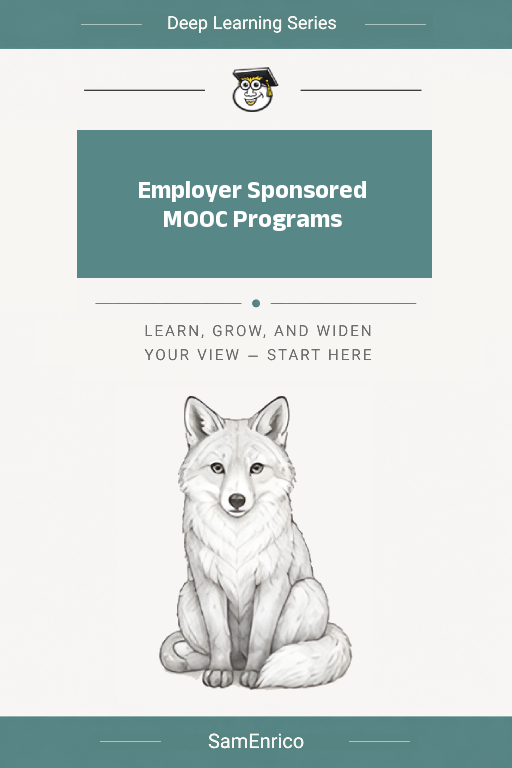
Employer Sponsored MOOC Programs eBook
Join Walmart, Bank of America, or Disney tuition f
by Troy Helene
Join Walmart, Bank of America, or Disney tuition free programs that pay for your certification.
Formats
Free sample
Chapter 1: The $1.7 Trillion Lie--–- On a humid Tuesday evening in Bentonville, Arkansas, a 24-year-old Walmart stocker named Maria did something that her high school guidance counselor had told her was impossible. She enrolled in a fully accredited Bachelor of Science in Supply Chain Management from the University of Florida, and she did it without filling out a single loan application, without asking her parents to cosign anything, and without promising to repay a single dollar. Her cost for the entire four-year degree: zero. Her employer, Walmart, paid every penny upfront, including books, fees, and even tutoring sessions. Two years later, Maria was promoted to a Supply Chain Coordinator role.
Her salary went from 32,000to32,000 to 32,000to58,000. She still owes nothing.Ten miles away, a Disney Cast Member named Elena was closing a different kind of deal. Working the front desk at a Disney resort, Elena had grown accustomed to guests yelling at her about lost luggage and incorrect room charges. She had a high school diploma and a pile of anxiety about her future. Then she discovered Disney's Aspire program.
Today, Elena is finishing a Master's degree in Data Science from the University of Florida—a graduate program that costs over 30,000.Disneypaidforitupfront.Shehasneverwrittenatuitioncheck.Upongraduation,shewillmoveintoa Consumer Insights Analystrolewithastartingsalaryof30,000. Disney paid for it upfront. She has never written a tuition check. Upon graduation, she will move into a Consumer Insights Analyst role with a starting salary of 30,000.Disneypaidforitupfront.Shehasneverwrittenatuitioncheck.Upongraduation,shewillmoveintoa Consumer Insights Analystrolewithastartingsalaryof85,000.Meanwhile, in Charlotte, North Carolina, a Bank of America teller named James was tired of asking customers if they wanted to open a savings account for the five hundredth time. He had no college degree and no clear path upward.
Then he enrolled in The Academy, Bank of America's internal licensing program. Within eight months, he passed his SIE, Series 7, and Series 66 exams. He is now a licensed Financial Solutions Advisor at Merrill Lynch. His base salary doubled, and his commission potential tripled. The bank paid for every exam, every study guide, and every practice test.
James still has no student debt.These three people are not anomalies. They are not lottery winners. They are not geniuses. They are ordinary hourly workers who discovered a secret that most of their coworkers will never know: their employers have already set aside billions of dollars to pay for their education. And they are not using it.Here is the truth that the student loan industry does not want you to hear.
Every year, Walmart alone spends over $1 billion on recruiting and training new hourly associates to replace the ones who quit. The company has done the math. It is cheaper to pay for an existing employee's four-year degree than to hire an external candidate for a management role. External hires cost 150 to 200 percent of the position's annual salary in recruiting fees, background checks, orientation programs, and the productivity drag of learning a new system. An internal graduate costs nothing beyond tuition—and that tuition is tax-deductible.
So Walmart, Disney, Bank of America, and dozens of other Fortune 500 companies have created a silent, secretive infrastructure to give away free education to their frontline workers. They just do not advertise it very loudly.This book exists because that silence is inexcusable.The Perverse Economics of American Education Let us begin with a number that should make you angry: 1.7trillion.Thatisthetotaloutstandingstudentloandebtinthe United States.Itisthesecondlargestcategoryofhouseholddebtinthecountry,behindonlymortgages.Forty−threemillion Americanscarrythisdebt.Theaverageborrowerowesnearly1.7 trillion. That is the total outstanding student loan debt in the United States. It is the second largest category of household debt in the country, behind only mortgages. Forty-three million Americans carry this debt.
The average borrower owes nearly 1.7trillion.Thatisthetotaloutstandingstudentloandebtinthe United States.Itisthesecondlargestcategoryofhouseholddebtinthecountry,behindonlymortgages.Forty−threemillion Americanscarrythisdebt.Theaverageborrowerowesnearly40,000. One in five borrowers is behind on their payments. And here is the punchline that the university marketing departments do not print on their glossy brochures: the vast majority of these loans were completely unnecessary.Do not misunderstand. Education is valuable. A college degree still correlates with higher lifetime earnings, lower unemployment rates, better health outcomes, and greater civic engagement.
The problem is not education. The problem is the financing mechanism. For decades, American students have been told a simple, seductive story. Go to college. Take out loans.
Get a good job. Pay them back. This story worked reasonably well for the generation that graduated in the 1980s, when college tuition was a fraction of what it is today and wages kept pace with inflation. But that generation is gone. Since 1980, the cost of college has increased by nearly 1,200 percent.
Over the same period, median wages have increased by only 15 percent. The math no longer works.The student loan industry has thrived on this broken math. Banks, servicers, and the federal government have created a system in which eighteen-year-olds are asked to make six-figure financial decisions with no collateral, no credit history, and no understanding of compound interest. Default rates have climbed. Delinquency rates have soared.
And yet, every August, another cohort of high school graduates packs their dorm room essentials and signs on the dotted line, convinced that debt is simply the price of admission to the middle class.It is not. It is a trap.The Great Resignation and the Great Awakening Something shifted in 2021. The Covid-19 pandemic had exhausted American workers. Millions had watched colleagues die, had worked double shifts without hazard pay, and had endured abuse from customers who seemed to have forgotten basic human decency. Then, as the economy reopened, these workers did something unprecedented.
They quit. In April 2021 alone, nearly four million Americans resigned from their jobs. The media called it the Great Resignation. Economists called it a labor market correction. But for the purpose of this book, we will call it the Great Awakening.Workers realized something fundamental during the pandemic.
They realized that their labor had value. They realized that employers were desperate. And they realized that the old bargain—loyalty in exchange for a pension and a gold watch—had been dead for decades. So they demanded more money, better conditions, and something that had never been a standard benefit before: education.The numbers tell the story. In 2019, fewer than 10 percent of Fortune 500 companies offered any kind of tuition assistance beyond the federally mandated $5,250 tax-free reimbursement limit.
By 2023, that number had jumped to over 60 percent. Walmart expanded its Live Better U program to cover 100 percent of tuition and books for all field associates. Disney launched Aspire, covering upfront tuition for everything from high school completion to master's degrees. Bank of America deepened its Academy, turning licensing into a mass production line for financial advisors. Starbucks, Target, Amazon, Lowe's, Chipotle, and dozens of others followed suit.These programs are not charity.
They are not public relations stunts. They are strategic responses to a brutal labor market. Companies realized that the cost of turnover—the constant cycle of hiring, training, and losing workers—was eating them alive. A single Walmart store with 200 hourly associates might lose 50 to 70 percent of its workforce annually. Each departure costs roughly 3,000inrecruiting,onboarding,andlostproductivity.Dothemath.Thatstoreisbleedingover3,000 in recruiting, onboarding, and lost productivity.
Do the math. That store is bleeding over 3,000inrecruiting,onboarding,andlostproductivity.Dothemath.Thatstoreisbleedingover300,000 per year just to stay fully staffed. A degree that costs…
This is the end of the free sample. Get the eBook to keep going. Buy now
About this book
Details
- Author
- Troy Helene
- Publisher
- SamEnrico
- Language
- English
- Genre
- Non-Fiction, Student's Shortcut
- Released
- 2026-05-29
- Pages (approx.)
- 143
- Available as
- eBook, Audiobook

Read better in the ZLOADR app
Your eBooks on your phone or tablet. Sign in with your SamEnrico account and start reading.
More by Troy Helene
 Opioid PAWS Recovery GuideTroy Helene$11.99
 Immigrant Home Health Agency GuideTroy Helene$11.99
 Traumatic Loss Grief WorkbookTroy Helene$11.99
 Metta for a Partner with PTSDTroy Helene$11.99
 Iron Supplementation GuideTroy Helene$11.99
 Forest Bathing VisualizationTroy Helene$11.99
 NVC For Restorative JusticeTroy Helene$11.99
 Decision Block MethodTroy Helene$11.99
 Baddeley Model GuideTroy Helene$11.99
 The Forgotten Cartographer: Pankhurst’s Pacific Quest for the Nile’s SecretsTroy Helene$11.99
 The Alchemists of Timbuktu: Gold, Science, and the Rise of African ChemistryTroy Helene$11.99
 The Complete Guide to Going RAWTroy Helene$11.99
You may also like
 Hong Kong Handover 1997Dunn Johnnie$11.99
 Zumba For Postnatal Recovery CourseNeal Christian$11.99
 Zumba for BeginnersLadner Nikia$11.99
 YouTube Comment Mining GuideHumes Pandora$12.99
 Worry Box MeditationCarlin Rudy$11.99
 Workplace Stress MeditationNguyen Lynn$11.99
 Workplace Stress and Sleep RepairHawley Ivory$11.99
 Workplace Perfectionism CureDelaney Jeffry$11.99
 Workplace Injustice Anger GuideWallen Isabelle$11.99
 Work Addiction and Burnout LinkGreenwood Ester$11.99
 Women in Yoga and WellnessBeattie Galina$11.99
 Women in Stand Up ComedyChun Evangeline$11.99