
Non-FictionInformativeEducational
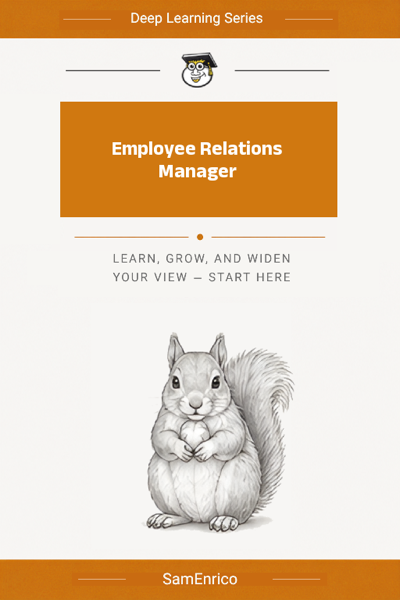
Employee Relations Manager eBook
A Coursebook on Employee Relations Manager
A Coursebook on Employee Relations Manager
Formats
Free sample
Chapter 1: The Two Hats--The phone rings at 7:43 PM on a Friday. You are the Employee Relations manager. On the line is a shift supervisor whose voice is trembling. One of her team members just accused another of sexual harassment. The accused is a senior director.
The witness is scared to come forward. Human Resources has gone home for the weekend. Legal is unavailable until Monday. And somewhere in the building, in a poorly lit break room, two employees are about to have a conversation that will end up in federal court if you do not act before midnight.This is the job.If you have spent any time in Employee Relations, you know that scene is not an exaggeration. It is a Tuesday.
It is the cost of doing business when you manage the space where human beings collide with organizational rules, where ambition rubs against fairness, and where the unwritten expectations of a hundred different employees grind against the written policies of a single handbook.But here is the question that will define your career: Is that Friday night phone call the only thing you do? Or is it merely the price you pay for the real work you do Monday through Thursday?The answer separates the firefighter from the architect. And this entire book exists to turn you into both—while teaching you how to make the firefighter role increasingly unnecessary.The Great Lie of Employee Relations Walk into any HR department and ask what Employee Relations does. The answers will vary, but they will cluster around a few predictable themes: "We handle complaints." "We deal with grievances." "We investigate misconduct." "We manage terminations." "We keep the company out of court."None of these answers is wrong. But every single one of them is incomplete.
And the incompleteness is not accidental. It reflects a deeply embedded assumption about what ER is for.The assumption goes like this: Employees are naturally inclined toward conflict. Managers are naturally inclined toward abuse of power. Left to their own devices, the workplace would devolve into chaos. Therefore, the ER function exists as a kind of fire department—stationed at the ready, equipped with hoses and ladders, waiting for the alarm to sound so we can rush in and save the day.This is the firefighter model.
It is reactive. It is heroic. It is necessary. And it is a trap.The trap springs shut when you realize that every fire you extinguish leaves behind scorch marks. The investigation that clears the accused also destroys team trust.
The termination that removes a toxic manager also demoralizes the employees who witnessed the slow, painful process. The grievance that gets resolved in the company's favor still cost forty hours of lost productivity and three thousand dollars in legal fees.Firefighting saves the building. But it does nothing to prevent the next fire. And in most organizations, the next fire is already smoldering while you are still wet from the last one.The Alternative That Changes Everything There is another model. It is practiced by the best ER leaders in the world, though you will rarely see it advertised on a job description.
Call it the architect model.The architect does not wait for the alarm. The architect studies the blueprints. Where are the electrical systems likely to short? Where are the emergency exits blocked? Where is the flammable material stored next to an open flame?
The architect redesigns the building before anyone smells smoke.In practical terms, this means the architect's week looks very different from the firefighter's. Seventy percent of the architect's time is spent on activities that have no crisis attached to them: designing onboarding processes that set realistic expectations, building voice mechanisms that catch resentment before it becomes a grievance, analyzing exit data for patterns that predict future turnover, coaching managers on feedback conversations that defuse conflict before it escalates.Thirty percent of the architect's time is still spent fighting fires. Because no system is perfect. Because human beings are unpredictable. Because even the best-designed building can be struck by lightning.But here is the crucial insight: The architect chooses the thirty percent.
The firefighter is owned by the ninety percent.Most ER professionals start as firefighters. The job demands it. The organization expects it. The emergencies are real, and they will not handle themselves. But the ones who stay firefighters forever burn out within five years.
The ones who become architects build careers that last twenty.The Uncomfortable Truth This Book Will Teach You You cannot become an architect by reading a single chapter. The skills are different. The mindset is different. And most importantly, the measurement is different.Firefighters measure success by what they stopped. "We closed forty-seven investigations this quarter." "We reduced legal spend by twelve percent." "We resolved the Smith grievance without litigation." These are honorable metrics.
They matter. But they are backward-looking. They count the bullets you dodged, not the wounds you prevented.Architects measure success by what never happened. "Turnover in the sales department dropped by thirty percent after we redesigned the bonus communication process." "Grievances in the warehouse fell to zero after we implemented the weekly listening circles." "Exit interview data shows that the psychological contract breach we identified in Q1 was repaired by Q3."These metrics are harder to produce. They require data systems that most ER departments do not have.
They require patience, because the effects of architectural work take months to appear. And they require courage, because when you claim credit for a fire that never started, no one can see the thing you did.And yet, these are the only metrics that matter. Because the organizations that win the war for talent are not the ones with the best firefighting crews. They are the ones that never catch fire in the first place.The Two Hats You Will Wear (And Why You Cannot Drop Either)Let us be precise about the duality that defines modern Employee Relations. You will wear two hats.
One is the firefighter's helmet—yellow, reflective, designed for visibility and protection. The other is the architect's hard hat—white, unremarkable, the kind worn by people who read blueprints before the foundation is poured.The firefighter's hat comes with specific responsibilities:Investigating complaints of harassment, discrimination, and retaliation Managing the progressive discipline process Conducting termination meetings Responding to workplace violence threats Navigating union grievances Handling leaves of absence and accommodation requests under duress Managing crisis communications during scandals The architect's hat comes with a different set:Designing employee handbooks that are both legally compliant and culturally authentic Building voice mechanisms that catch problems early Creating onboarding processes that establish realistic psychological contracts Analyzing ER data to identify systemic patterns Coaching managers on conflict prevention Designing fair and transparent promotion and compensation systems Building a "just culture" that distinguishes human error from reckless behavior Notice that both lists are long. Notice that both lists require expertise. Notice that both lists are simultaneously expected of you by most organizations, even though they rarely admit it.Here is the promise of this book: By the final chapter, you will be competent in both domains. You will know how to investigate a harassment complaint (firefighter) and how to redesign…
This is the end of the free sample. Get the eBook to keep going. Buy now
About this book
Details
- Author
- Gillespie Eulah
- Publisher
- SamEnrico
- Language
- English
- Genre
- Non-Fiction, Informative, Educational
- Released
- 2026-05-04
- Pages (approx.)
- 149
- Available as
- eBook, Audiobook

Read better in the ZLOADR app
Your eBooks on your phone or tablet. Sign in with your SamEnrico account and start reading.
More by Gillespie Eulah
 Birth Prep Pelvic ExercisesGillespie Eulah$11.99
 Train Journey Sleep GuideGillespie Eulah$11.99
 Comparison in GriefGillespie Eulah$11.99
 Gratitude Practice LongevityGillespie Eulah$11.99
 The Make Peace With Food GuideGillespie Eulah$11.99
 The Corsair of Florence: Andrea Doria and the Art of Naval DominanceGillespie Eulah$11.99
 The Breeder's Guide to Devon Or Beef Devon CattleGillespie Eulah$11.99
 Non Resident LLC Currency RiskGillespie Eulah$12.99
 Kigali Startup EventsGillespie Eulah$12.99
 How to Become a Package-dyeing-machine OperatorGillespie Eulah$11.99
You may also like
 Hong Kong Handover 1997Dunn Johnnie$11.99
 Zumba For Postnatal Recovery CourseNeal Christian$11.99
 Zumba for BeginnersLadner Nikia$11.99
 YouTube Comment Mining GuideHumes Pandora$12.99
 Worry Box MeditationCarlin Rudy$11.99
 Workplace Stress MeditationNguyen Lynn$11.99
 Workplace Stress and Sleep RepairHawley Ivory$11.99
 Workplace Perfectionism CureDelaney Jeffry$11.99
 Workplace Injustice Anger GuideWallen Isabelle$11.99
 Work Addiction and Burnout LinkGreenwood Ester$11.99
 Women in Yoga and WellnessBeattie Galina$11.99
 Women in Stand Up ComedyChun Evangeline$11.99